

Audio By Carbonatix
A Democracy and Development Fellow at the Centre for Democratic Development (CDD-Ghana) has weighed in on the ongoing investigation into the sole-sourced contracts tied to the controversial “Big Push” initiative.
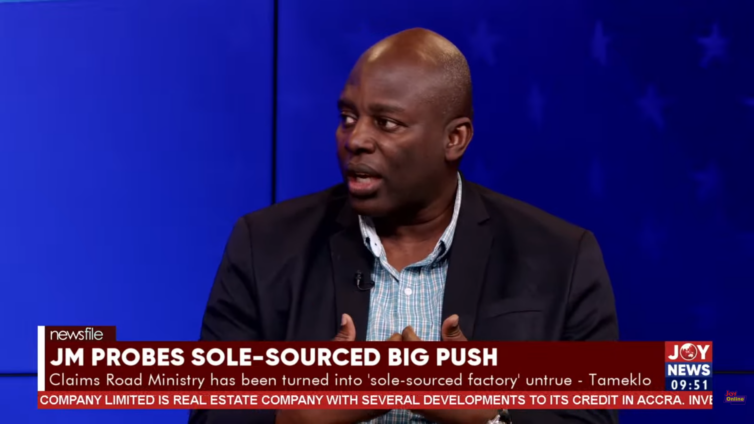
Speaking on JoyNews' Newsfile, Prof John Osae-Kwapong called for greater political consensus on procurement practices and addressed the wider political implications of the ongoing debate over the cost and transparency of government contracts.
Prof. Osae-Kwapong’s comments come as the media, often referred to as the Fourth Estate, intensify scrutiny of government activities, particularly focusing on the procurement processes linked to the “Big Push” initiative.
This initiative, designed to expedite infrastructure projects across Ghana, has been criticised for relying heavily on sole-sourced contracts.
The newly launched probe aims to investigate the rationale behind these sole-sourcing decisions and to determine whether taxpayer money is being well spent.
Professor Osae-Kwapong emphasised the crucial role of the media in ensuring government transparency and accountability.
He praised the Fourth Estate for its efforts to shine a light on the workings of the government, stating that, even if some of the findings from media investigations were questioned, the broader aim of promoting transparency is a positive one.
“I think shining light on what is going on in government, bringing transparency and accountability, for me, is a good thing,” Prof. Osae-Kwapong said.
He acknowledged that while the media’s revelations may spark political controversy, the ultimate goal should be to hold public officials accountable and ensure that citizens are aware of how public funds are being managed.
The conversation also touched upon the political dynamics surrounding the “Big Push” initiative. Prof. Osae-Kwapong pointed out that while in opposition, the National Democratic Congress (NDC), had been vocal in its criticism of the current administration’s procurement practices.
However, he noted a contradiction between the government's previous stance while in opposition and its current position, highlighting the challenge of reconciling these differing narratives.
“Part of the conversation goes back to some of the things that the NDC said whilst in opposition. The Fourth Estate is now asking: how do we reconcile some of the narratives we heard when the NDC was in opposition with what we are seeing with this infrastructure initiative called the ‘Big Push’?” he asked.
Prof. Osae-Kwapong implied that political parties may have been quick to criticise the other side when in opposition, but once in power, they often find themselves utilising similar tools, such as sole-sourcing, that they once condemned.
One of the central issues raised by Prof. Osae-Kwapong was the recurrent political bickering over the cost of government procurement.
Over the years, he noted that, there has been a pattern of complaints from political parties about the inflated costs of various infrastructure projects.
These disputes often centre on whether the government is overpaying for goods and services, leading to accusations of wasteful spending.
Prof. Osae-Kwapong observed that, regardless of which political party is in power, there is a persistent narrative about the inflated costs of contracts.
From interchanges to road construction, the costs are often debated, with each side accusing the other of overpricing public projects.
“There’s a constant political bickering between our two main political parties over the stated cost of contracts versus what they believe should be the true cost of a good or service,” he said.
Prof. Osae-Kwapong questioned the effectiveness of the procurement processes in place, noting that established procedures, such as tender committees and evaluations by the Public Procurement Authority (PPA), are supposed to ensure fairness and transparency in government acquisitions.
“We have built certain processes into procurement, including tender committees and PPA evaluations. Unless these processes themselves are flawed, then why do we continue to doubt the validity of the stated costs?” he asked, suggesting that it was crucial to reassess these processes and consider whether they can truly inspire public confidence.
Prof. Osae-Kwapong argued that the debate over sole-sourcing is not merely a matter of political posturing but reflects deeper issues surrounding public policy tools and the role of politics in shaping procurement laws.
“The law itself makes provisions for when competitive tendering cannot be used and for situations where sole-sourcing or other forms of procurement are necessary,” he said, referring to the legal framework that guides public procurement in Ghana.
However, he expressed concern that what was intended as an exception—sole-sourcing—has increasingly become the default method of awarding contracts.
He pointed out the irony in political parties accusing each other of abusing sole-sourcing when, in fact, both parties have used it under the same legal provisions.
“The exception has become the default,” he remarked, suggesting that the cycle of political bickering over procurement practices must end.
Prof. Osae-Kwapong called for a national dialogue to build political consensus on the use of procurement tools like sole-sourcing. “Maybe we need to come back to the table and say, ‘You know what, let’s build a political consensus around this,’” he suggested.
Latest Stories
-
Power restoration fault suspected in Kumasi Central Market fire
4 hours -
The 7-foot giant of Ngleshie Amanfro: Seven-foot Ghanaian Ephraim Saawa dreams of joining the national basketball team
5 hours -
Government promises support for Kumasi Central Market fire victims
5 hours -
Vibes The Movie: Big Ghun’s Ghanaian film earns five nominations at 2026 REFFA
5 hours -
MamaCare CEO warns unresolved conflicts among health workers could undermine maternal and neonatal care
6 hours -
Health professionals urged to translate medical knowledge into practice to save mothers
6 hours -
Conflicts among care providers linked to maternal, neonatal deaths – Expert
7 hours -
GIS marks 10th TIME conference, champions improved teaching practices
7 hours -
BRICS Or Balance? What Ghana’s bid really means
8 hours -
GPRTU wants full TRAFFITECH-GH implementation to start in 2027
8 hours -
Mahama announces plans to import electric wheelchairs for PWDs
8 hours -
KGL U17 Colts 2026: Western beat Prempeh Elite Academy to set up final final with Greater Accra Region
8 hours -
Late Solanke strike salvages 10-man Spurs draw at Man United
9 hours -
Gender Ministry to monitor welfare of Nana Akua Addo’s children amid domestic violence case
9 hours -
Benedict Okyere Yeboah: Ghana’s football problem goes beyond sacking a coach
9 hours