

Audio By Carbonatix
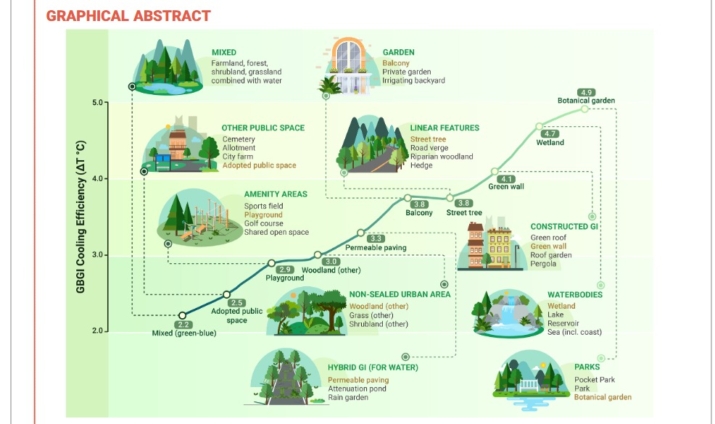
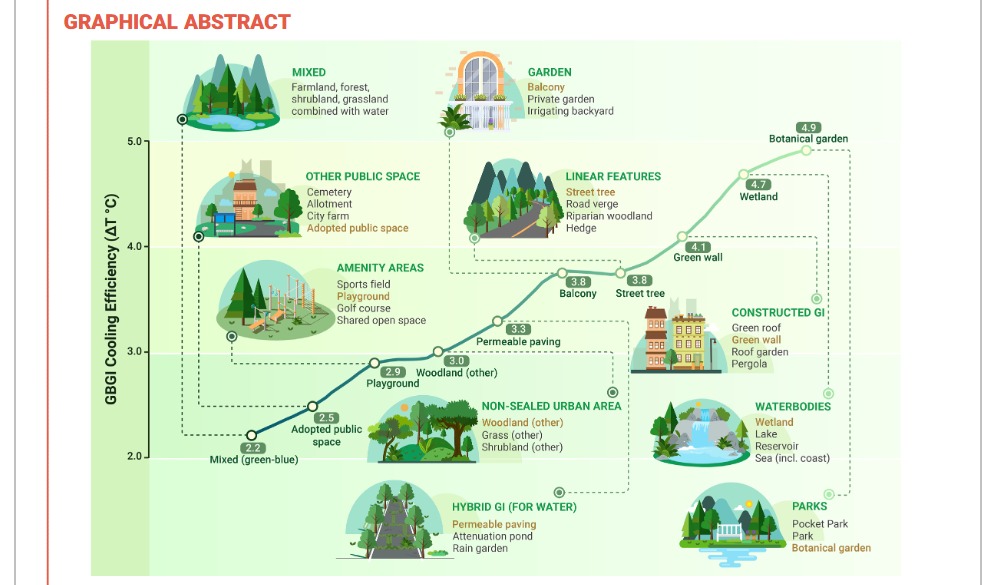
A study published in The Innovation has revealed that green-blue-grey infrastructure (GBGI)—including botanical gardens, wetlands, green walls, street trees, and vegetated balconies—is the most effective strategy for reducing urban heat while providing additional environmental benefits.
The study titled, “Urban heat mitigation by green and blue infrastructure: Drivers, effectiveness, and future needs,” analyzed 27,486 papers and conducted a detailed review of 202 studies, examining 51 types of GBGI categorized into ten broad groups to assess their cooling effectiveness.
A review of number of studies on green infrastructure highlights its role in mitigating urban heat by providing shade, enhancing evapotranspiration, and offering thermal insulation. The cooling also effects of green and blue infrastructure contribute to reducing energy consumption in buildings.
The majority of green infrastructure studies come from Asia (51.1%), with China (29.95%) leading the research. Europe (30.4%), Australia (7.5%), and North America (7.0%) also contribute significantly. In contrast, research in South America (1.8%), Africa (1.8%), and New Zealand (0.4%) remains limited.
The focus of green-blue-grey infrastructure (GBGI) studies varies by continent. In Asia, wetlands (14.7%) and parks (12.9%) were the most commonly researched solutions for mitigating urban heat. Meanwhile, in Europe, the emphasis was on street trees (18.8%), green walls (15.9%), and green roofs (13.0%) as key strategies for cooling cities.
In Australia, green wall studies (17.6%) were prominent, along with research on irrigating backyards, parks, street trees, and green roofs, which collectively accounted for 58.8% of total green-blue-grey infrastructure (GBGI) studies. In North America, the focus was on parks (31.3%), street trees (18.8%), and wetlands (12.5%), making up approximately 62.5% of documented GBGI interventions.
The study suggests that variations in green-blue-grey infrastructure (GBGI) research across continents are influenced by regional contexts, climate conditions, and urban planning priorities, which shape the selection of GBGI interventions best suited for addressing urban overheating in each region.
Beyond cooling, GBGI offers multiple co-benefits, such as stormwater management, flood reduction, and CO₂ sequestration. However, drawbacks include high maintenance costs and land-use conflicts. Street trees provide the greatest cooling and climate adaptation benefits, followed by green roofs and botanical gardens.
Conversely, playgrounds, green walls, green roofs, and street trees were associated with drawbacks like pollutant accumulation in street canyons and allergic rhinitis. The study underscores the need for a balanced heat mitigation and adaptation approach in GBGI implementation.
The study offers a heat mitigation inventory to assist policymakers and urban planners in choosing the most effective Green, Blue, and Gray Infrastructure (GBGI) strategies to combat heatwaves and reduce urban temperatures. This is especially important for cities facing growing risks of extreme, deadly heatwaves, which are expected to become more frequent and intense due to climate change.
Latest Stories
-
COCOBOD says $1.4bn domestic funding is a strategic shift, not market exclusion
35 minutes -
Richmond Quarcoo appointed Ghana’s Chef de Mission for 2028 Olympics
1 hour -
‘Our missing players are more important’ – Gambia coach fires shot at Ghana
2 hours -
Today’s front pages: Tuesday, September 29, 2026
2 hours -
Ghana ‘showing up differently’ on global stage – Joyce Bawah Mogtari
3 hours -
Ghana’s tuna industry in crisis as 20 hook-and-line vessels collapse
4 hours -
South Tongu MP launches apprenticeship programme for 159 young people
4 hours -
The Pusiga connection behind Gertrude Atongi’s work in New York
4 hours -
Teachers took promotion exams in December to beat government clearance deadline – GNAT
4 hours -
NPA launches 2026 staff welfare week with focus on teamwork and employee wellbeing
4 hours -
Ghana, Saint Kitts and Nevis sign labour deal to strengthen protections for Ghanaian nurses
4 hours -
Delayed promotions put teachers’ retirement benefits at risk – GNAT
5 hours -
No ‘Bawumia candidates’ in NPP executive elections – Anthony Karbo
5 hours -
Over 3,000 displaced as flooding overwhelms Hohoe communities
5 hours -
Sunyani East NPP executives begin reconciliation drive ahead of 2028 polls
5 hours