

Audio By Carbonatix
THE CALL FOR EXECUTIVE INTERVENTION ON ENERGY SECTOR CHALLENGES, COCOA FARMERS’ PLIGHT, FOOD SECURITY, AND ENVIRONMENTAL GOVERNANCE AT THE EPA
It is with profound concern and a sense of public duty that I write to draw Your Excellency’s urgent attention to the critical national issues affecting governance and institutional stability in Ghana. The country is at a point where the increasing public involvement in governance ought to be recognised as an advantage, which can help tailor the administration of the state and its resources to improve the lives of even the otherwise marginalised citizens. It is also particularly important that Your Excellency swiftly act to eliminate the identified problems outlined in this letter, which are compounding the burden on Ghanaians and, indeed, all who interact with our country.
The issues are:
1. The resurgence of ‘dumsor’ with rooted energy sector challenges.
2. The plight of the cocoa farmers across the country who are losing not only their crops and investments due to the price cuts, but also the hope of an agricultural industry which can sustain their livelihoods.
3. A developing institutional crisis at the Environmental Protection Authority (EPA), which poses serious risks to environmental governance, regulatory enforcement, and Ghana’s credibility in international environmental and climate commitments.
4. The glut of staples such as maize, yams, beans, etc., the reports by CHASS of shortage of some foodstuffs in most Senior High Schools, and the government’s forced intervention to finance the National Food Buffer Stock indicate that there are deep-seated structural issues which ought to be addressed.
EXECUTIVE SUMMARY
This letter respectfully draws Your Excellency’s attention to some interrelated national governance concerns requiring urgent executive attention:
1. The structural failures that continue to undermine Ghana's energy sector are causing the country to revisit the economy-crippling ‘dumsor’.
2. The reduction in cocoa producer prices and its implications for rural livelihoods, foreign-exchange stability, and long-term sustainability of Ghana’s cocoa sector.
3. An emerging administrative and financial instability at the Environmental Protection Authority (EPA) with negative implications for regulatory continuity, extractive-sector oversight, climate-finance readiness, and investor confidence;
4. Structural failures within national food distribution systems reflected in the coexistence of staple crop gluts at the farmgate level and shortages of essential food supplies in public Senior High Schools.
Taken together, these issues reveal institutional misalignments across key sectors that affect independent and credible monetary governance, energy-sector viability, environmental governance, agricultural productivity, and national food security.
The Energy Sector issue
The return of persistent load-shedding “dumsor” in Ghana, despite earlier assurances that it had ended, is distressing. The effects of these prolonged power outages are directly associated with financial losses across almost all industries in the country. Recurring deficits, gas shortfalls, and transmission failures point to unresolved systemic problems. The government must pursue structural reforms to save the economy, which relies significantly on a reliable power supply. Nevertheless, such reforms must also be reflected in the management of the Energy Sector Levy, which is presently not meeting an acceptable standard.
The Cocoa Producer-Price Adjustment issue
The recent producer-price reduction places additional strain on cocoa-growing households already facing rising input costs, climate-related productivity risks, and declining real incomes. Sustained producer-price compression risks weakening farmer incentives, encouraging cross-border smuggling, and reducing medium-term sector productivity with corresponding implications for foreign-exchange stability and rural economic resilience. Timely cushioning interventions would help sustain confidence within cocoa-growing communities and protect the long-term viability of the sector.
The EPA issue
Available information indicates that more than 3,000 contract staff were reportedly recruited at the Environmental Protection Authority at a time when the Authority did not yet have a constituted Governing Board and prior to the receipt of Ministry of Finance financial clearance required under established public financial management procedures. Subsequent financial clearance appears to have covered only approximately 500 positions, leaving a substantial number of recruits without a clear fiscal regularisation pathway. At a time when Ghana is strengthening oversight of environmentally sensitive mining activities nationwide, the EPA's operational stability remains essential to maintaining regulatory credibility and institutional continuity.
The EPA crisis also extends well beyond administrative difficulties. It threatens:
Effective environmental permitting, compliance enforcement, and pollution control.
Oversight of the mining and extractive sector.
Ghana's readiness for Article 6 carbon markets and access to climate finance.
Investor confidence in Ghana's regulatory environment.
The Food Distribution and School Feeding Pressures
Reports of staple crop surpluses at the farmgate alongside shortages of essential food supplies within Senior High Schools indicate structural coordination challenges between storage systems, procurement arrangements, and distribution channels involving the National Food Buffer Stock Company and related agencies. These gaps have direct consequences for farmer incomes, student welfare, and national food-security planning and therefore warrant coordinated administrative review.
Recommendations and calls for Executive intervention on the issues.
Considering the nature of the issues, Your Excellency is respectfully invited:
To consider structural reforms to address energy-sector challenges using a redesigned, streamlined operational framework for agencies and activities.
Regarding the issue of the EPA, Your Excellency is respectfully urged to direct an immediate administrative and financial review of the EPA recruitment exercise, and to ensure strict alignment of any regularisation measures with Ministry of Finance clearance ceilings and public-service grading structures.
On the issue affecting cocoa farmers, the President is called to institute targeted cushioning interventions to support farmers affected by the producer-price adjustment.
Finally, on food glut at crop-producing areas and food shortages in Schools, to review and establish coordinated food-storage, procurement, and distribution systems to support, especially Senior High School feeding supply chains.
THE CRITICAL ISSUES
Energy Sector Crisis
Again, I bring to your attention, with deep concern, the issue of the return of persistent load-shedding, popularly known as ‘dumsor’, which continues to plague Ghanaian homes, businesses, and critical public institutions. Despite repeated assurances that the era of dumsor had been brought to a definitive end, the reality on the ground tells a starkly different story. Businesses, such as cold-store operators, are struggling. A fishmonger in Tema who invests GHS 10,000 in stock can lose everything in a single unannounced 18-hour outage. Restaurants are closing, salons are laying off apprentices, and small-scale manufacturers cannot meet production targets.
Not long ago, your government introduced and rushed the passage of a levy of GHS 1 on every litre of fuel through Parliament, against the protests of the Minority NPP with two arguments: first, to “keep the lights on” without needing the previous government’s levies; second, to reduce prices at the pump. Today, the evidence contradicts. When you took office, a litre of diesel was approximately GHS 14.20; it is now GHS 16.20. Petrol has jumped from GHS 11.40 to over GHS 13.20. Despite collecting millions from the new levy, the lights are going out even more frequently.
Businesses cannot operate for six consecutive hours, yet you promise a 24-hour economy. Layoffs are mounting because employers cannot afford to run generators on fuel that now includes your levy. This is not governance; it is a contradiction.
Ghanaians across the country are still enduring hours of power cuts daily. The unending cycle of GRIDCO and ECG citing generation deficits, gas supply shortfalls, and transmission failures as recurring causes is a taint on governance and the agencies responsible for the sector.
In the past, the ‘dumsor’ was driven mainly by energy generation deficits, where Ghana had a mix of 41.9% hydro, 57.5% thermal, and 0.6% renewable energy, giving a total installed capacity of 3,774.6 MW. In current times, we have a mix of 28.8% hydro, 68.8% thermal, and 2.4% renewable energy, corresponding to an installed capacity of 5,507 MW, which is a significant improvement. Though electricity demand has also grown from 2,486 MW to 4,284 MW over the past 10 years, the fact that we are experiencing this erratic power supply across major cities in the country points to underlying issues yet to be addressed. Dumsor is not just a technical fault; it is a policy failure that is bleeding jobs and hope.
The previous government initiated policy discussions to reorganise the sector, which are noteworthy and should be pursued to definitively resolve this energy predicament.
I therefore urge Your Excellency to:
1. Conclude policy discussions to merge NEDco and ECG to create one distribution company, which would make the proposed Private Sector Participation (PSP) exercise easier.
2. Progress with plans to merge The Bui Power Authority and Volta River Authority to create one hydro authority. This will reduce waste and eliminate role duplication between the two authorities.
3. Allow GRIDCO to focus on power transmission and establish an Independent Power Market Administrator (IPMA) to improve management across the power value chain. The IPMA will be able to effectively undertake planning for current and future capacities, technical operations, power wheeling, and wholesale and export market administration.
4. Urgently suspend the GHS 1 fuel levy, publish the energy sector’s financial audit, and tell Ghanaians the existing reality about our generation capacity.
5. To convene an Emergency Energy Sector Task Force comprising parliamentary representatives, independent experts, and civil society to develop and implement a credible short- to medium-term recovery plan; and
6. To engage with Independent Power Producers and gas suppliers to resolve outstanding payment arrears and restore full generation capacity without further delay.
Beyond the immediate crisis, we wish to place on record the Minority's concerns regarding the deeper structural failures that continue to undermine Ghana's energy sector.
Among these is the sector's debt overhang, which remains at alarming levels. Also, Independent Power Producers are owed significant arrears, and this threatens to curtail generation capacity. Take-or-pay contracts entered under terms that have proven unfavourable to the Ghanaian taxpayer continue to drain public resources. The regulatory architecture spanning PURC, ECG, VRA, and GRIDCO continues to be weakened by institutional fragmentation and chronic underfunding. These are systemic issues that require bold and urgent reform, and I urge Your Excellency to treat them with the seriousness they demand.
Institutional challenges affecting the EPA’s workforce.
Your Excellency, a grave injustice is unfolding at the Environmental Protection Agency (EPA). Young Ghanaians were recruited through a transparent process, with contractual salaries clearly defined by rank, ranging from GHS 8,000 to GHS 12,000 and up to GHS 14,000. Based on these figures, many made life-altering decisions. Professionals, including dedicated teachers with years of service, resigned from their secure, permanent positions, believing they were securing a better future. Just months into their probation, these same individuals have been blindsided. Their salaries have been unilaterally slashed to between GHS 3,000 and GHS 4,000, a reduction of nearly 70%. Those who resigned from their teaching posts cannot return since their former positions have been filled. They are now trapped, earning less than junior clerks, yet overqualified for alternatives.
This directly undermines your flagship promise of “One job, three shifts.” That policy, properly implemented, could have expanded employment. Instead, the current approach of slashing existing salaries undermines the country's employment viability. The message being sent is terrifying: in Ghana, a signed employment contract is not worth the paper it is written on. If this trend continues, qualified professionals will refuse to leave their current roles for any new government opportunity, fearing a bait-and-switch. Consequently, labour mobility will freeze, and unemployment will worsen, not because jobs are scarce, but because trust in job security has been annihilated.
It is critical, Your Excellency, that:
1. You direct the restoration of the original salaries of the EPA recruits and honour their contracts. Let their story become a testament to your integrity, not a cautionary tale that scares others away from public service.
Similarly, following the recent transition in the EPA's executive management under the leadership of Professor Nana Ama Brown Klutse and her deputies, a series of administrative decisions appear to have been taken without the legally required oversight structures in place.
Specifically:
Over 3,000 persons were reportedly recruited as contract staff at a time when the Authority did not yet have a properly constituted Governing Board;
These recruitments were undertaken without prior financial clearance from the Ministry of Finance, contrary to established public financial management practice and administrative controls governing public sector employment.
Appointment letters issued to several recruits reportedly placed them on remuneration levels above existing officers, including senior technical staff and management personnel.
Some recruits were allegedly placed directly into senior staff positions without adherence to established recruitment procedures, grading structures, or career progression requirements within the public service framework.
These reported actions appear to have produced two immediate institutional consequences:
i. First, serious disruption of staff morale and internal professional cohesion, undermining the technical functioning of the Authority;
ii. Second, significant financial strain on the Authority, following the liquidation of existing internally held investments and the expansion of the wage bill beyond sustainable levels.
Indeed, my understanding is that subsequent financial clearance from the Ministry of Finance covered only approximately 500 positions, leaving a large number of previously engaged contract personnel without a clear legal or fiscal regularisation pathway. At the same time, additional recruitment commitments appear to have been introduced within that limited clearance framework. The result is an unsustainable staffing structure, institutional uncertainty, and operational paralysis within Ghana’s principal environmental regulatory body. While all matters pertaining to our state institutions are systematically structured under your governance and leadership, the nature of some administrative actions, such as this—if not nipped in the bud—bear lasting consequences which negatively affect governance.
This situation has implications far beyond internal administrative management. It directly affects:
environmental permitting and compliance enforcement,
monitoring of mining and extractive sector activities,
pollution control and public health protection,
Ghana’s Article 6 carbon market readiness,
climate finance credibility,
and investor confidence in Ghana’s environmental regulatory stability.
In short, environmental governance itself is now exposed to systemic risk. In the absence of a Governing Board at the time these decisions were taken, and given the apparent deviation from established financial clearance procedures, it cannot be treated as a routine administrative matter. It raises serious questions of public financial discipline, regulatory integrity, and institutional accountability.
Your Excellency should urgently:
1. Institute an immediate administrative and financial review of the recruitment exercise at the EPA;
2. Direct the regularisation process to comply strictly with Ministry of Finance clearance limits and public service recruitment procedures;
3. Protect the technical integrity and operational continuity of the EPA as a strategic environmental regulatory institution.
4. Ensure that environmental governance in Ghana is not weakened through unresolved staffing and payroll irregularities.
The adverse cocoa producer-price adjustment.
The recent reduction in the producer price of cocoa has imposed additional economic stress on smallholder farmers, already at heightened vulnerability. Cocoa farming households continue to grapple with rising input costs, climate‑related yield risks, labour constraints, and declining real incomes. A downward adjustment in producer prices, without adequate compensatory measures, risks entrenching poverty within cocoa‑growing communities and weakening incentives for sustainable production.
Beyond its immediate impact on farmers, the cocoa price cut carries broader macroeconomic and governance implications. It is also regrettable that even the adjusted price presented by the Government has not yet been accompanied by releases to the Licensed Cocoa Buying Companies (LBCs), who are struggling with liquidity in their businesses. Since they are unable to engage their Purchasing Clerks to buy cocoa, the brunt of this chain reaction is felt by our vulnerable farmers.
Cocoa remains a cornerstone of Ghana’s foreign exchange earnings and rural employment base. Sustained farmer disaffection threatens productivity, encourages smuggling across borders, and undermines confidence in the state’s commitment to equitable burden‑sharing during economic adjustment. Unfortunately, the government's posture and that of its relevant agencies in addressing this matter, coupled with other government actions, such as the recent $10 billion injection to stabilise the cedi, tell an unfortunate story about the government’s priorities for these farming communities. Prolonged producer price reductions risk eroding the viability of cocoa farming and general agribusiness.
Your Excellency is respectfully urged to:
1. Direct an immediate review to provide income‑support interventions which would cushion the cocoa farmers against the adverse effects of the price adjustment.
The glut of staples and the shortage of perishables are affecting school feeding mechanisms.
While the shortage of food is typically alarming, the glut of foodstuffs is equally problematic. Unfortunately, we are now witnessing both. Farmers of grains, roots, and tubers are reporting little to no sales of their crops, and with institutions like the National Buffer Stock constrained by paltry budgetary allocations, it is no surprise that these things are taking place. Persistent food shortages and food supply disruptions in Senior High Schools also represent a serious failure of governance and administration with direct social consequences. Inadequate and irregular food supply undermines student welfare, affects concentration and academic performance, and places unnecessary pressure on school management.
Food shortages put national food security at risk. The vulnerable students will also struggle to balance two key aspects of their lives: education and health.
Our farmers did their part to deliver a bumper harvest last year. But today, their produce rots because there are no markets. A tomato farmer in the Ketu South cannot sell his harvest even at rock-bottom prices, while households in Accra buy expensive imported tomato paste. Maize farmers cannot find buyers, yet a bag of local rice is more expensive than imported parboiled rice from Vietnam or Thailand. This paradox is crushing the backbone of our nation. Farmers who cannot sell their harvest cannot afford seeds, fertiliser, or labour for the next planting season. Many are abandoning their farms altogether, threatening a future famine. Some are even selling their farmland to real estate developers out of desperation. The situation is unbearable: a farmer who fed the nation is now unable to feed his own family. The absence of an agricultural marketing board with guaranteed minimum prices, the lack of storage infrastructure (silos and cold chains), and the neglect of feeder roads mean that abundance becomes waste.
With these issues in perspective, I respectfully call on Your Excellency to:
1. Order an urgent administrative audit to identify and rectify systemic bottlenecks, and establish a clear framework, especially relating to the institution(s) responsible for delivering the necessary food items to all public senior high schools.
2. Create an emergency produce purchase scheme, open strategic reserves, and support farmers to hold their crops until prices stabilise.
Without such interventions, the next season could bring scarcity and hunger because farmers will not be willing to take on any risk by investing in their produce.
Conclusion
Overlooking the warning signs of the issues raised causes major setbacks in our national development. The issues spiral out of administrative control into urgent financial intervention, which derails economic growth. Let us also bear in mind that the costs to the ordinary citizen and taxpayer when we ignore these issues are usually greater than we know. I therefore seek urgent executive attention to these issues and deliberate efforts to involve the affected citizens in their resolution.
Kindly accept, Your Excellency, the assurances of my highest consideration.
Yours faithfully,
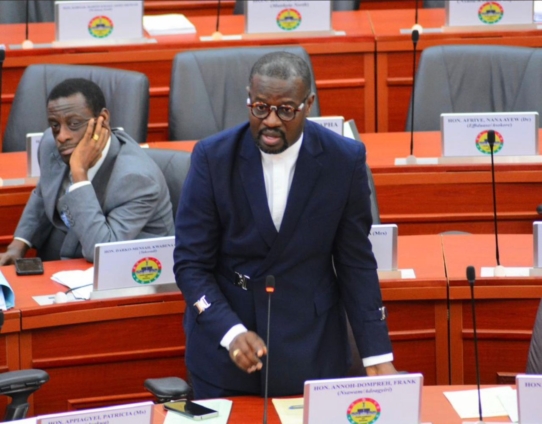
HON. FRANK ANNOH-DOMPREH
MINORITY CHIEF WHIP
PARLIAMENT OF GHANA
Latest Stories
-
Christa Pike has ‘profound’ health turnaround after botched execution, lawyers say
15 minutes -
Outspoken Indian actor Nana Patekar dies suddenly at 75
24 minutes -
White House blocks Microsoft from foreign worker hiring program
33 minutes -
ICE agent shoots man in New York City
43 minutes -
Zambia signs US health deal after disputes over data-sharing
1 hour -
‘Bold and inventive’ Canadian poet Anne Carson wins Nobel Prize in Literature
2 hours -
Venezuela’s ex-leader Nicolás Maduro charged with conspiracy to commit torture
4 hours -
Harry says he ‘slipped into depression’ after leaving UK
4 hours -
Adidas sues Australian label White Fox over four stripes design
4 hours -
Ghana is not bending rules for foreign investors – GIPA CEO
4 hours -
Asos hackers took more personal details than first revealed, BBC finds
5 hours -
Fort Hood shooter’s execution by firing squad will be livestreamed, Pentagon says
5 hours -
Chrysler Building to get its crown restored after being sold
5 hours -
Infantino re-election boost as Concacaf chief will not stand
5 hours -
Everton’s Sherif fined for breaching betting rules
5 hours