

Audio By Carbonatix
A soundtrack of explosions, a skyline dominated by bitter, black smoke, a daily existence of fear and uncertainty as bullets, rockets and rumours fly.
Life in Sudan's capital, Khartoum, and in many other parts of the country, has taken a sudden, very dramatic turn for the worse.
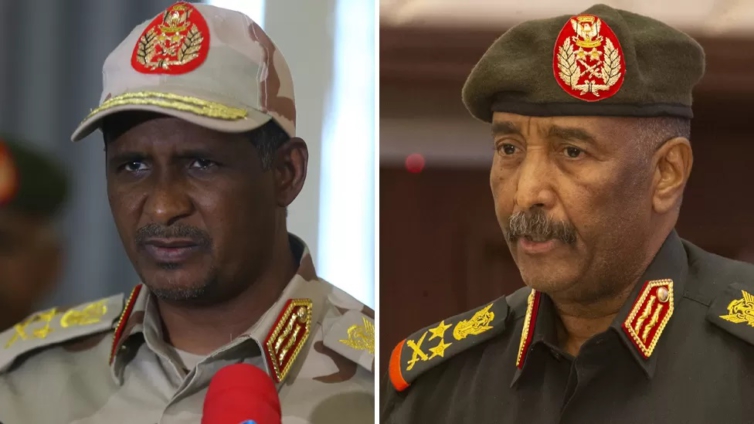
At the heart of it are two generals: Abdel Fattah al-Burhan, the leader of the Sudanese Armed Forces (SAF), and Mohamed Hamdan Dagalo, better known as Hemedti, the head of the paramilitary Rapid Support Forces (RSF).
The two worked together, and carried out a coup together - now their battle for supremacy is tearing Sudan apart.
The relationship between the two goes back a long way.
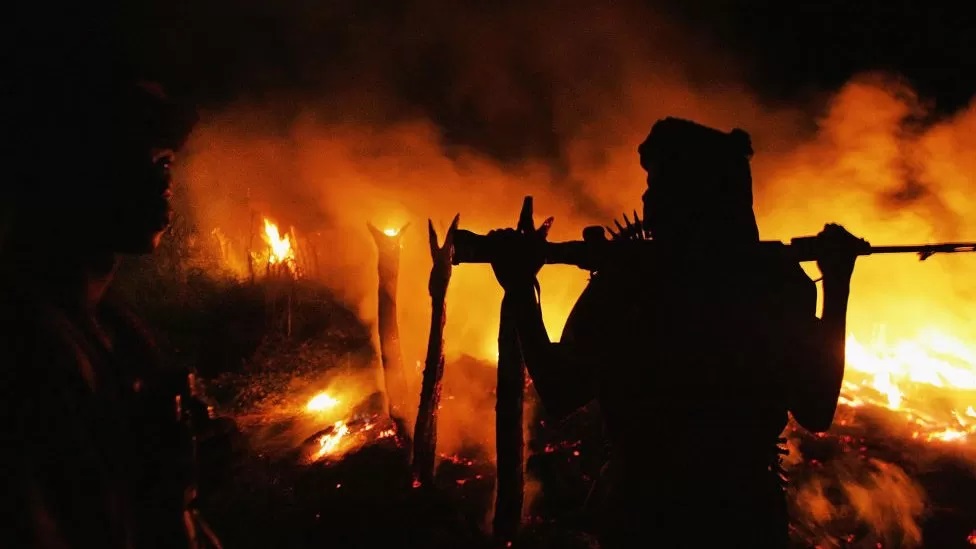
Both played key roles in the counter-insurgency against Darfuri rebels, in the civil war in Sudan's western region that began in 2003.
Gen Burhan rose to control the Sudanese army in Darfur.
Hemedti was the commander of one of the many Arab militias, collectively known as the Janjaweed, which the government employed to brutally put down the largely non-Arab Darfuri rebel groups.
Majak D'Agoot was the deputy director of the National Intelligence and Security Services at the time - before becoming deputy defence minister in South Sudan when it seceded in 2011.
He met Gen Burhan and Hemedti in Darfur, and said they worked well together. But he told the BBC he saw little sign that either would rise to the top of the state.
Hemedti was simply a militia leader "playing a counter-insurgency role, helping the military", while Gen Burhan was a career soldier, though "with all the ambitions of the Sudanese officer corps, anything was possible".
The military has been running Sudan for most of its post-independence history.
The government's tactics in Darfur, once described by Sudan expert Alex de Waal as "counter-insurgency on the cheap", used regular troops, ethnic militias and air power to fight off the rebels - with little to no regard for civilian casualties.
Darfur has been described as the first genocide of the 21st Century, with the Janjaweed accused of ethnic cleansing and using mass rape as a weapon of war.
Hemedti eventually became the commander of what could be described as an offshoot of the Janjaweed, his RSF.
Hemedti's power grew massively once he began supplying troops to fight for the Saudi-led coalition in Yemen.
Sudan's then-military ruler, Omar al-Bashir, came to rely on Hemedti and the RSF as a counterweight to the regular armed forces, in the hope that it would be too difficult for any single armed group to depose him.
In the end - after months of popular protests - the generals clubbed together to overthrow Bashir, in April 2019.
Later that year, they signed an agreement with the protesters to form a civilian-led government overseen by the Sovereign Council, a joint civilian-military body, with Gen Burhan at its head, and Hemedti as his deputy.
It lasted two years - until October 2021 - when the military struck, taking power for themselves, with Gen Burhan again at the head of the state and Hemedti again his deputy.
Siddig Tower Kafi was a civilian member of the Sovereign Council, and so regularly met the two generals.
He said he saw no sign of any disagreements until after the 2021 coup.
Then "Gen Burhan started to restore the Islamists and the former regime members to their old positions", he told the BBC.
"It was becoming clear that the plan of Gen Burhan was to restore the old regime of Omar al-Bashir to power."
Mr Siddig says that this is when Hemedti began to have doubts, as he felt Bashir's cronies had never fully trusted him.
Sudanese politics has always been dominated by an elite largely drawn from the ethnic groups based around Khartoum and the River Nile.
Hemedti comes from Darfur, and the Sudanese elite often talk about him and his soldiers in pejorative terms, as "country bumpkins" unfit to rule the state.
Over the last two or three years, he has tried to position himself as a national figure, and even as a representative of the marginalised peripheries - trying to forge alliances with rebel groups in Darfur and South Kordofan that he had previously been tasked with destroying.
He has also spoken regularly of a need for democracy despite his forces having brutally put down civilian protests in the past.
Tensions between the army and the RSF grew as a deadline for forming a civilian government approached, focused on the thorny issue of how the RSF should be re-integrated into the regular armed forces.
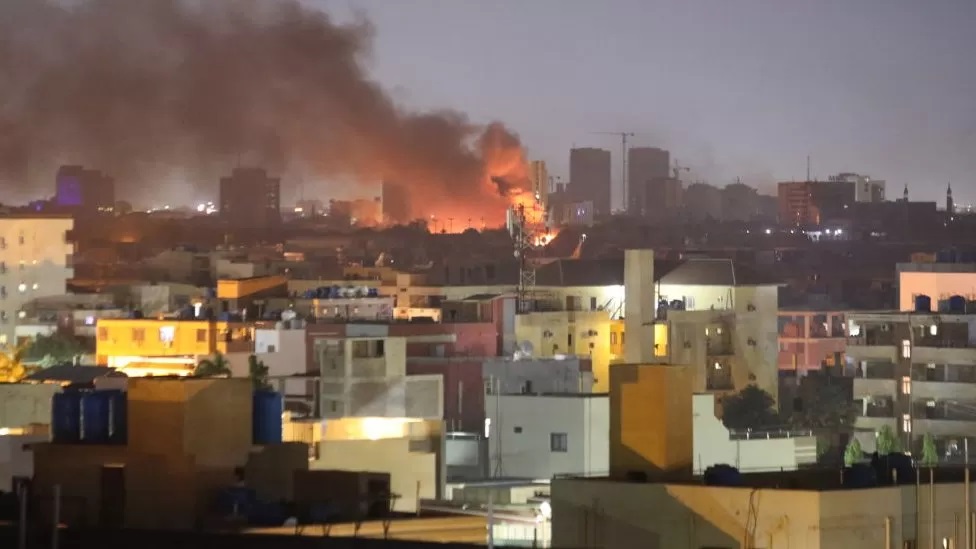
And then the fighting began, pitting the RSF against the SAF, Hemedti against Gen Burhan, for control of the Sudanese state.
In one way, at least, Hemedti has followed in the footsteps of the SAF top brass, who he is now fighting - over the last few years, he has built a vast business empire, including interests in gold mines and many other sectors.
Gen Burhan and Hemedti have both faced calls from civilian leaders and victims of the conflict in Darfur and elsewhere to face trial for alleged abuses.
The stakes are extremely high, and there are plenty of reasons for these former-allies-turned-bitter-enemies to not back down.
Latest Stories
-
GAEC must retain nuclear scientists for Ghana’s nuclear ambitions – Minister
16 minutes -
Man reportedly mistaken for game and shot by hunter dead in forest
18 minutes -
19-year-old mason jailed 15 years for defiling seven-year-old pupil
23 minutes -
Ghana’s banking sector assets rise 20.47% to GH¢500.2bn – BoG Governor
27 minutes -
22 injured as Sprinter bus overturns at Sege after tyre burst
28 minutes -
UN housing expert urges Ghana to strengthen Rent Control Department amid housing affordability concerns
37 minutes -
Delta-BCI partnership reaches 166,000 people with breast cancer education
46 minutes -
Power restoration fault suspected in Kumasi Central Market fire
6 hours -
The 7-foot giant of Ngleshie Amanfro: Seven-foot Ghanaian Ephraim Saawa dreams of joining the national basketball team
7 hours -
Government promises support for Kumasi Central Market fire victims
7 hours -
Vibes The Movie: Big Ghun’s Ghanaian film earns five nominations at 2026 REFFA
7 hours -
‘I’m a fulfilled man’—Justice Korbieh on missing out on Supreme Court despite two nominations
7 hours -
MamaCare CEO warns unresolved conflicts among health workers could undermine maternal and neonatal care
8 hours -
Health professionals urged to translate medical knowledge into practice to save mothers
8 hours -
Retired judge Justice Francis Korbieh charges 1,568 new lawyers to uphold integrity
9 hours