

Audio By Carbonatix
Super Typhoon Rai, known locally as Odette, slammed into the eastern coast of the Philippines Thursday afternoon, bringing torrential rain and the threat of widespread flooding across the archipelago.
The storm rapidly intensified on Thursday morning and was upgraded from a typhoon to a super typhoon. By the time it made landfall on Siargao Island on the central east coast, it had reached sustained winds of 260 kilometers per hour (160 miles per hour) with gusts over 300 kilometers per hour (185 miles per hour) - equivalent to a Category 5 hurricane in the Atlantic.
Around 198,000 people have already evacuated from their homes to government shelters, the country's National Disaster Risk Reduction and Management Council (NDRRMC) said on Thursday.
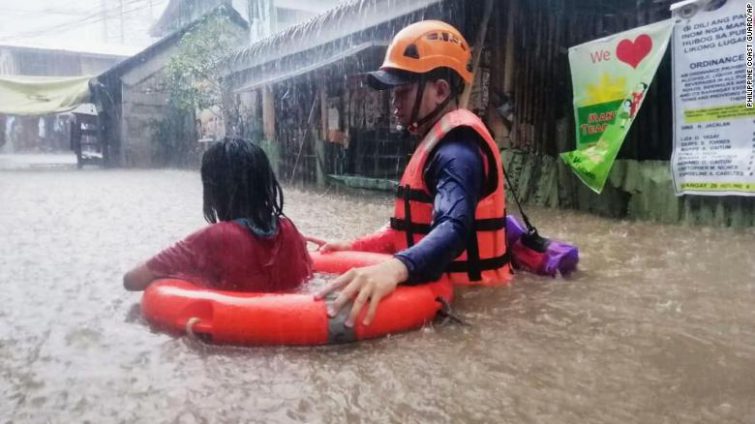
Many preemptive evacuations and storm preparations began earlier in the week as the country began seeing heavy rain. In central Misamis Oriental province, the Agay-ayan River overflowed on Tuesday, flooding streets and homes with muddy brown water.
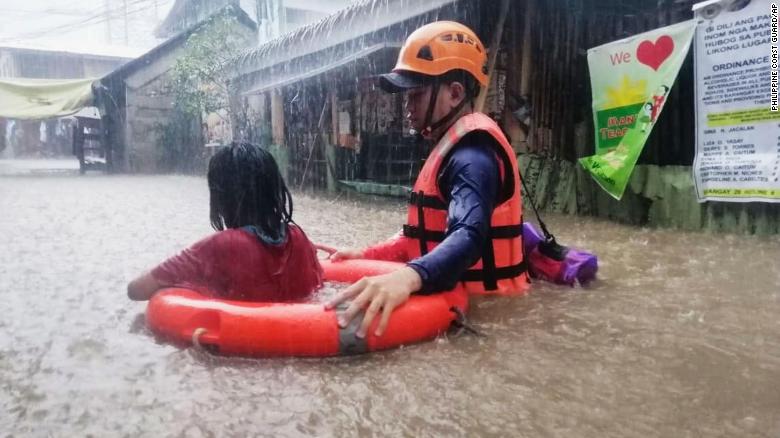
The storm is expected to travel through the country's central and southern regions. Some of the worst conditions are expected in Surigao Province, which lies on the northern tip of Mindanao, one of the country's major islands.
The storm is also expected to hit a number of provinces in the country's Visayas region, a central group of islands. More than 20 million people live in the Visayas, according to 2020 official figures.
In Surigao Province, more than 2,600 people have been evacuated as of Wednesday evening, according to the state-owned Philippine News Agency.
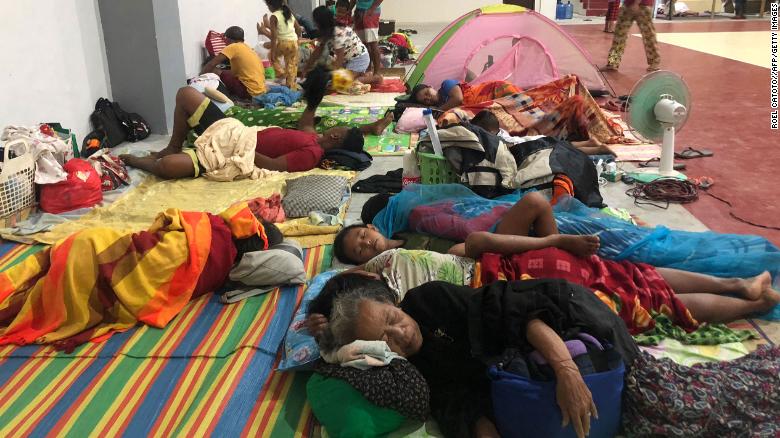
Photos from Surigao show one sports complex turned into an evacuation center, with plastic tents set up in a large hall and families asleep on rugs and tarps on the floor.
Meanwhile in Eastern Visayas, more than 45,000 people have evacuated to government shelters in the Eastern Visayas region, according to the National Disaster Risk Reduction and Management Council on Thursday.
"We are getting pounded already by strong wind and rain," said Governor Ben Evardone of Samar Province, located in Eastern Visayas.
In Tacloban City, just outside Samar, hundreds of residents have also taken shelter in evacuation sites. Many lived through Super Typhoon Yolanda, which killed more than 6,000 Filipinos in 2013 - and they're not taking any chances now.
"We are concerned that this storm is taking the same path as the typhoon in 2011, and the other in 2013," said Karen Janes Ungar, the country representative for the humanitarian organization Catholic Relief Services Philippines.

"However, we have learned a lot from both of those previous disasters, and in a lot of disaster preparedness...for this emergency."
The biggest concern, she added, are smaller towns on the coast, home to fishermen and poorer populations that might not have access to government announcements or are unable to evacuate.
Thousands of villages in the storm's projected path are at high risk of flooding and landslide, with the region's soil already saturated and unsteady from the week's heavy rain, according to the country's Mines and Geosciences Bureau, which urged local authorities to prepare evacuation plans.
Airlines have canceled dozens of flights, while transport authorities banned sea and land travel in the central and southern Philippines, leaving thousands stranded at ports.
Humanitarian organizations and aid agencies are also on the ground, working with local authorities to prepare for the storm and assist in evacuations. Teams from the Philippine Red Cross are spread out across the east coast, helping organize first aid teams, food and water, and supplies such as blankets and safety equipment.
"Filipinos are tough but this Super Typhoon is a bitter blow for millions of people who are still recovering from devastating storms, floods and Covid-19 in the past year," said Philippine Red Cross Chairman Richard Gordon in a news release on Thursday.
Super Typhoon Rai is the 15th storm to hit the country this year - compounding the struggles of people still recovering.
Millions are still rebuilding their homes and livelihoods, especially after several devastating storms late last year, according to the Red Cross.
Latest Stories
-
Brandon Asante and Coventry all but promoted to Premier League despite Sheffield Wednesday draw
10 minutes -
GPL 2025/26: Late Kwartemaa strike downs Hearts in Tema
16 minutes -
Ghana Faces Sierra Leone Moment as Prosecutorial Powers come under strain
26 minutes -
Don’t consume fish or seafood from Tema Shipyard until further notice – FDA warns
30 minutes -
Why volunteering might be Africa’s most underrated career accelerator
37 minutes -
ActionAid Ghana raises concern over gender gaps in Feed Ghana Programme
39 minutes -
Windstorm wreaks havoc in Gushegu, displacing nearly 2,000 residents and damaging schools
41 minutes -
Friends of Bridget Bonnie Marks her 35th birthday with donation to Kasseh Model Health Centre
1 hour -
From Ekumfi Kokodo to the Pulpit Stage: Essi Donkor’s gospel journey takes shape
2 hours -
Landfilling waste management creates no value, it’s an economic waste
2 hours -
Photos: Speaker Bagbin Commissions MPs constituency office under parliamentary decentralisation programme
2 hours -
Black Stars technical advisor Winfried Schäfer sacked as GFA shakes up backroom staff
2 hours -
Wenchi water project almost complete, critical to gov’t agenda – GWL MD
3 hours -
Anti-LGBTQ+ bill not part of government’s legislative agenda – Inusah Fuseini
3 hours -
Anti-LGBTQ Bill: Forget the rumour mongers, I’m a man of action, and will pass the bill – Speaker
3 hours