

Audio By Carbonatix
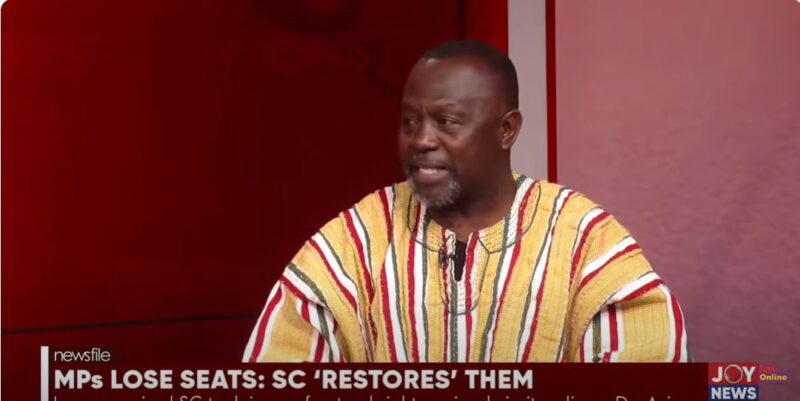
Former Deputy Attorney General, Dr. Dominic Ayine, has accused the Supreme Court of overstepping its jurisdiction and acting prematurely in a recent decision involving the declaration of parliamentary seat vacancies.
Speaking on JoyNews' Newsfile on October 19, Dr. Ayine argued that the Court’s intervention was legally flawed and driven by a hasty attempt to assert its authority.
Dr. Ayine noted that the stay-of-execution mechanism only applies to judicial or quasi-judicial orders, which usually require an appeal to trigger the process.
However, in this case, there was no formal appeal or notice of appeal because the Speaker of Parliament did not allow a challenge, following parliamentary procedures.
Dr. Ayine argued that the absence of a pending judicial order meant the Court had no legal grounds to issue a stay.
“The Supreme Court in its ruling, in haste to assert its authority, grossly erred… When he [Alexander Afenyo-Markin] wanted to challenge Mr Speaker he was told no, he was going to give him leave to do so. So there was no appeal, there was no notice of appeal before any court of competent jurisdiction for there to have been a stay of execution.” he said.
His comments come after the Supreme Court issued a stay of execution on Speaker Alban Bagbin's ruling, which declared four parliamentary seats.
He explained that the Constitution assigns jurisdiction over parliamentary seat vacancies to the High Court under Article 99(b).
According to him, the Supreme Court’s role would only arise indirectly, as a referenced jurisdiction. This would occur if the High Court while handling the case, needed clarification on constitutional interpretation and referred the matter to the Supreme Court.
“At best, the jurisdiction of the Supreme Court in this matter would be a referenced jurisdiction... The High Court would stay its hand, and the matter could be referred to the Supreme Court for interpretation.”
Dr. Ayine also cited concerns about the nature of the case brought before the Supreme Court. He explained that Mr. Afenyo-Markin’s suit, which was filed before the Speaker’s ruling, involved a hypothetical situation rather than an actual controversy.
“In Billson and Apaloo, the court was very clear that the Supreme Court does not deal with hypothetical situations but actual controversies.”
He added “the Supreme Court clearly erred, did not jurisdiction in this matter.”
Latest Stories
-
NPP had more permanent fuel relief measures than current GH¢2 diesel cut – Amin Adam
16 minutes -
Photos from the 3rd Republic Bank-JoyNews Habitat Fair Clinic
19 minutes -
Ethiopia’s army promises restraint amid fears of new civil war
29 minutes -
Amin Adam calls for review of fuel taxes as diesel prices remain above GH¢18
1 hour -
World Vision Ghana, Ahafo districts sign MoU for universal WASH coverage
1 hour -
When the gold engine stutters: What Ghana’s Cedi and reserves are telling us about the new economic architecture
2 hours -
Two reportedly die after being trapped in mining pit at Juaboso
2 hours -
Petrosol cleans up Wa Municipal Hospital, to donate medical equipment
2 hours -
‘If NPP was ‘insensitive’ over fuel prices, NDC must accept same description now’ — Amin Adam
2 hours -
KiDi brings the hits to London in sold-out UK headline concert
2 hours -
The last goodbye of Ghanaian shot dead in the US
3 hours -
MCC opens door to Ghana again as MiDA revives development partnership
3 hours -
CSIR moves to turn scientific research into jobs, national growth
3 hours -
More patrons troop in as 3rd Republic Bank-JoyNews Habitat Fair clinic enters final day stretch
3 hours -
German, Russian foreign ministers hold rare talks amid rising tensions
3 hours