

Audio By Carbonatix
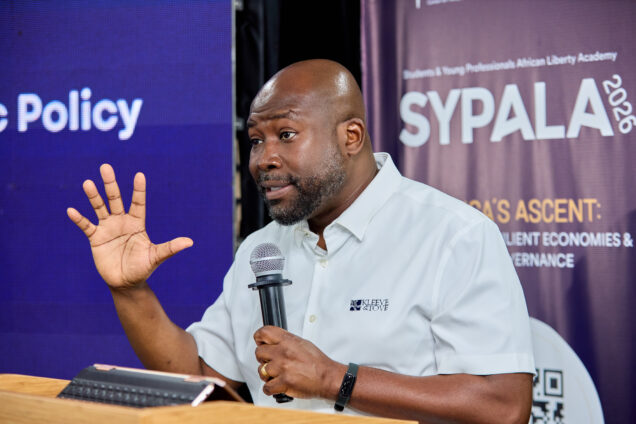
Founder and Executive Chairman of Kleeve and Tove Ltd, Senyo Hosi, has said that Africa’s unemployment crisis goes beyond the lack of jobs, saying the continent also faces a deeper problem of weak production, low productivity and a shortage of businesses capable of employing young people at scale.
Speaking on the topic "Beyond Politics: How Business and Public Policy Can Drive Africa’s Transformation”, at the Students & Young Professionals Africa Liberty Academy (SYPALA) 2026 organised by IMANI Africa, Mr Hosi said the scale and quality of employment available to young people should be a major concern for governments, businesses and policymakers.
Mr Hosi said the employment crisis also reflected the continent’s limited productive capacity.
He said African economies had too few companies operating at a scale that could absorb large numbers of skilled young people.
“It points to a deeper problem in how our economy is abstracted,” he said.
“Unemployment is often discussed as a labour market problem. But Africa is also a production problem.”
Mr Hosi pointed to the wider labour market situation in sub-Saharan Africa, where he said nearly three out of four young adults between the ages of 25 and 29 were in insecure work as of 2023.
“The wider labour market evidence remains even so. In sub-Saharan Africa, nearly three in four young adults aged 25 to 29 were insecure at work as of 2023,” he said.
“I don’t think the story has changed, if not possibly worse,” he added.
According to him, the figures become more worrying when the nature of the work being done by young people is considered.
He said about 60 per cent of those experiencing employment insecurity were in the agrarian sector and largely outside the more productive parts of the agricultural value chain.
“And in all these numbers, these three we are talking about are out of four, and insecurity, 60% are within the agrarian sector,” he said.
“Not in the very productive part of the agrarian chain.”
Mr Hosi said the figures showed that simply counting the number of people engaged in some form of economic activity did not give a complete picture of the employment situation in Africa.
“In other words, Africa’s challenge is not only unemployment,” he said.
Mr Hosi identified informality, underemployment and low productivity as some of the deeper challenges affecting Africa’s labour market.
“It is informality, underemployment, and low productivity. It is weak job quality, too few firms able to absorb young talent and skill,” he said.
He said Ghana’s situation should be understood within this wider continental challenge rather than treated as an isolated national problem.
“Ghana’s experience, therefore, sits inside a larger African pattern,” he said.
For Mr Hosi, the key question should not simply be whether young people are engaged in an economic activity. The quality and future prospects of that activity also matter.
“The issue is not simply whether young people are busy. It is whether they are productively employed, securely engaged, and connected to a pathway of rising income,” he said.
He said that young people needed access to work that could provide stability and allow them to improve their incomes over time.
According to him, the tendency to describe every small economic activity as entrepreneurship could obscure the fact that many of these businesses lack the capacity to grow.
“We have too few firms producing at scale. Everybody is a village young man. Everybody is an entrepreneur,” he said.
He said Ghana faced the same structural difficulties, including limited large-scale production and inadequate links between businesses and sources of finance.
“Ghana’s experience, therefore, sits within that bigger problem,” Mr Hosi said.
He identified “too few firms producing at scale, too few industries adding value, too few firms connected to money markets, too little patient capital, and too many barriers that keep small enterprises from becoming large employers” as some of the factors contributing to the problem.
Mr Hosi urged policymakers to stop treating youth employment as a secondary issue that could be addressed separately from broader economic planning.
“We must stop treating youth employment as a side issue,” he said.
“And you must stop thinking of it as a normal issue.”
He said the employment situation had implications far beyond individual livelihoods, warning that the failure to create productive jobs could affect the stability of African economies and societies.
“It is central to our macroeconomic stability, our social cohesion, our democratic legitimacy, and national security,” he said.
He therefore called for a shift in focus from simply reducing unemployment figures to building productive economies capable of creating quality jobs at scale.
Mr Hosi said Africa’s growing youth population could become a major economic advantage only if governments and businesses created the productive capacity needed to employ and retain young talent.
“A young continent cannot afford economies that grow without jobs,” he said.
Latest Stories
-
Nearly GH¢6m spent to fix Kpong-Tema transmission lines to improve water supply – GWL
2 minutes -
Dr Olukoya-backed MFM rules Nigerian women’s basketball
4 minutes -
THE LAW 101: Before you fly that drone
6 minutes -
Wa West DCE, MP hand over and commission health, education, and hospitality projects
10 minutes -
Drone ownership does not give unrestricted right to fly anywhere – Anyenini
16 minutes -
GFA confirms two-legged format for FA Cup final
17 minutes -
GWL assures of efforts to improve water supply in Tema, Ashaiman amid shortages
30 minutes -
Community 25 residents demand answers over two-month water shortage
48 minutes -
Ampem Darkoa Ladies and Hasaacas Ladies clash in 2026 Women’s Champion of Champions
54 minutes -
Business dies when luxury takes over leadership
1 hour -
No family should lose everything to save a loved one – GMTF administrator
1 hour -
Bawumia has the dignity to lead and the vision Ghana needs – Gabby
1 hour -
GOC, GFA chart Olympic qualification roadmap for Black Queens, Black Meteors
1 hour -
Absa InspireMe 2026 highlights opportunities for women-led business growth
1 hour -
The only thing that flows regularly is THE BILL
2 hours