

Audio By Carbonatix
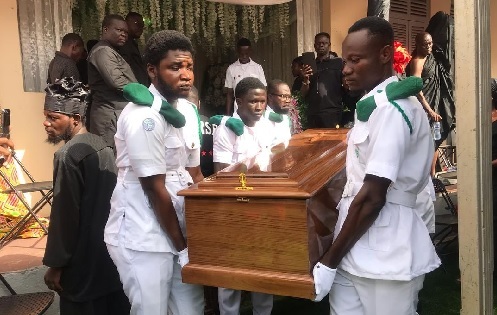
The legendary Teddy Osei, renowned for his role in the Afro-pop band Osibisa, was laid to rest following a body viewing and final funeral rites held at his family residence in Chiriapatre, Kumasi, on Saturday, April 5, 2025.
A burial mass was held at the St. Peter's Cathedral Basilica, near Fante Newtown in Kumasi, after the body viewing, where family members, friends, and loved ones gathered to mourn and celebrate his life.
Born Francis Kwabena Osei on December 17, 1935, and better known as Teddy Osei, he was a Ghanaian musician celebrated for his talents as a saxophonist, drummer, and vocalist. Osei was the founder and leader of Osibisa, the iconic Afro-pop band formed in 1969.
Osibisa’s legacy includes timeless hits such as Woyaya (1971), with the famous lyrics "We are going... Heaven knows where we're going... We know we will," as well as Sunshine Day and Dance The Body Music.
Teddy Osei leaves behind three daughters—Matilda, Agnes, and Shanta—as well as several grandchildren and great-grandchildren.
Widow
In a heartfelt tribute, Benedicta Adu-Poku honored her late husband, Kwabena Teddy Osei, saying, "Today, I pay a glorious tribute to my dear husband, Kwabena Teddy Osei.
As the Book of Romans clearly expresses, our love endures even though you are no longer with me. Your song—We are going, heaven knows where we are going—continues to echo in my heart."

She also shared that, despite Teddy’s busy schedule and constant travel due to his music career, it never affected the strength and unity of their family.
"If not on tour, he always made time for me and those were very precious times together. I will carry your love with me always, until we meet again"., she soberly said.
Biography
Osei was born in Kumasi, the Ashanti Regional capital. At birth, he was christened "Francis" by his parents - Micheal Kyekyere and Josephine Kyekyere - who were Roman Catholics.
He was the second of seven children. Osei was named after the Ashanti King Osei Tutu I. Osei's father was an amateur musician who played the horn in the local church band, thus exposing Teddy to music at an early age.
He was introduced to traditional music instruments by his school teacher , and played the bass drum in the school band. He also frequently visited the Ashanti Palace, where he occasionally learned folk songs from visiting musicians.
Music career
Following his graduation, Osei worked as an office help for a year, before moving to Sekondi to study craftsmanship at a college. Sekondi was an important commercial and cultural hub, where he encountered a number of modern musicians and genres.
During this time, he was by Ghana's First President Osagyefo Dr Kwame Nkrumah, and supported his political party and its campaign against British colonialism.

After completing his degree, he returned to Kumasi and worked as a building inspector for a brief while, before choosing to become a professional musician.
Teddy created a semi-professional band along with his brother, Mac Tontoh of blessed memory, and some friends.The band was known as "Comets", and became successful in Ghana, recording with Philip West Africa and playing for a radio show.
Their music was inspired by "Highlife," a genre derived from a fusion of European and African influences. Comets, enjoyed brief popularity before Osei travelled to London in 1962.
He received a grant from the Ghanaian government to study at a private music and drama school for three years , before being forced to leave by a regime change in Ghana.
In 1969, he founded Osibisa along with several other musicians. The band remained popular through the 1980s and 90s, and continues to perform till date.
Stardom
In 1969, Teddy Osei, Sol Amarfio, and Mac Tontoh came together with other musicians, that they had been previously acquainted with to form Osibisa.
The new band derived its name from "Osibisaaba", the name given to the style of music that was a fusion of "palm wine" music and traditional Fante fisherman's traditional music.

In its early stages , Osibisa had neither an agent nor a manager. The band played at psychedelic venues around London while it tried to find financial support.
During the period, Osei played flute, African drums, as well as, saxophone.
The band became an instant success, producing several songs that reached the British top-ten. They were even more popular when playing live.
During the late 1970s they played on several international tours to India, Japan, Australia, New Zealand and several African countries.
In 1980, the band played at a concert celebrating the Independence of Zimbabwe.
Latest Stories
-
Ablakwa receives Presidential Special Envoy on Reparations to advance global agenda
9 minutes -
Christina Koch becomes first woman to travel around the moon on Artemis II
19 minutes -
Epstein survivors’ calls to meet King Charles and Queen harder to ignore as US visit approaches
25 minutes -
UN Secretary-General names Ghana’s Anita Kiki Gbeho as South Sudan envoy
27 minutes -
Mali withdraws recognition of Sahrawi Republic, backs Morocco’s autonomy plan
31 minutes -
Gov’t distributes over 8,500 laptops to One Million Coders project
32 minutes -
Julius Debrah, ‘man to beat’ as NDC’s James Agbey dismisses Musah Dankwah’s polls
38 minutes -
GPRTU in Savannah Region to protest alleged eviction in Damongo
1 hour -
Re: Reinsurance does not replace process — A response to the SIGA–SIC defence
1 hour -
Gender Ministry supports Harriet Amuzu in ongoing abuse case
2 hours -
AG joins plaintiff to scrap OSP ?: We should be mindful of the mischief in this – Bobby Banson
2 hours -
Samson Lardy Anyenini questions willingness of Attorneys-General to prosecute political colleagues
2 hours -
It is only fair the OSP is heard in Supreme Court case – Bobby Banson
2 hours -
Asiedu Nketia resumes Ashanti tour, second leg kicks off on Sunday
2 hours -
NLA denies salary cut claims, threatens legal action over reports
2 hours