

Audio By Carbonatix
Ghana does not run out of miracles. We run out of courage. And today, courage is exactly what this Parliament lacks. Because the revised 2025 Ewoyaa lithium lease is not merely a bad contract. It is the most unpatriotic attempt at self disinheritance since independence.
It is a quiet surrender of sovereignty dressed up as investment promotion. And it is being forced down our throats with a straight face, as if the Ghanaian public cannot read, cannot count, and cannot remember the value of its own land.
This lease must fall. It must fall because it insults our Constitution. It must fall because it cripples our future fiscal space. It must fall because it hands over a strategic mineral of the energy transition century for peanuts while pretending the country has no alternatives.
Every paragraph of this revised lease carries the scent of panic, political expediency, and the familiar Ghanaian habit of negotiating against ourselves. And it must fall because Ghana has already been here before. We have watched gold slip away. We have watched oil become a mirage of promises. Lithium is not the mineral to repeat those sins.
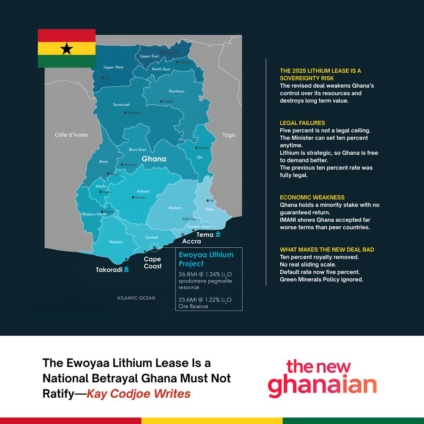
The first and boldest misunderstanding being pushed on the public is the idea that Ghana cannot legally charge more than five percent. This narrative relies entirely on the hope that citizens will never open the law, never read the lease, and never consult experts. Yet page after page of the IMANI analysis dismantles this notion with the precision of a forensic audit.
The five percent figure sitting in current regulations is not a ceiling. It is not a constitutional commandment. It is simply the number chosen in a subsidiary instrument that the minister can amend tomorrow, subject to parliamentary oversight. Parliament’s ratification powers under Article 268 allow it to approve higher royalties in specific agreements. The Constitution does not bind the nation. Political timidity does.
It is even more embarrassing that Ghana forgets its own history. Our royalty regimes have previously crossed ten percent. The country has operated price linked models that generated even higher effective rates during boom cycles. These facts sit in our statutes and archives and in the lived memory of the mining sector. So when government calls a ten percent lithium royalty illegal, what they truly mean is that defending Ghana’s interest has become politically inconvenient.
Then comes the tale of collapsing lithium prices, crafted to make the country feel desperate enough to beg. The numbers, however, reveal a different picture. Atlantic Lithium’s own financial model was built around a price of one thousand five hundred and eighty seven dollars per tonne, not the exaggerated three thousand being thrown around to dramatize supposed losses.
Even when prices dipped below eight hundred, the same investor was pleading with Parliament to ratify the original ten percent royalty deal. They did so because their all in cost is about six hundred and ten dollars per tonne. With current prices above one thousand, the company enjoys margins approaching thirty percent.
In any serious jurisdiction, a ten percent royalty would be non negotiable under such conditions. Reducing it to five percent channels millions of dollars every year away from Ghana without any strategic justification. And if a company remains unable to raise capital in spite of such generous terms, Ghana should question whether this is the right partner at all. A strategic mineral cannot be entrusted to an entity that survives only on concessions from the host country.
To soften this economic retreat, government touts Ghana’s nineteen percent equity stake as if it were a steady source of revenue. But equity is not cashflow. Dividends come only after all costs are deducted, and in mining those costs can be massaged, allocated, shifted, or hidden through related party sales and transfer pricing. The IMANI analysis repeatedly highlights these risks. Equity cannot replace a strong royalty structure. Equity cannot guarantee anything. Equity without firm fiscal terms is simply a distraction.
Another subtle misimpression being sold is the promise of value addition. The revised lease reduces the dream of downstream industry to an instruction that the investor should conduct a scoping study to decide whether refining is viable. This is not an obligation. It is an escape clause. It is a polite way of allowing the company to decline without consequence.
Meanwhile, large volumes of Ewoyaa’s future output have already been pre sold to offshore refineries, which means the real value, converting spodumene concentrate into lithium hydroxide worth fifteen thousand to twenty thousand dollars per tonne, will be captured outside Ghana. In this arrangement, Ghana becomes a supplier of cheap ore to fuel the prosperity of other nations.
Even the infrastructure clause being dangled before the Central Region, the proposed Saltpond jetty, is exposed in the IMANI file as technically flawed, economically irrational, and likely to become a tax shield rather than a genuine development project. The coastline is unsuitable for bulk loading without enormous breakwater investments. The capital required would swallow any possible benefit. By the time this jetty is inevitably declared unfeasible, the lease will already have been ratified and Ghana will bear the cost.
A look at the international comparison table in the same file shows the stark truth. Chile captures up to forty percent through a sliding scale. Zimbabwe prohibits raw ore export to force local beneficiation. Western Australia secures value through effective taxation and solid infrastructure. Ghana alone is shrinking its claim to a five percent royalty and calling it the best we can do.
The real tragedy is the attempt to convince the public that this is the limit of Ghana’s capability. It is not. The minister could revise the royalty to ten percent by regulation tomorrow. Parliament could ratify a stronger agreement the next day. Ghana could publish its Green Minerals Policy immediately and place lithium within a modern fiscal and industrial framework. Nothing in law stops us. Only fear and compromise stand in the way.
Every Parliament has a moment that tests its conscience. This is that moment. Lithium is not gold. It is not manganese. It is not bauxite. It is the mineral that will power the coming century. To hand it away so cheaply is to abandon generations yet unborn.
The revised Ewoyaa lithium lease weakens Ghana’s sovereignty, drains value, insults the Constitution, and betrays the future. Parliament must reject it. Reject it and renegotiate it. Restore what was lost. Demand what is Ghana’s.
A vote for this lease is a vote against the Republic.
Latest Stories
-
The 7-foot giant of Ngleshie Amanfro: Seven-foot Ghanaian Ephraim Saawa dreams of joining the national basketball team
36 minutes -
Government promises support for Kumasi Central Market fire victims
42 minutes -
Vibes The Movie: Big Ghun’s Ghanaian film earns five nominations at 2026 REFFA
1 hour -
MamaCare CEO warns unresolved conflicts among health workers could undermine maternal and neonatal care
2 hours -
Health professionals urged to translate medical knowledge into practice to save mothers
2 hours -
Conflicts among care providers linked to maternal, neonatal deaths – Expert
3 hours -
GIS marks 10th TIME conference, champions improved teaching practices
3 hours -
BRICS Or Balance? What Ghana’s bid really means
4 hours -
GPRTU wants full TRAFFITECH-GH implementation to start in 2027
4 hours -
Mahama announces plans to import electric wheelchairs for PWDs
4 hours -
KGL U17 Colts 2026: Western beat Prempeh Elite Academy to set up final final with Greater Accra Region
5 hours -
Late Solanke strike salvages 10-man Spurs draw at Man United
5 hours -
Gender Ministry to monitor welfare of Nana Akua Addo’s children amid domestic violence case
5 hours -
Benedict Okyere Yeboah: Ghana’s football problem goes beyond sacking a coach
5 hours -
GPL 2026/27: Darkwah Wiafe’s winner sees All Blacks beat Kotoko
5 hours