

Audio By Carbonatix
The Institute of Economic Affairs (IEA) has condemned the parliamentary ratification of the Ewoyaa Lithium mining lease and the passage of the new Minerals and Mining Royalty Regulations, describing them as "troubling" developments that rob Ghanaians of their rightful share of the extractive sector.
In a sharp critique of government’s recent moves, the institute questioned the decision to slash the Growth and Sustainability Levy (GSL) from 3% to 1%, alongside the ratification of the 15-year Ewoyaa lease on March 19, 2026.
This follows the passage of the Minerals and Mining (Royalty) Regulations, 2025 (L.I. 2512) on March 10, 2026, officially making it law.
The new regulation sets new sliding-scale royalties which caps gold and lithium at 12% and all other earth minerals at 5% based on global prices. This according to government marks a shift toward greater local value retention.
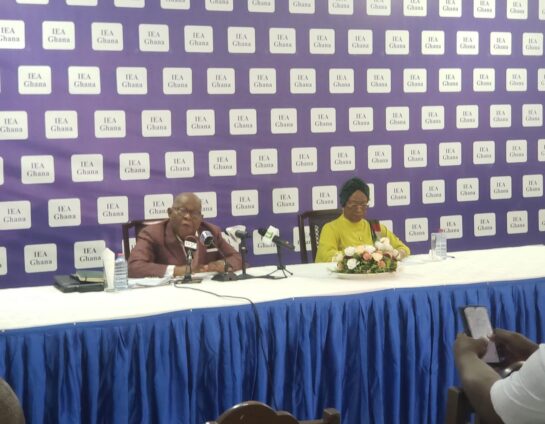
However, the IEA disagrees. Addressing the media at a short presser organised in Accra by the Institute to respond to this development, Justice Sophia Akuffo, a Distinguished Fellow of the IEA and former Chief Justice, argued that the deals fail to reflect modern economic sovereignty.
She pointed out that contemporary global extractive trends now favour state ownership and service contracts over traditional concessionary models.
“Ghana must have full ownership of its natural and mineral resources; and must exercise this ownership right by engaging private sector, local and foreign expertise strictly through service contracts that preserve national control,” Justice Akuffo stated.
"Are we suggesting that all we want as a nation, irrespective of world market prices, should be capped at 12%?" she questioned.
On the 15-year lease granted to Barari DV Ltd, a subsidiary of Atlantic Lithium, the Institute remarked that the new Ewoyaa agreement forces Ghana to remain "under the same old colonial system of royalties," rather than leveraging the country’s "once-in-a-generation opportunity" to reset its mineral governance framework.
Justice Akuffo questioned how a lease covering over 42 square kilometers with "virtually zero actual state participation" could possibly uphold the principles of national sovereignty.
The Institute also raised red flags over the government’s logic to reduce the Growth and Sustainability Levy to 1% as a "cushion" for investors. The IEA described this as a step that "weakens the objective of maximizing national benefits," arguing that fiscal policy should be "coherent, predictable, and aligned with a long-term national interest, not reactive concessions to investor pressure."
Drawing comparisons to international models, Justice Akuffo noted that countries like Chile, Botswana, and Burkina Faso have already moved toward arrangements anchored on state ownership.
Latest Stories
-
Vibes The Movie: Big Ghun’s Ghanaian film earns five nominations at 2026 REFFA
10 minutes -
MamaCare CEO warns unresolved conflicts among health workers could undermine maternal and neonatal care
34 minutes -
Health professionals urged to translate medical knowledge into practice to save mothers
41 minutes -
Conflicts among care providers linked to maternal, neonatal deaths – Expert
2 hours -
GIS marks 10th TIME conference, champions improved teaching practices
2 hours -
BRICS Or Balance? What Ghana’s bid really means
3 hours -
GPRTU wants full TRAFFITECH-GH implementation to start in 2027
3 hours -
Mahama announces plans to import electric wheelchairs for PWDs
3 hours -
KGL U17 Colts 2026: Western beat Prempeh Elite Academy to set up final final with Greater Accra Region
3 hours -
Late Solanke strike salvages 10-man Spurs draw at Man United
4 hours -
Gender Ministry to monitor welfare of Nana Akua Addo’s children amid domestic violence case
4 hours -
Benedict Okyere Yeboah: Ghana’s football problem goes beyond sacking a coach
4 hours -
GPL 2026/27: Darkwah Wiafe’s winner sees All Blacks beat Kotoko
4 hours -
ITF World Tour : Patel Wins Boys’ Singles Final at J100 Accra
4 hours -
Ghana must pursue BRICS partnership if it brings economic benefits – Kpebu
4 hours