

Audio By Carbonatix
The Institute of Economic Affairs (IEA) says the government’s cut in the Growth and Sustainability Levy (GSL), from three to one per cent, risks undermining the efforts to maximise national benefits from the country’s natural resources.
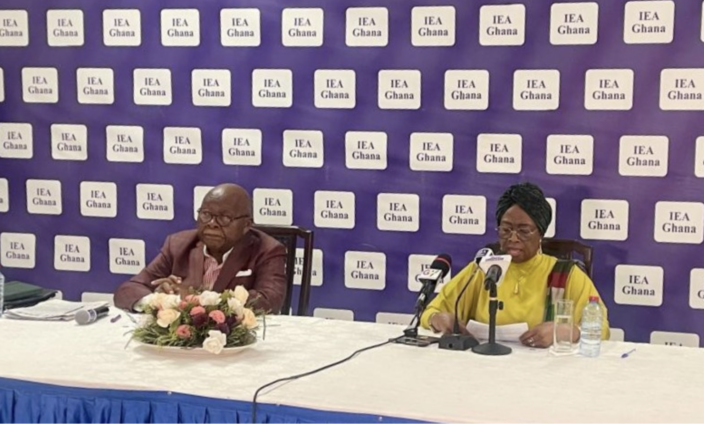
At a press briefing in Accra on Wednesday, the policy Think-Tank said the government's decision, with the intention of cushioning investors, was a departure from the global development shift, anchored in ownership and greater benefits.
“Why did government increase royalties, ostensibly to capture greater value from Ghana’s mineral wealth, only to simultaneously dilute that gain through tax concessions?” Justice Sophia Akuffo, a Distinguished Fellow of the IEA, said.
She noted that the reduction in the levies weakened the broader objective of ensuring that Ghana derived maximum benefit from its extractive sector, calling for coherent and predictable fiscal policies aligned with long-term national interests.
The former Chief Justice raised concerns that the country has trillions of dollars in natural resources, yet has visited the International Monetary Fund (IMF) 17 times for financial bailouts to avoid imminent economic collapse.
She also cited the Minister of Finance’s recent announcement that the Government would borrow GH¢17 billion to pay salaries as concerning, urging action to leverage the country’s natural and mineral resources to champion the national development agenda.
Justice Akuffo referred to Botswana, Burkina Faso, Chile, and Venezuela, which have embraced a new arrangement anchored in ownership, calling on the government to adopt new terms for resource extraction to ensure long-term benefits for the country.
In Botswana, for example, there was increased State participation in its diamond industry to capture greater value for the people, while Burkina Faso used similar agreements in the management of its natural and mineral resources, the former Chief Justice said.
“These developments have shown that asserting sovereignty does not repel investment; rather, it redefines the terms of engagement in favour of national development,” she said.
“They also show that Africans have woken up, and Ghana must join the awakening.”
“The fact that over 30 mining leases are nearing expiration, the record highs in the global prices of key minerals and the discoveries of new critical minerals, offer Ghana a once-in-a-generation opportunity to reset the country’s mineral resource governance framework.”
That, she indicated, required engaging the private sector, local and foreign expertise strictly through service contracts that preserved national control and maximised benefits for Ghana’s industrial transformation.
Latest Stories
-
Mahama satisfied with Aayalolo contra-flow results – Ayariga
19 seconds -
Ghana’s Rabiu Alhassan joins board of International Fact-Checking Network, IFCN
13 minutes -
Argentina hit 7 as Burkina Faso land five hours before kick-off
17 minutes -
NPP’s choice of Kojo Bamba, is a rejection of ‘suit and big English’ – Mustapha Gbande
21 minutes -
Innovators urged to build low-cost, locally maintainable health solutions
24 minutes -
Frank Appiah Kusi, PhD: Governance Gaps, Transparency, and the Business of Football in Ghana
24 minutes -
Manhyia South MP charged with conspiracy, financial loss and money laundering
32 minutes -
Attorney-General charges Manhyia South MP over alleged GH¢9.85m financial loss
35 minutes -
Food Security: Buffer Stock CEO calls for more investment in Agri-Tech
35 minutes -
Three missing children found dead in parked vehicle in Tamale
45 minutes -
Nana Akomea denies reports linking his absence from NPP executives’ introduction to Kojo Bamba
45 minutes -
2026 U-17 WWC: Black Maidens arrive in Morocco for tournament
48 minutes -
GSA suspends pre-shipment inspection of imported used vehicles
55 minutes -
Elevate Africa confirms presidents, vice presidents and ministers for 2026 Annual Convening in Accra
1 hour -
Keta MP commissions 60-seater kindergarten facility to replace unsafe structure
1 hour