

Audio By Carbonatix
Every day, lives are lost not because modern medicine has failed, but because help did not arrive soon enough or because those present did not know what to do. Whether at home, at church, in a market, at work, or on the roadside, a person can suddenly collapse from cardiac arrest. In those first few minutes, the difference between life and death often depends not on a doctor or a hospital, but on the actions of ordinary people nearby.
Unfortunately, this is where Ghana faces a major challenge. A study by Offei-Awuku et al. at Winneba Municipal Hospital found that 96.2% of clinical staff did not have a valid or recent Basic Life Support (BLS) certification, with only 3.9% meeting the national certification requirement. These findings highlight significant gaps in BLS training, even among healthcare professionals who are expected to maintain these lifesaving skills.
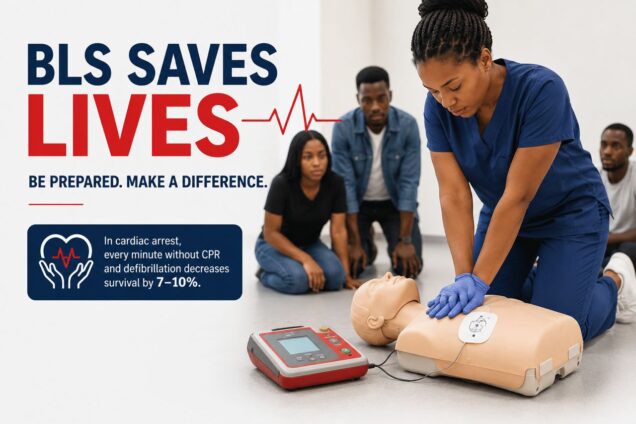
Basic Life Support (BLS), which includes recognizing cardiac arrest, calling for help, performing cardiopulmonary resuscitation (CPR), and using an Automated External Defibrillator (AED), remains unfamiliar to most Ghanaians. Many people have never received CPR training, have never seen an AED, and understandably panic when confronted with a medical emergency. Others fear causing harm and therefore choose not to act at all. Yet cardiac arrest is unforgiving. When the heart suddenly stops beating effectively, blood flow to the brain and other vital organs ceases almost immediately. Brain injury begins within minutes, and for every minute that passes without CPR, the chances of survival decline significantly.
In many countries, this reality has transformed public health policy. CPR is taught in schools. Employees receive workplace emergency training. Security personnel, police officers, teachers, and even students know the basics of responding to cardiac arrest. Automated External Defibrillators are commonly found in airports, shopping malls, train stations, sports arenas, and other public places, allowing bystanders to intervene before emergency medical services arrive. In Ghana, however, AEDs are virtually absent from public spaces. Most citizens have never encountered one, let alone been taught how to use one. While improving access to emergency care remains essential, strengthening our capacity to respond before patients reach the hospital deserves equal attention.
Recent events have reminded us that medical emergencies can strike anyone and have highlighted the importance of timely emergency response. Public discussions following the death of Charles Amissah brought renewed attention to the challenges facing emergency healthcare delivery in Ghana. Similarly, the sudden death of Sara Araba Tetteh, Esq following a reported cardiac arrest underscored how devastating these emergencies can be for families and communities.These tragedies should not be viewed simply as isolated incidents. Rather, they remind us that emergency care begins long before a patient reaches a hospital. It starts with the person standing next to the victim.
Building a nation prepared to respond to cardiac emergencies requires commitment from government, institutions, healthcare professionals, and the public alike. Basic Life Support training should become part of secondary school and university curricula. Workplaces should routinely train staff in Basic Life Support. Police officers, firefighters, commercial drivers, teachers, and security personnel should receive regular certification. Public institutions, airports, shopping centres, sports facilities, and other high-traffic locations should be equipped with AEDs and personnel trained to use them.
Public awareness campaigns are equally important. The more people understand that immediate action can save lives, the more likely they are to intervene confidently during emergencies. As healthcare professionals, we often say that “time is muscle” during a heart attack. The same principle applies to cardiac arrest, except that time is also brain, and ultimately, time is life. We cannot prevent every cardiac arrest. But we can ensure that when one occurs, every Ghanaian has a better chance of surviving it. Cardiac arrest does not wait for an ambulance, hospital bed or doctor and neither should we.
The author, Dr Zelda Boatemaa Boateng, is a Medical Doctor at Adiebeba Specialist Hospital in Kumasi with clinical experience in acute and chronic care, and a strong interest in public health advocacy.
References
https://www.annalsofhealthresearch.com/index.php/ahr/article/view/721
Latest Stories
-
Ballon d’Or Power Rankings: Lamine Yamal leads race for Golden Ball ahead of Rodri and Kane
1 hour -
‘Nothing worked for us’ – Gideon Mensah takes responsibility for Gambia defeat
2 hours -
2026 Women’s Super Cup: FC Savannah beat Epiphany Warriors to win trophy for first time
3 hours -
AFCON 2027Q: ‘The last time Ghana won was eight games ago’ – Carlos Queiroz
3 hours -
AFCON 2027Q: Gambia defeat doesn’t make me a loser – Carlos Queiroz
4 hours -
2027 AFCONQ: Late goals seal 2-0 for Côte d’Ivoire against Somalia
4 hours -
AFCON 2027Q: My resignation won’t solve Ghana football issues – Queiroz
4 hours -
Morocco call off Ghana friendly after Black Stars’ AFCON setback
4 hours -
‘We have to say sorry’ – Queiroz apologises after Ghana’s humiliating defeat to Gambia
4 hours -
New Yorker identified as Yaw Boahene, 57, killed after bag was caught in subway train doors
4 hours -
Former American Idol contestant and pastor found guilty of murdering wife
4 hours -
Trump rules out joint US-China venture to develop AI
5 hours -
‘Beating Ghana did not surprise me’ – Gambia boss
5 hours -
OpenAI agents get rebrand – as ‘dots’ – while safety worries delay new model
5 hours -
US ban on Canadian alcohol and dairy takes effect as trade war drags on
5 hours