

Audio By Carbonatix
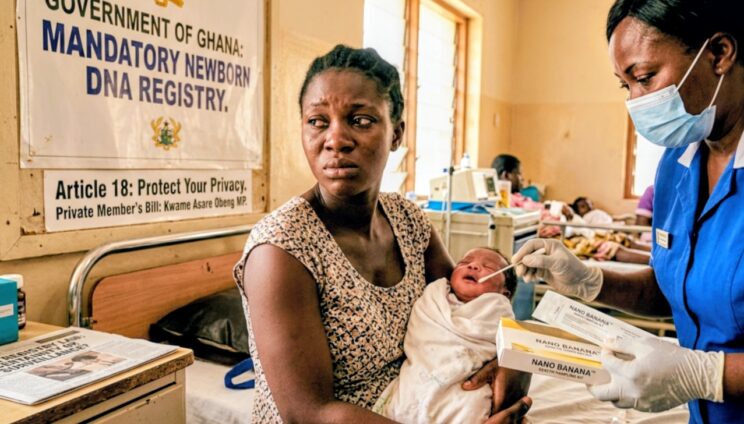
When Gomoa Central MP Kwame Asare Obeng recently unveiled a Private Member’s Bill proposing to criminalise "paternity fraud" and mandate DNA testing for every newborn in Ghana, it touched a raw and deeply emotional nerve.
The argument is seductive in its simplicity: no man should be tricked into raising a child that is not biologically his. By making a paternity test a universal, mandatory procedure at birth, the state ostensibly removes the stigma of suspicion, unclogs the family courts, and establishes a foundation of absolute biological truth.
But zooming out from the emotional theatre of daytime television scandals reveals a labyrinth of systemic risks.
Attempting to solve a human crisis of trust with a blunt legislative mandate opens Pandora's box—threatening to reconfigure our constitutional rights, our public health priorities, and the very architecture of our digital sovereignty.
To understand the sheer scale of what is being proposed, we must first look at global best practices. Currently, no democratic nation on earth mandates universal DNA testing at birth; the global standard heavily prioritises the right to privacy and bodily integrity.
Consider France, where the legal system explicitly prioritises la paix des familles—the peace of families—over biological absolutism. There, private, at-home paternity testing without a judicial order is a criminal offence, punishable by up to a year in prison and a €15,000 fine.
Even in jurisdictions that allow accessible testing, such as the US and the UK, it remains strictly voluntary.
For decades, Ghana’s legal architecture has mirrored this global restraint.
Under the Evidence Act of 1975 (NRCD 323), our family courts rely on the foundational common-law presumption of legitimacy: a child born during a valid marriage is legally presumed to be the husband's. It is a legal status requiring overwhelming evidence to overturn.
Mandating DNA tests would obliterate this tradition, replacing social fatherhood entirely with scientific verification.
But the fallout extends far beyond the philosophical debate of what makes a father. First is the glaring paradox of resource allocation.
Standard DNA diagnostics in Ghana currently run between GH¢2,500 and GH¢5,000 per test—an astronomical figure for a healthcare system still wrestling with fundamental deficits. Pregnant women in rural areas routinely lack access to critical maternity care, basic prenatal vitamins, and emergency transit.
Imposing a mandatory procedure of this cost raises severe questions of institutional governance. If citizens are forced to pay, it becomes an extortionate tax on childbirth. If the state absorbs the cost, it represents a staggering misallocation of public funds, prioritising an adult’s peace of mind over a mother's and child's right to survive delivery.
Yet, the most dangerous intertwined issue is the data itself.
A mandatory DNA testing law does not merely adjudicate domestic disputes; it quietly constructs the most comprehensive biological registry in the nation’s history. If the state mandates the extraction of genetic material from every newborn, it lays down a new, highly sensitive layer of Digital Public Infrastructure.
This is where the spectre of digital colonialism enters the frame. DNA is the ultimate personal identifier—precisely why Ghana’s Data Protection Act of 2012 deliberately classifies biometric and genetic information as "special personal data." Where will this massive database of genetic profiles be stored? Who will process the samples?
Currently, complex diagnostic tests in West Africa are frequently analysed by foreign laboratories or managed through foreign-designed platforms. If the biological blueprints of the next generation of Ghanaians are processed or secured by external commercial entities, we are no longer just exporting raw minerals or mortgaging our crude oil. We are surrendering the genetic sovereignty of the nation.
We must consider what happens when this biological database inevitably intersects with other digital systems, linking everything from national ID cards to future healthcare and insurance algorithms.
History shows that whenever a state compiles a massive database for a single, benevolent purpose, function creep is inevitable. A registry built to confirm paternity today can easily become a tool for surveillance, exclusion, or biometric profiling tomorrow.
This directly collides with Article 18 of the 1992 Constitution, which unequivocally defends the citizen against unwarranted interference with their privacy. Forced biological extraction by the state without reasonable suspicion of a crime is the ultimate interference.
The urge to legislate away deception is understandable, but trust cannot be mandated by parliament, and fidelity cannot be built in a laboratory.
In its rush to cure the silent crisis of paternity fraud, the state risks building a permanent, inescapable surveillance architecture that commodifies our very biology. We must be very careful before we trade our constitutional right to privacy for the cold, clinical comfort of certainty.
Latest Stories
-
We are with all flood victims – Hohoe MP
5 minutes -
Asharami Ghana commends NPA CEO Edudzi Tameklo for support towards LPG vessel arrival
11 minutes -
Finance Minister engages AGI, leaders ahead of 2027 Budget
17 minutes -
Enforce surcharges, modernise audits to curb GH¢100bn losses – Audit Service urged
25 minutes -
Six persons denied bail in 3.9-tonne alleged cocaine case
33 minutes -
Court jails man 25 months for setting three vehicles ablaze
42 minutes -
Miner jailed 24 months for stealing GH¢4,300
51 minutes -
Father jailed for defiling 13-year-old daughter in Tarkwa
1 hour -
Prosperity Architecture: Drawing II – Organising institutions for shared prosperity
1 hour -
First female prime minister named in Morocco after winning elections
1 hour -
Burkina Faso’s junta leader opens major gold refinery to keep mining profits at home
1 hour -
Nigeria’s Ben Dancer completes 168-hour dance marathon, awaits Guinness verdict
2 hours -
I’m now a minister of God – Actress Jumoke Odetola announces
2 hours -
Banks accounted for 86% total enquiries for credit in 2025
2 hours -
‘I paused for my mom’ – Kizz Daniel opens up on music break
2 hours