

Audio By Carbonatix
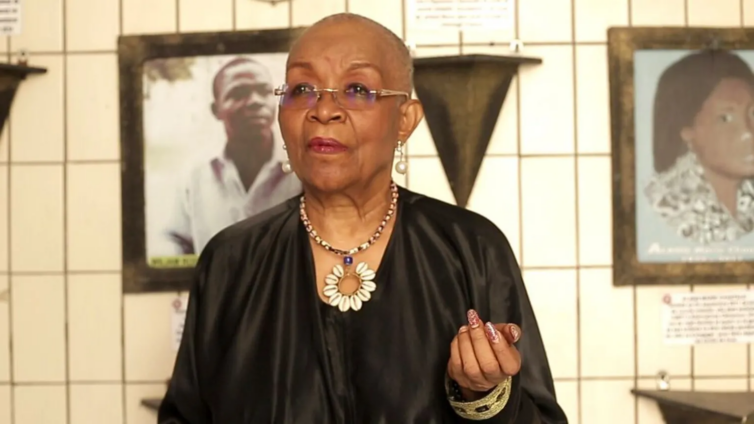
Despite being vilified, threatened and humiliated in public, veteran Cameroonian lawyer Alice Nkom is determined to uphold the rights of homosexual people in her country.
A human rights NGO that she runs, Redhac, was recently suspended by the government and she is due to appear before investigators to answer accusations of money laundering and funding terror groups – which she denies.
The 80-year-old says the authorities are obstructing her work and believes she is being targeted because of her legal advocacy with the LGBT community.
"I will always defend homosexuals because they risk their freedom every day, and they are thrown into prison like dogs," she tells the BBC in a firm tone, speaking in her office in the city of Douala.
"My job is to defend people. I don't see why I would say I'm defending everyone except homosexuals."
Dressed in a black gown, Ms Nkom delivers her stark message in a measured voice that reflects years of thoughtful legal argument.
According to the country's penal code, both men and women found guilty of homosexual sex can be sentenced to up to five years in prison and made to pay a fine. Members of the LGBT community also face being ostracized by their families and wider society.
As a result, Ms Nkom has been viewed as a surrogate parent to some in her country who have been open about their sexuality with their family.
The legal expert has children of her own, but hundreds, maybe thousands, of others, look up to her as their protector following her work over more than two decades to defend those accused of homosexuality.
"She's like our father and our mother. She's the mother we find when our families have abandoned us," says one LGBT activist, Sébastien, not his real name.
Committed to the Universal Declaration of Human Rights, which is included in Cameroon's constitution, Ms Nkom argues that freedom from discrimination on the grounds of sexual orientation should be seen as a fundamental right that supersedes the penal code.
"You shouldn't jail fundamental rights, you shouldn't repress them – you should protect them," she says.
This is a struggle that has landed Ms Nkom in difficulties.
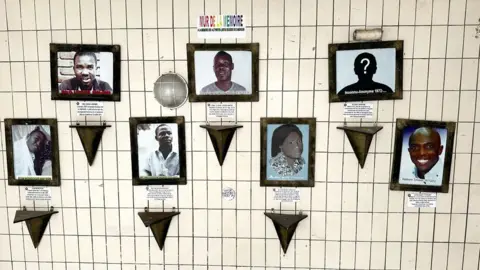
She says she has been physically threatened several times in the street, and reveals that when she first started out in this area of law, she hired bodyguards to help protect her.
But her journey to become one of Cameroon's most outspoken legal figures began well before that.
In 1969, aged 24, she became the country's first black female lawyer, after studying in both France – the former colonial power - and Cameroon.
She says she was encouraged to pursue her studies by her then-boyfriend, who later became her husband.
Her earlier legal work involved representing the less well-off and disadvantaged but it was a chance encounter in 2003 that led her to become involved in the fight to decriminalise homosexuality.
She was at the public prosecutor's office in Douala when she observed a group of young people handcuffed in pairs, who did not dare to look up.
"When I checked the court docket, I realised that they were being prosecuted for homosexuality," she says.
'Attempted homosexuality'
This offended her sense of human rights and she was very clear that sexual minorities should be included among those whose rights were protected by the constitution.
"I decided to fight to ensure that this fundamental right of freedom was respected," Ms Nkom adds.
She went on to found the Association for the Defence of Homosexuality (Adefho) in 2003.
Since then she has been involved in dozens of cases. One of the most high-profile in recent years was her defence of transgender celebrity Shakiro and a friend, Patricia, in 2021.
The two were arrested while eating in a restaurant and then charged with "attempted homosexuality".
They were sentenced to five years for contravening the penal code and outraging public decency.
"It's a hammer blow. It's the maximum term outlined in the law. The message is clear: homosexuals don't have a place in Cameroon," Ms Nkom was quoted as saying at the time.
Shakiro, along with Patricia, was later released pending an appeal and has since fled the country.
Since then the situation for LGBT people has not improved. LGBT activist Sébastien, who runs a charity to support families with homosexual children, feels things have got worse recently.
Last year, a song based on the popular mbolé rhythm with a title and lyrics that encouraged people to target and kill homosexuals was released. It is still being widely shared and is regularly played in the trendiest places in the country's major cities.
"People attack us because of this song, which glorifies crime," says Sébastien.
LGBT people have to hide their sexual identities but "some people set traps to get close to us and attack us or report us to the police", he says.
Ms Nkom says that when Brenda Biya, the daughter of President Paul Biya, came out in public to say that she was a lesbian last year, she thought it might help to change the law.
Ms Biya – who spends most of her time outside Cameroon – has been quoted as saying she hoped that her openness could alter things at home.
Ms Nkom senses an opportunity. "I'm using the Brenda case as a precedent. Now I have a case on which I can challenge the president," she says.
The lawyer also asked Ms Biya to do more for the cause of the LGBT community in Cameroon.
"Brenda hasn't replied to me yet, since I made the statement in the media, but I know that she will."
For now, though, she will continue her legal work.
She views the latest attempt to restrict her efforts as just another obstacle – certainly not enough tomake her stop the battle she has been waging since 2003.
Latest Stories
-
Chief Justice has designated Achimota Court to handle petroleum diversion cases – NPA CEO
3 minutes -
Philip Nai and friends gear up for bigger seventh Christmas outreach
4 minutes -
GSA strengthens electricity meter testing to protect consumers and improve energy reliability
5 minutes -
‘Dismissed or suspended? Ghanaians deserve clarity’ – NPP demands clarity on Ampofo Ankrah’s fate
9 minutes -
Teach consent and sexual boundaries from pre-school to prevent abuse – Gender advocate
14 minutes -
Zonda Tec launches HOWO T3M truck to support agric and logistics
23 minutes -
Obuasi SHTS scandal: Eduwatch calls for sex offenders’ register and mandatory background checks for teachers
35 minutes -
GloMeF CEO urges intensified public education on new road traffic regulations
47 minutes -
‘Any tax on ChatGPT is an attack on education and innovation’- Akim Swedru, MP
50 minutes -
Obuasi SHTS sexual abuse scandal exposes systemic failure in child protection – Moving Masculinity
51 minutes -
Hubtel CEO calls for national data-sharing framework to boost AI development
54 minutes -
Twelve Golden Rules of real estate development in Ghana, Africa
58 minutes -
Five new telephony cell sites in Ashanti Region to be activated in October 2026 – Sam George
58 minutes -
Mahama cuts sod for Afienya Industrial Park, targets 120 enterprises
1 hour -
Rush for fuel from accident tankers is stealing, punishable by law – NPA boss, Edudzi Tamakloe
1 hour