

Audio By Carbonatix
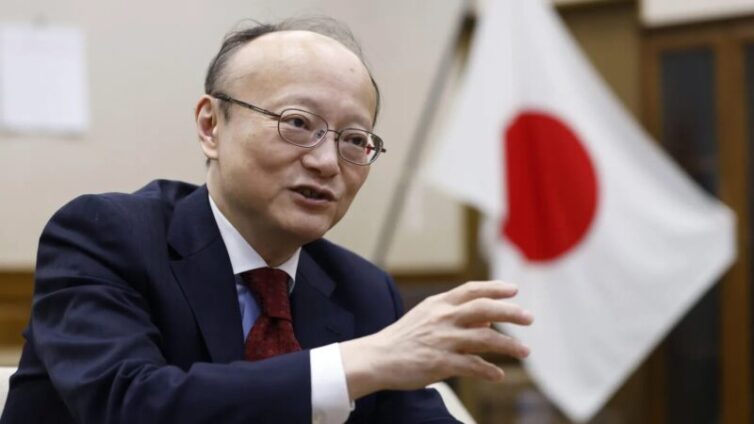
For several years, Masato Kanda hardly slept.
"Three hours a night is an exaggeration," he laughs as he speaks to the BBC from Tokyo.
"I slept for three hours consecutively before being woken up but I then went back to bed, so if you add them up, I got a bit more."
So why was this 59-year-old bureaucrat's schedule so punishing?
Until the end of July, he was Japan's vice finance minister for international affairs, the country's top currency diplomat, or yen czar.
Key to the role was fending off currency market speculators that could trigger turmoil in one of the world's largest economies.
Historically, authorities intervened to weaken the value of the Japanese currency. A weak yen is good for exporters like Toyota and Sony as it makes goods cheaper for overseas buyers.
But when the yen plummeted during Mr Kanda's time in office it increased the cost of importing essential items like food and fuel, causing a cost of living crisis in a country more used to seeing prices fall rather than rise.
In his three years in the role, the value of the yen against the US dollar weakened by more than 45%.
To control the yen's slide, Mr Kanda unleashed an estimated 25 trillion yen ($173bn) to support the currency, marking Japan's first such intervention in almost a quarter of a century.
"The Bank of Japan and the Ministry of Finance are very clear. They intervene not at a particular level of the currency, but they intervene when market volatility is too much," says economist Jesper Koll.
Japan now finds itself on the US Treasury's watchlist of potential currency manipulators.
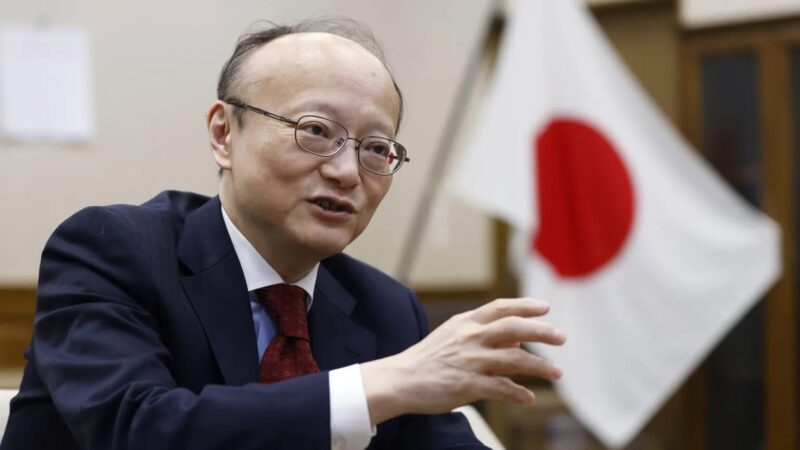
But Mr Kanda argues that what he did was not market manipulation.
"Markets should move based on fundamentals but occasionally they fluctuate excessively because of speculation, and they don't reflect fundamentals which don't change overnight," he says.
"When it affects ordinary consumers who have to buy food or fuel, that is when we intervened."
While countries like the US and UK can raise interest rates to boost the value of their currencies, Japan had for years been unable to put up the cost of borrowing due to the weakness of its economy.
Professor Seijiro Takeshita of the University of Shizuoka says Japan had no other option other than to intervene in the currency markets.
"It is not the right thing to do, but in my opinion, it is the only thing they can do."
The irony is that the yen's value jumped in recent months without Mr Kanda or his successor lifting a finger after the Bank of Japan surprised the markets with a rate hike, and the country got a new prime minister.
So was the $170bn bid to prop up the yen a waste of money?
No, says Mr Kanda and points out that his interventions actually made a profit although he emphasises that it was never a goal.
On whether or not his actions were ultimately successful he says: "It is not up to me to evaluate, but many say our exchange management stopped the excessive level of speculation."
Markets or historians should be the final judges, he adds.
After decades of economic stagnation, Mr Kanda also sounds an optimistic note about Japan's prospects.
"We are finally seeing investments and wages rising, and we have a chance to go back to a normal market economy," he says.
A more surprising legacy for this "humble public servant" is his becoming a star on the internet after Japanese social media users celebrated his ability to surprise financial markets with a series of AI-generated dancing videos.
7月末で辞める神田財務官
— 音速のGOX(2冠)⚡️ (@GOXGOXGOX2) July 11, 2024
最後の為替介入
pic.twitter.com/MzfbuSQllX
Latest Stories
-
Gender Ministry supports Harriet Amuzu in ongoing abuse case
5 seconds -
AG joins plaintiff to scrap OSP ?: We should be mindful of the mischief in this – Bobby Banson
6 minutes -
Samson Lardy Anyenini questions willingness of Attorneys-General to prosecute political colleagues
9 minutes -
It is only fair the OSP is heard in Supreme Court case – Bobby Banson
14 minutes -
Asiedu Nketia resumes Ashanti tour, second leg kicks off on Sunday
23 minutes -
NLA denies salary cut claims, threatens legal action over reports
27 minutes -
BoG Governor honoured for stabilising cedi, improve inflation
29 minutes -
Trade Minister applauds GUTA as a pillar of economic growth; Prez Mahama honoured
1 hour -
President’s brother’s takeover of Damang Mines is ‘untidy’ – Alhassan Tampuli
2 hours -
It’s not true that gov’t decided not to renew the lease for Gold Fields – Bobby Banson
2 hours -
Ghana to boost tomato production with 60-hectare irrigated farms and processing initiatives
2 hours -
E&P’s takeover process of Damang Mines was very clean – Inusah Fuseini
2 hours -
Damang takeover: There is not going to be any job loss; it is a lease change – Bobby Banson
2 hours -
Gold Fields didn’t stop mining at Damang mines; such claims are untrue – Bobby Banson
3 hours -
Engineers and Planners currently operate only in Ghana – Bright Simons
3 hours