

Audio By Carbonatix
I remember standing backstage at a mid-size festival in Accra — watching an artist with genuinely rare ability perform to a crowd that didn't know his name. He had the sound. He had the stagecraft. What he didn't have was a manager who had filed his publishing rights, a booking agent who could convert that night into a regional tour, or even a basic rider that communicated his value before he walked on stage. He performed brilliantly. And then he went home, the same as before.
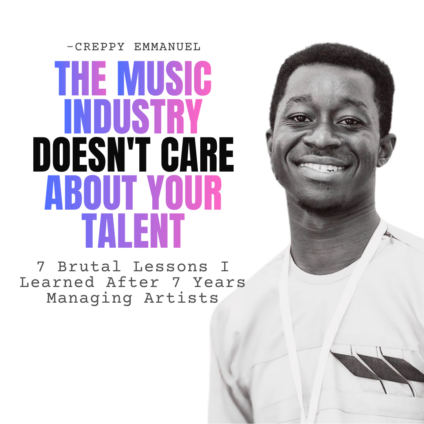
The music industry has a habit of confusing success with visibility, and visibility with value. After seven years working across talent recruitment, branding strategy, event production, and artist management in West Africa and beyond, one thing is clear: the industry rewards structure, not noise.
A generation of African artists is rewriting what global music sounds like. But sound travels faster than structure — and that gap is where careers get lost. These lessons came from being in those gaps.
1. Keep Career Business — Business
There is a dangerous culture in creative spaces where friendship replaces structure. It is expensive.
From managing emerging talents to working with established acts, I have watched projects collapse — not because of lack of talent, but lack of clarity. Agreements were verbal. Roles were assumed. Expectations were personal.
I once watched a promising duo dissolve — not over music, not over money, exactly — but over an assumption. One believed he owned the masters. The other believed they were shared. Neither had thought to write it down. The project ended. So did the friendship.
The correction is simple but often resisted: sign contracts. Define deliverables. Set timelines. Build in room for honest feedback.
Contracts do not destroy relationships. They protect them. They remove ambiguity, and in doing so, they preserve respect.
I learned some of this the hard way — sitting in rooms where a handshake had replaced a contract, watching good talent and genuine friendships dissolve at the same time.
2. Build Community, Not Just Audience
Streams can be bought. Loyalty cannot.
Many artists chase numbers — viral moments, quick spikes, audiences that arrive like weather and leave the same way. What sustains a career is not traffic. It is culture.
In event production, the most successful shows I have been part of were not always the biggest. They were the most connected. The fans knew the artist. The artist knew the fans. There was a shared identity between them.
Some of the most commercially underestimated artists I have worked with in West Africa had communities that were ferociously loyal — fans who showed up, shared without being asked, and returned. When regional label interest eventually came, it came because of that groundwork, not despite its modesty.
The artists who crossed over internationally did not do so because algorithms found them first. They had communities that believed before the numbers did. Stay human. Stay reachable. Speak in a way your audience actually feels.
3. Let Your Values Lead Your Art
There is consistent pressure in this industry to perform identities that are not real. It may sell in the short term. But it fractures something that is very difficult to repair.
I have worked on branding campaigns where the temptation was to repackage an artist into something more commercially aggressive. The strongest brands we built were always the ones aligned with who the artist actually was.
If you cannot stand by your message in front of the people who raised you, that is worth examining. If your art consistently contradicts your values, it will eventually contradict your growth.
Be deliberate about the environments you move in and the collaborations you accept. The rooms you enter shape your output more than most artists acknowledge — wrong circles wear you down quietly, and the cost only becomes visible later. Clarity in art is not accidental. It is guarded.
Fame without integrity is unstable. And instability does not build legacy.
4. Respect the Ecosystem — All of It
The music industry looks wide. It operates in tight circles.
A sound engineer today could be a label executive in three years. A journalist you dismiss today could shape the narrative around you next year. In managing collaborations and events, I have seen how respect travels faster than any promotional campaign. So does the opposite.
Treat everyone — creatives, media, backstage crew, junior managers — with basic dignity. In this industry, reputation builds quietly over time until it becomes either your greatest currency or your most significant liability.
That same principle extends inward — to the personal relationships closest to your process. Professional ecosystems can be built and rebuilt. Personal trust, once broken, is harder to restore. Be transparent with the people who will need to stand for you when things go wrong. Give them the real picture, not the managed version.
Not every connection deserves proximity to your process. And not every situation deserves an emotional response.
5. Be Strategic With Your Voice — Especially in Interviews
Interviews are not conversations. They are permanent records.
In artist development, I have had to step in after poorly handled interviews that misrepresented an artist's identity or position. The damage is rarely immediate — but it accumulates.
Before any interview, ask: why this platform? What message am I reinforcing? What perception am I building or confirming?
Prepare. Align your narrative. Because once it is said, it belongs to the public — and the public holds onto things selectively.
6. Treat Art as an Asset, Not Just Expression
Art is emotional. It is also economic.
Too many artists create without understanding ownership, royalties, publishing, or long-term monetisation. The biggest regret I have heard from talents I have worked with was rarely about exposure. It was about the lack of structure around what they had already built.
I once sat across from an artist whose streaming numbers had tripled in eighteen months. He owned nothing — not a single master, no publishing registration, no performance royalty account. The money had moved. None of it had stopped with him. That conversation was not unusual. It should have been.
Your music, your brand, your name — these are assets. They should generate income beyond performances. They should be documented, protected, and structured for scale.
If you do not know where to start: in Ghana and across West Africa, organisations like the Ghana Music Rights Organisation (GHAMRO) and ECOWAS-affiliated creative economy initiatives exist specifically to help artists formalise ownership. Ask. The system is imperfect, but it is there.
Build systems that allow your work to sustain others, even when you are no longer in the room.
7. Evolve Deliberately — And Collaborate Across Disciplines
The industry shifts constantly. Platforms change, audience behaviour moves, trends come back wearing different clothes.
The error is either refusing to adapt entirely, or chasing every new wave without any sense of direction. Both are expensive.
Some argue that structure constrains creativity. In practice, the opposite tends to be true. Structure is what gives creativity somewhere to go. The most effective growth I have witnessed comes from alignment — where an artist's evolution stays connected to their core identity rather than abandoning it for relevance.
Stay informed. Study what is actually working and why. Collaborate across fields — music, technology, fashion, policy, media. Because art expands when it intersects with something beyond itself.
The Real Advantage Was Never Talent
Talent gets you in the room. Structure keeps you in the building.
The artists who endure understood this early — that a career is not one performance, one viral moment, or one great song. It is the thousand small decisions made between those moments that nobody sees and everybody eventually feels.
These are not rules. They are anchors.
The real advantage was never talent. It was always the work behind the work.
Latest Stories
-
Knights and Ladies of Marshall group backs Catholic Bishops’ stance on anti-LGBTQ+
32 minutes -
Bright Simons writes: All the Filla in the Ibrahim Mahama/E&P – Gold Fields Saga
56 minutes -
Monetise Idiocy In Ghana
1 hour -
The Ghanaian prophet and the mysterious death of his scottish wife Charmain Speirs
2 hours -
Nearly 400 sentenced in Nigeria for links to militant Islamists
2 hours -
Ghana’s recovery supported by gold strength despite global oil price pressures – Standard Bank Research
2 hours -
Methodist Church hails Mfantsipim@150; calls for “fresh consecration” to excellence
3 hours -
‘Excellence is our inheritance’ – Nana Sam Brew-Butler hails Mfantsipim’s 150-year reign in leadership
3 hours -
Kwaku Azar writes: A-G vs OSP
3 hours -
Mfantsipim–Adisadel rivalry built excellence, not division – Sam Jonah
3 hours -
Vice President launches Mfantsipim’s 150 years of shaping Ghana’s greatest mind
4 hours -
I assure Otumfuo, Mahama will join him to commission KNUST Teaching Hospital by end of this year – Haruna Iddrisu
4 hours -
Barcelona dominate derby to extend La Liga lead
4 hours -
Gov’t to roll out free special education for persons with disabilities from July 1 – Education Minister
5 hours -
Importers and Exporters Association declares full support for Publican AI port system
5 hours