

Audio By Carbonatix
First unveiled to a somewhat muted response back in 1963, Rolex's Cosmograph Daytona model went on, over the six decades that followed, to become arguably the most important motor racing-adjacent timepiece on the market.
Versions of the Daytona are given out as prizes to first-place winners at the legendary 24 Hours Of Le Mans and 24 Hours Of Daytona races, but it was improbably handsome motor racing fan Paul Newman – an early proponent of bicolor dial Daytona wristwatches – who helped secure the model's place in horological history.
One piece from Newman’s collection, which went up at Phillips' “Legendary Watches Of The 20th Century” auction in 2017, became, at the time, the most expensive wristwatch ever sold. It fetched a cool $17.8 million.
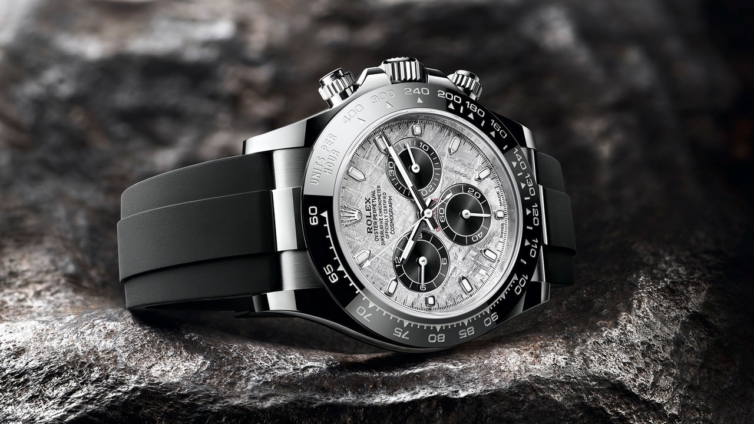
Today, by way of a characteristically slick virtual presentation as part of the digital Watches And Wonders Geneva watch fair 2021, Rolex unveiled three new additions to the Oyster Perpetual Cosmograph Daytona family, all of which come furnished with dials crafted from a meteorite.
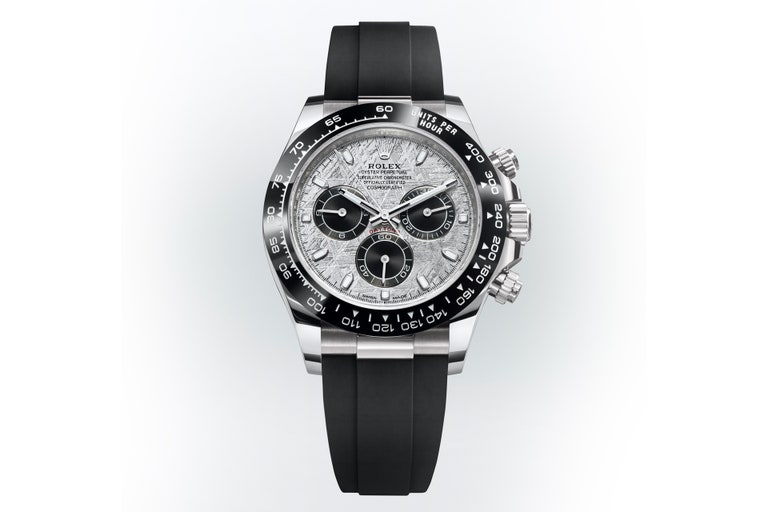
The first – and perhaps our favorite – iteration is housed in 18-carat white gold. Fitted with both a monobloc Cerachrom bezel and extra-comfortable Oysterflex bracelet, the glinting Widmanstätten pattern of the meteorite dial affords it an otherworldly quality. It’s the kind of thing one could imagine Elon Musk wearing on his personal race into space, channeling Newman's more terrestrial straight, long since completed.
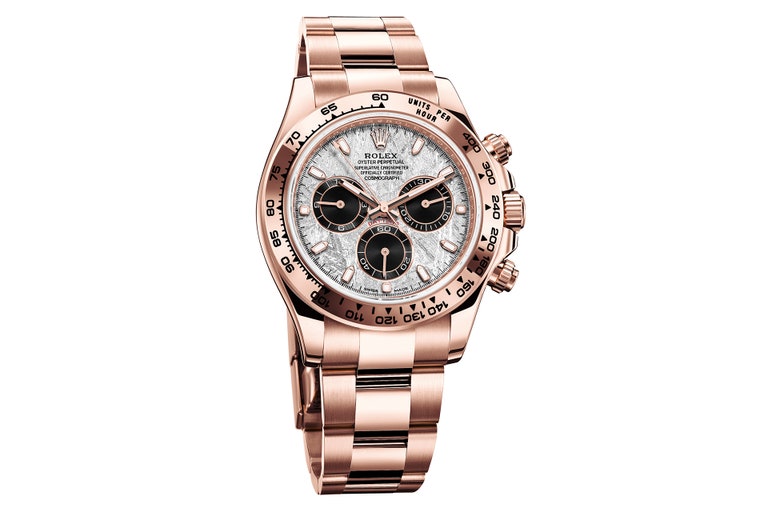
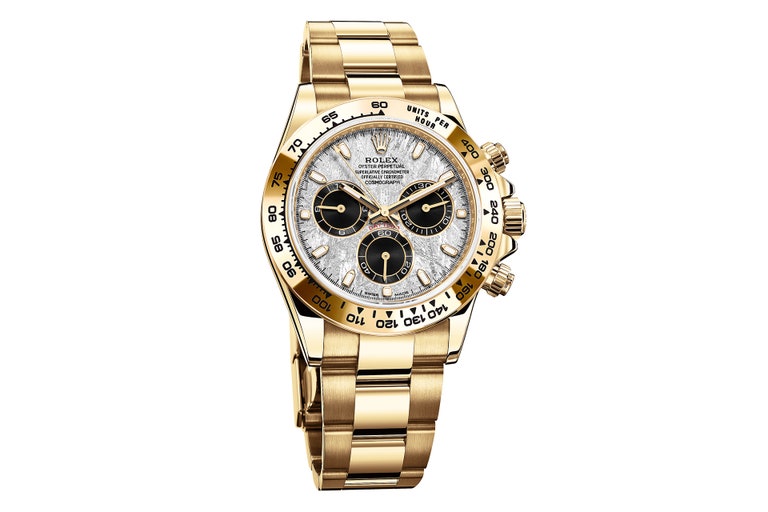
The other two timepieces in the new collection are crafted from 18-carat Everose gold and 18-carat yellow gold respectively. Each watch comes fitted with Rolex’s calibre 4130 movement – a self-winding mechanical chronograph with an impressive 72-hour power reserve – boasting the Superlative Chronometer certification, guaranteeing −2/+2 seconds accuracy per day.
It’s the aforementioned meteorite dials, however, which really set these new timepieces apart from the other motor racing-focused chronographs being released this year. Created from extraterrestrial rock formations that exploded in space millions of years ago, every one of the dials – each of which are unique to each watch – are cut from ultrathin sections of the iron and nickel material, revealing the distinctive crystallised pattern within.
Coming in at £27,350 for the white-gold version and scaling up to £32,900 for the yellow gold and £35,100 for the Everose gold, each piece in the new Daytona Cosmograph collection will be available from around June onwards. So you'd better get yourself into hyperdrive if you want to get your hands on one.
Latest Stories
-
AFCON 2027Q: ‘Our Black Stars team is gone’ – Former Sports Minister
9 minutes -
Prof. Prempeh calls for public review of draft constitutional reform bills
21 minutes -
AFCON 2027Q: ‘I have never seen a poor performance from Black Stars like against Gambia’ – Nii Lante Vanderpuye
26 minutes -
Nigeria set to launch National Digital Address System 9 years after Ghana showed the way
49 minutes -
Policy rate decision takes time to reflect in lower lending rates – BoG
59 minutes -
Western Regional Minister applauds Karpowership’s role in Ghana’s power sector
1 hour -
Livestream: Road safety crises: Where are we getting it wrong?
1 hour -
Enterprise Life celebrates 25 years of protecting families and building trust
2 hours -
ICC London rules in favor of Ghana against Tullow over $400m tax charge
2 hours -
We are disappointed in ICC’s ruling over our corporate income tax assessment in Ghana – Tullow Oil
2 hours -
Cost of building inflation for August 2026 increases to 4.6% – GSS
2 hours -
Today’s front pages: Wednesday, September 30, 2026
2 hours -
Bawumia highlights agricultural, compulsory insurance reforms in IBAG engagement
2 hours -
Ghana will secure Tullow tax revenues while protecting Jubilee, TEN investments – Ato Forson
3 hours -
Ghana wins $393m Tullow tax arbitration as tribunal upholds GRA assessment
3 hours