

Audio By Carbonatix
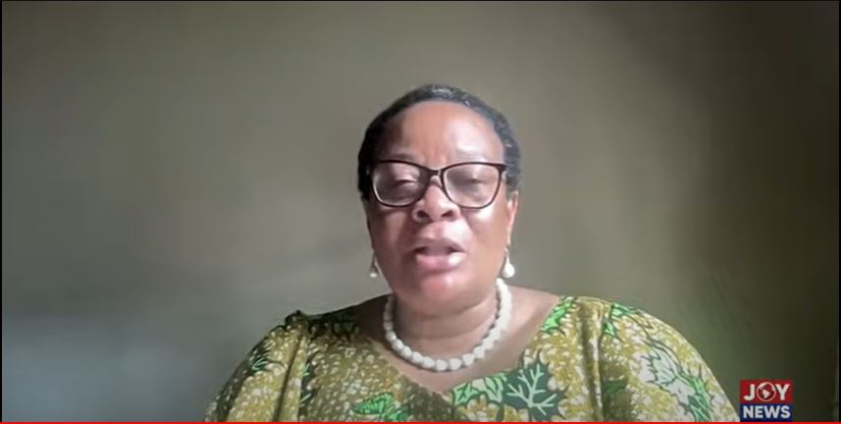
Executive Director of Transparency International-Ghana, Mary Addah, says the Office of the Special Prosecutor (OSP) was built on a structural weakness from the very beginning.
She insists these flaws have affected its work to this day.
Speaking on Joy News’ PM Express on December 8, she said the problems that inspired the creation of the office have not improved, and in some cases have worsened, because the institution was never given a proper foundation.
Host Evans Mensah began by asking whether the real problem was the person holding the office or the institutional design around it. Her response was clear. “So it is both. It is both.”
She explained that the country has seen what a proper rollout looks like, and she used the RTI Commission to make that point.
“Let me use the RTI example, for instance, to give you what we are talking about in the passage of the RTI law and the setting up of the commission. When the law was passed, we realised that there was a one-year cooling-off period to ensure that the office was set up and set up very well.”
According to her, Ghana did not follow the same standard when creating the OSP.
“In the case of the SP, when the law was passed, by February, the SP was appointed. He didn’t have space to even operate, and so the first SP had his issues of setting up office, which office he wanted and who he was going to work with. He didn’t have staff. And for about three years, we went up and down.”
She said this alone showed how poorly the institution was launched. “So structurally, we had a flaw, a serious flaw, there and then in the office.”
Addah also pointed to the long-standing concerns over independence and political interference.
“The issues around independence, either being substantive or otherwise, also remain a key problem, because we saw that in the execution of the mandate, we continue to see interference, and it led to the first SP leaving office and the second one taking office.”
She said public confidence made the situation worse.
“But then, even as we remember that the appetite of citizens as well, and at the time, in the fight against corruption, was very low.
"Because the trust levels were very low, we thought that the politician would do what they would do to get away with what they would do anyway. And so citizens' trust had dwindled...citizens believe.”
She said this lack of belief became deeper because of how some cases were handled.
“And this has been entrenched by some of the cases that have come through the office. For instance, in the issue of Cecilia Dapaah, we saw that this case didn’t go anywhere.
"And then now we also have the issue of the former Minister of Finance, who is also treading almost the same path and the trust of citizens, that’s why the voices are that loud.”
She admitted that institutions need time to take shape, but said that only works if the foundation is solid. “But it remains also true that in setting up an office, we should give them time to be able to settle in, to put in place structures.”
Evans asked whether eight years had not been enough. Her answer was simple. “Yes, it depends on what we have given them and how they are doing it.”
Latest Stories
-
Power restoration fault suspected in Kumasi Central Market fire
3 hours -
The 7-foot giant of Ngleshie Amanfro: Seven-foot Ghanaian Ephraim Saawa dreams of joining the national basketball team
4 hours -
Government promises support for Kumasi Central Market fire victims
4 hours -
Vibes The Movie: Big Ghun’s Ghanaian film earns five nominations at 2026 REFFA
4 hours -
MamaCare CEO warns unresolved conflicts among health workers could undermine maternal and neonatal care
5 hours -
Health professionals urged to translate medical knowledge into practice to save mothers
5 hours -
Conflicts among care providers linked to maternal, neonatal deaths – Expert
6 hours -
GIS marks 10th TIME conference, champions improved teaching practices
6 hours -
BRICS Or Balance? What Ghana’s bid really means
7 hours -
GPRTU wants full TRAFFITECH-GH implementation to start in 2027
7 hours -
Mahama announces plans to import electric wheelchairs for PWDs
7 hours -
KGL U17 Colts 2026: Western beat Prempeh Elite Academy to set up final final with Greater Accra Region
8 hours -
Late Solanke strike salvages 10-man Spurs draw at Man United
8 hours -
Gender Ministry to monitor welfare of Nana Akua Addo’s children amid domestic violence case
8 hours -
Benedict Okyere Yeboah: Ghana’s football problem goes beyond sacking a coach
8 hours