

Audio By Carbonatix
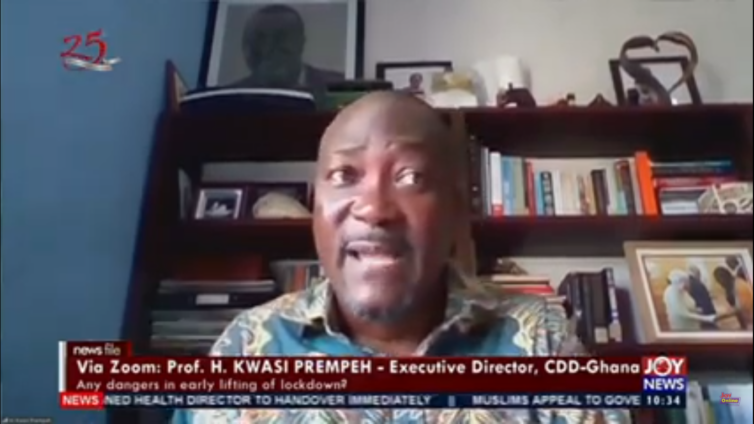
The Executive Director of the Centre for Democratic Development (CDD) has debunked claims that government’s annulment of the partial lockdown is ill-timed.
Professor Henry Kwasi Prempeh said there is no science-informed directive on when the best time is to implement or lift national lockdowns.
“This is an evolving situation and there is a whole lot of variation to countries’ responses,” he said on Joy News’ Newsfile, Saturday.
“I don’t have an answer to whether or not the lockdown was lifted too soon or not. I don’t know what another week or two would have accomplished,” he said.
Prof. Prempeh noted that the varying measures being experimented across the world provides an opportunity to choose the most suitable way to deal with the spread of coronavirus.
His comments come after a massive outcry followed President Nana Akufo-Addo's lifting of the restriction on movement after three weeks of enforcing a partial lockdown.
The decision was to enable the country contain cases of Covid-19 which keeps rising. The lockdown according to government was to give it time to do more testing and contact tracing of people who may have come into contact with some affected persons.
While some Ghanaians were relieved to get back to work, others were left fretting after Ghana became the first in Africa to lift a coronavirus lockdown.
Commenting on the development, Prof. Prempeh said, “The political authorities based on their own estimate had a particular view of a lockdown and we as a country could not go for the India- style or Wuhan style lockdown.
"When you look at the Ghana lockdown, in some parts, even the limited one wasn’t being enforced. Our capacity to mitigate the social consequences was considerably weak” Kwasi Prempeh said.
The law Professor added that behavior modification by individuals is key in trying overcoming the Covid-19 outbreak.
According to him, it appears the state has reached it’s the limit of its capacity in terms of enforcing a lockdown.
Meanwhile, he has called for the intensification of public education on the need to protect oneself by adhering to the WHO protocols of staying safe.
He appealed for more uncompounded information on the spread of Covid-19 in the country to enhance attitudinal change.
“I think the information has been aggregated at the national level. We need a lot of disaggregated data to know how the virus is behaving in our midst.
"We need to know where it is in terms of hotspots, clusters because it is about us and our livelihood,” he stated.
Latest Stories
-
Benedict Okyere Yeboah: Ghana’s football problem goes beyond sacking a coach
2 minutes -
GPL 2026/27: Darkwah Wiafe’s winner sees All Blacks beat Kotoko
7 minutes -
ITF World Tour : Patel Wins Boys’ Singles Final at J100 Accra
20 minutes -
Ghana must pursue BRICS partnership if it brings economic benefits – Kpebu
23 minutes -
Success and Wright Claims J100 Accra Girls’ Doubles Championship
24 minutes -
ITF J100: America’s Wright wins J100 Accra Girls’ Singles Title
30 minutes -
Expedition hopes to find aviator Amelia Earhart’s plane on remote island
31 minutes -
US seeks changes to rejected $109m health compact with Ghana – Mahama
1 hour -
Nine dead in mass shooting at Pennsylvania home
1 hour -
‘Time for Ukraine to get new president,’ says Trump after Zelensky condemns diesel deal
1 hour -
Hincapie injury adds to Arsenal issues after Guimaraes rescue act
1 hour -
Henderson scores twice as Chelsea thumb Bournemouth
2 hours -
Photos: Mentapulse Africa convenes health and labour summit to address talent retention
2 hours -
Mahama inspects Nkokɔ Nketenkete plant, eyes Bechem as chicken capital
2 hours -
Ghana not seeking full BRICS membership, applying as Partner Country – Ablakwa
2 hours