

Audio By Carbonatix
More than 2,700 people may have died from heat-related causes during the UK's exceptionally hot weather in May and June, experts' estimates suggest.
The figure, from a team at Imperial College London, the Met Office and the London School of Hygiene and Tropical Medicine, is based on what's known about the dangers of extreme heat.
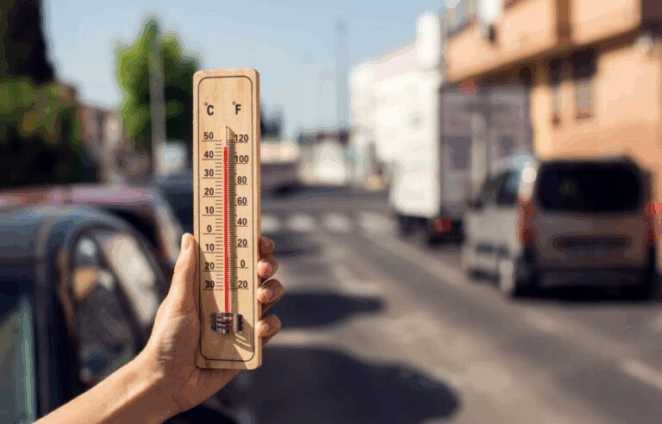
Most deaths will have occurred in the June heatwave, they say - the warmest June on record in England, when temperatures hit 37.7C (99.9F) at Lingwood, Norfolk, smashing the previous high of 35.6C (96F) set in 1957.
A rare red heat alert was issued for parts of England and Wales at the time, warning even healthy people of the significant risk to life.
Silent killer
May temperatures, meanwhile, hit a new UK high of 35.1C at Kew Gardens on May 26 – a significant increase on the previous high mark of 32.8C, which had been set back in 1922 and equalled in 1944.
Both heatwaves were caused by a "heat dome" - a stalled area of high pressure that trapped hot air over the region, say experts.
The heat dome was made worse by human-induced climate change, the researchers say. This has warmed the planet by around 1.4C since pre-industrial times and scientists believe it added between 3 and 4C to the maximum temperatures recorded in May and June.
Hot tropical nights added to the sweltering conditions, offering little respite.
Many UK homes are not built to cope, leaving people vulnerable to prolonged, high temperatures.
Heat puts immense physical strain on the body, made worse if you are dehydrated, with the heart pumping harder and faster to cool you off.
Babies and older people are among those most at risk of harm, as well as those with existing health conditions.
It can lead to more heart attacks, strokes and other potentially fatal emergencies.
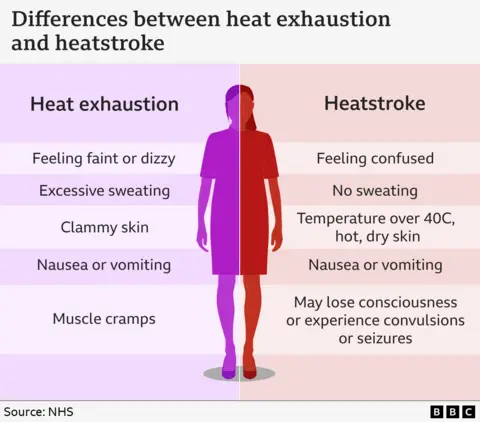
Intense heat can affect anyone, including fit and healthy people, and is dubbed a 'silent killer' because early symptoms are easily overlooked.
And when the hot air is very wet or humid, like it was in June, it's more difficult for the body to cool down through sweating.
Heatwaves could become more frequent
The study uses death records from previous years to model or estimate how many there might have been in May and June 2026.
It makes assumptions about how badly people were affected by the heat, so the findings may not play out.
One of the researchers, Dr Clair Barnes, who is an expert in extreme weather and climate change at Imperial College London, said: "If by putting out these estimates we highlight to people how dangerous it is and they change their behaviour next time there's a heatwave and our estimates turn out to be high, I will be thrilled.
"These are big numbers and we don't want to see this many people dying."
Experts thought 2025 was going to be a very bad year for heat-related deaths, but the numbers who died turned out to be much lower than expected - roughly half the 3,039 predicted.
Heat health alerts, alongside action taken across the NHS and care system are likely to have reduced the impact, the UKHSA said.
Some of the researchers believe, on current trajectories, heat-related deaths in parts of northern Europe could begin to rival cold-related ones within a couple of decades – though they stress that outcome depends heavily on how fast the world cuts climate emissions and how well countries adapt.
Heatwaves are expected to become more frequent, more intense and longer-lasting the more greenhouse gases are emitted.
Latest Stories
-
Mr President, Ghana was mentioned at the UN; why aren’t we talking about it?
45 minutes -
Accra to convene Africa’s regulators and markets on tokenisation at AVAS 2026
47 minutes -
The Paradox of Plenty — When every smartphone becomes a newsroom
1 hour -
GTA sensitises taxi drivers in ‘Know Ghana’ tourism campaign
3 hours -
Archbishop Agyinasare calls for responsible speech amid growing social media abuse
3 hours -
‘It will be inexcusable for gov’t not to honour payment of teachers’ arrears by 30th October’ – Haruna Iddrisu
3 hours -
Forbes’ World’s Best Employers 2026: No Ghanaian firm ranked among 900 companies
3 hours -
Electronic processing of teachers’ data: ‘The decision is the Controller’s’ – GES boss
3 hours -
Teachers’ Strike: Haruna Iddrisu questions paper-based processing of promoted teachers’ data
3 hours -
Savannah Region: Kunfusi bridge collapses again, leaving nearly 4,000 residents cut off
3 hours -
Teachers’ strike: GES targets Monday deadline to submit promotion data to Controller
3 hours -
Inflation to average 11.3% in 2027 – Fitch Solutions
4 hours -
‘I didn’t campaign for NDC to come and do this nonsense’ – Kpebu on EOCO’s conduct
4 hours -
Fitch Solutions maintains policy rate forecast of 14% by December 2026
4 hours -
Diaspora Nasara Caucus congratulates Mohammed Ali Suraj, new NPP executives
5 hours