

Audio By Carbonatix
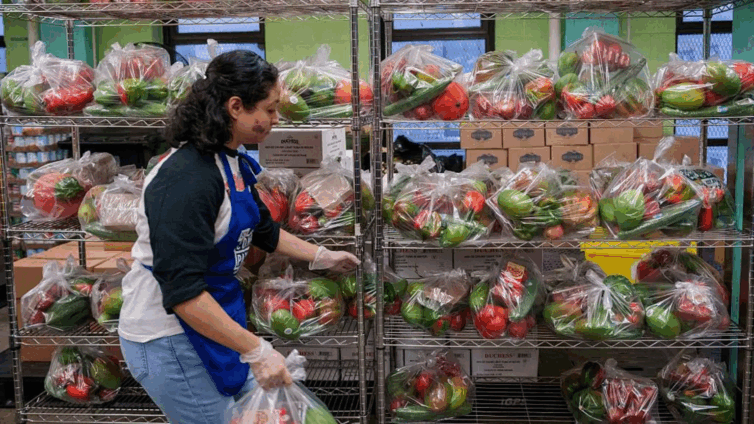
US President Donald Trump's administration has said it will provide reduced food aid to more than 42 million Americans, as the government shutdown this week heads towards becoming the longest ever, with no resolution in sight.
The US Department of Agriculture (USDA) said in a court filing that Americans who receive food assistance will get half their normal monthly allotment after the government dipped into emergency funding.
Judges had given the Trump administration until Monday to provide a plan for how it would pay out Supplemental Nutrition Assistance Program (SNAP) benefits, also known as food stamps.
Funding for the programme has been in limbo due to the more-than-month-long shutdown.
While individual US states administer the benefits, the programme relies on money from the federal government, which has been unfunded and shut down since 1 October.
States will get clarity on how they are to distribute the reduced funds by the end of the day on Monday.
Federal judges in Massachusetts and Rhode Island ruled that the USDA needs to use $5.25bn (£4bn) in emergency funds to make at least partial payments to Americans on SNAP.
Snap costs about $8bn per month.
The judges both said the Trump administration could use the money set aside for contingencies to provide the benefits.
President Trump previously said he had instructed government lawyers to ask the courts how the administration could legally fund Snap, adding: "Even if we get immediate guidance, it will unfortunately be delayed."
On Sunday, Treasury Secretary Scott Bessent said in a CNN interview that the president wanted to hear from the courts about how to legally move money around to fund Snap payments, but they could go out as soon as Wednesday.
"There's a process that has to be followed," Bessent said. "So, we've got to figure out what the process is."
Late last month, the USDA said it would not distribute food-assistance funds starting 01 November because of the shutdown, saying: "The well has run dry."
Half the states and the District of Columbia sued the administration over the food-aid freeze and argued that they had a legal obligation to keep the programme running in their jurisdictions.
Separately, cities and non-profits also filed a lawsuit. Some states said they would use their own money to fund Snap benefits.
Snap allows many low-income Americans to buy groceries. It provides them reloadable debit cards that they can use to buy food.
A family of four on average receives $715 per month, which breaks down to a little less than $6 per day, per person.
Latest Stories
-
Association of Small-Scale Industries empowers trade executives in Bono East with a mentorship programme
5 minutes -
AMA evacuates refuse along Graphic Road, warns against indiscriminate dumping
10 minutes -
STC interdicts driver over Pokuase overtaking incident
14 minutes -
Ekumfi: How $6m EXIM participation built a $53m industrial asset — now poised for a 24-Hour Economy breakthrough
15 minutes -
4 arrested, 142 parcels of suspected Indian hemp seized as officers reject GH¢50k bribe
15 minutes -
No MMDCE can say they don’t see galamsey – Local Government Ministry
17 minutes -
Ghana, Germany explore stronger partnership in technical and vocational education
23 minutes -
AMA urges motorists and road users to comply with traffic regulations
24 minutes -
Sam George urges One Million Coders participants to complete all three levels
24 minutes -
Communications Minister announces 2,800-site telecom expansion during Volta visit
26 minutes -
Impunity fuelling sexual abuse in Ghana – Angela Dwamena-Aboagye
27 minutes -
NUGS condemns alleged sexual abuse by Obuasi SHTS headmaster, calls for prosecution
31 minutes -
President Mahama urges investors to employ trained local residents as 1,238-acre industrial park takes off
34 minutes -
Media doing its job, but politicians fuelling insults on social media – NMAG president
36 minutes -
Child protection must be the state’s responsibility, not NGOs’ burden – ARK Foundation Boss
42 minutes