

Audio By Carbonatix
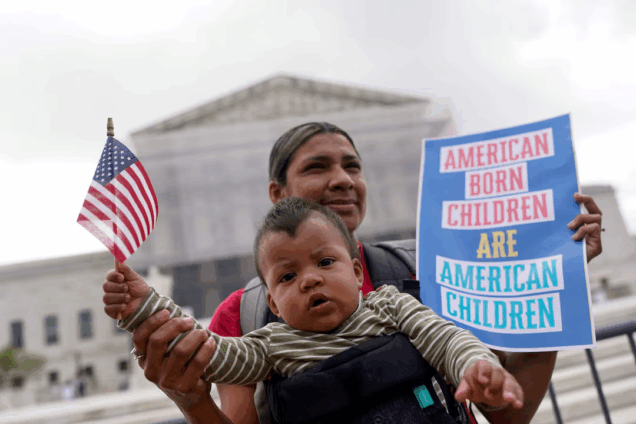
President Donald Trump's administration will not deport children deemed ineligible for U.S. citizenship until his executive order curtailing birthright citizenship takes effect on July 27, a government lawyer said on Monday after being pressed by two federal judges.
During separate hearings in lawsuits challenging Trump's order, U.S. District Judges Deborah Boardman in Greenbelt, Maryland, and Joseph LaPlante in Concord, New Hampshire, set expedited schedules to decide whether the order can be blocked again on grounds that the U.S. Supreme Court's ruling on Friday, opens new tab curbing the ability of judges to impede his policies nationwide does not preclude injunctions in class action lawsuits.
Both judges asked U.S. Department of Justice lawyer Brad Rosenberg, who represented the government in both cases, for assurances that the Trump administration would not move to deport children who do not have at least one parent who is a U.S. citizen or legal permanent resident at least until the executive order takes effect.
Rosenberg said it would not, which Boardman and LaPlante respectively asked him to confirm in writing by Tuesday and Wednesday.
In the Maryland case, immigrant rights advocates revised their lawsuit just a few hours after the 6-3 conservative majority U.S. Supreme Court on Friday ruled in their case and two others challenging Trump's executive order. The New Hampshire lawsuit, a proposed class action, was filed on Friday.
The Supreme Court ruling did not address the merits or legality of Trump's birthright citizenship order, but instead curbed the ability of judges to issue "universal" injunctions to block the Republican president's policies nationwide.
But while the Supreme Court restricted the ability of judges to issue injunctions that cover anyone other than the parties appearing before them, Justice Amy Coney Barrett's opinion held out the possibility that opponents of a federal policy could still obtain the same type of relief if they instead pursued cases as class actions.
William Powell, a lawyer for immigration rights groups and pregnant non-citizen mothers pursuing the case, told Boardman at a hearing on Monday that an immediate ruling was necessary to address the fears and concerns migrants now face as a result of the Supreme Court's decision.
"They want to see how fast we can get class relief because they are afraid about their children and their babies and what their status might be," Powell said.
Trump's executive order, which he issued on his first day back in office on January 20, directs agencies to refuse to recognise the citizenship of U.S.-born children who do not have at least one parent who is an American citizen or a lawful permanent resident, also known as a "green card" holder.
In Friday's ruling, the high court narrowed the scope of the three injunctions issued by federal judges in three states, including Boardman, that prevented enforcement of his directive nationwide while litigation challenging the policy played out.
Those judges had blocked the policy after siding with Democratic-led states and immigrant rights advocates who argued it violated the citizenship clause of the U.S. Constitution's 14th Amendment, which has long been understood to recognise that virtually anyone born in the United States is a citizen.
Immigrant rights advocates in the hours after the Supreme Court ruled swiftly launched two separate bids in Maryland and New Hampshire to have judges grant class-wide relief on behalf of any children nationally who would be deemed ineligible for birthright citizenship under Trump's order.
The Supreme Court specified that the core part of Trump's executive order cannot take effect until 30 days after Friday's ruling. Boardman on Monday pressed Rosenberg on what it could do before then.
"Just to get to the heart of it, I want to know if the government thinks that it can start removing children from the United States who are subject to the terms of the executive order," Boardman said at the end of the hearing.
Boardman scheduled a further briefing in the case to continue through July 9, with a ruling to follow. LaPlante scheduled a hearing for July 10.
Rosenberg said the Trump administration objected to the plaintiffs' attempt to obtain the same relief through a class action. He stood by the administration's view of the constitutionality of Trump's order.
"It is the position of the United States government that birthright citizenship is not guaranteed by the Constitution," he said.
Latest Stories
-
Association of Small-Scale Industries empowers trade executives in Bono East with a mentorship programme
6 minutes -
AMA evacuates refuse along Graphic Road, warns against indiscriminate dumping
11 minutes -
STC interdicts driver over Pokuase overtaking incident
15 minutes -
Ekumfi: How $6m EXIM participation built a $53m industrial asset — now poised for a 24-Hour Economy breakthrough
16 minutes -
4 arrested, 142 parcels of suspected Indian hemp seized as officers reject GH¢50k bribe
16 minutes -
No MMDCE can say they don’t see galamsey – Local Government Ministry
18 minutes -
Ghana, Germany explore stronger partnership in technical and vocational education
24 minutes -
AMA urges motorists and road users to comply with traffic regulations
25 minutes -
Sam George urges One Million Coders participants to complete all three levels
25 minutes -
Communications Minister announces 2,800-site telecom expansion during Volta visit
27 minutes -
Impunity fuelling sexual abuse in Ghana – Angela Dwamena-Aboagye
28 minutes -
NUGS condemns alleged sexual abuse by Obuasi SHTS headmaster, calls for prosecution
32 minutes -
President Mahama urges investors to employ trained local residents as 1,238-acre industrial park takes off
35 minutes -
Media doing its job, but politicians fuelling insults on social media – NMAG president
37 minutes -
Child protection must be the state’s responsibility, not NGOs’ burden – ARK Foundation Boss
43 minutes