

Audio By Carbonatix
US President Donald Trump has issued a sweeping new travel ban for people from 12 countries, revisiting a hallmark policy of his first term in office.
There are some key differences, however.
The original travel ban suffered a series of legal defeats. This time, the policy appears to have been designed to avoid the same pitfalls.
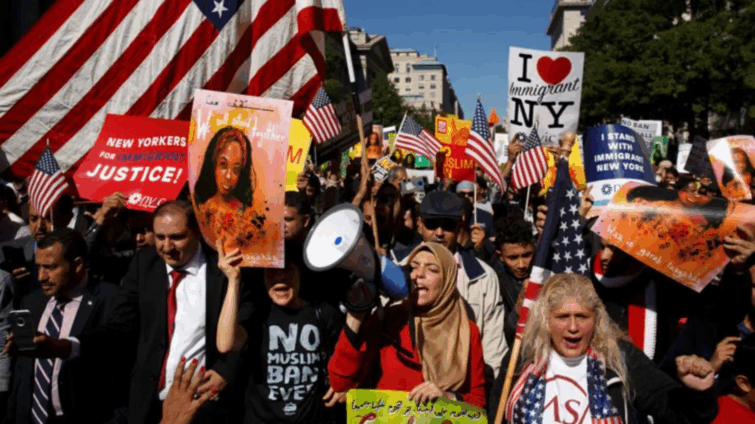
Its predecessor, which targeted seven predominantly Muslim countries and was dubbed the "Muslim ban" by critics, was ordered just a week after Trump took office in 2017, during his first term in the White House.
The ban was amended twice to overcome court challenges, after opponents argued it was unconstitutional and illegal because it discriminated against travellers based on their religion.
A scaled-back version was eventually upheld by the US Supreme Court in 2018, which this new ban closely resembles.
Legal experts told the BBC that it appeared Trump had learned lessons from his first attempt.
Christi Jackson, an expert in US immigration law at the London firm Laura Devine Immigration, said the new ban was more legally robust as a result.
While the first lacked "clarity", the new restrictions were "wider in scope" and had "clearly defined" exemptions, she said.
While there are some similarities in the nations chosen by the 2017 ban and the 2025 ban, Muslim-majority states are not the express target of the latest order.
Barbara McQuade, professor of law at the University of Michigan and former US attorney for the Eastern District of Michigan, told the BBC World Service's Newshour programme that, on this basis, it seemed likely to win the approval of the Supreme Court if it was ever referred up to that level.
The 12 countries subject to the harshest restrictions from 9 June are mainly in the Middle East, Africa and the Caribbean, including Afghanistan, Iran and Somalia.
There will be partial restrictions on travellers from another seven countries, including Cuban and Venezuelan nationals.
Trump said the strength of the restrictions would be graded against the severity of the perceived threat, including from terrorism.
But besides Iran, none of the 12 countries hit by the outright ban are named on the US government's state sponsors of terrorism list.
Trump cited Sunday's incident in Boulder, Colorado, in which a man was accused of throwing Molotov cocktails at demonstrators attending a march for Israeli hostages, in a video announcing the ban on X.
The alleged attacker was an Egyptian national. However, Egypt does not appear on either list.

Trump also specified high rates of people overstaying their visas as a reason for listing certain countries.
However, Steven D Heller, an immigration lawyer based in the US, said there was a "lack of clarity" over what threshold had to be met by a country's overstaying rate in order for that country to be placed on Trump's ban list. That could be the basis for a successful legal challenge, he suggested.
"If they're relying on this notion of excessive overstay rates... they have to define what that actually means," he told the BBC.
But he noted that existing US law gave the president broad powers over immigration policy.
Unlike the first ban, which was to last for only 90 to 120 days, today's order has no end date.
It has been met with dismay in the targeted countries.
Venezuela has described the Trump administration as "supremacists who think they own the world", though Somalia has pledged to "engage in dialogue to address the concerns raised".
The original ban spurred mass protests and sowed chaos at US airports.
It was repealed in 2021 by Trump's successor, President Joe Biden, who called the policy "a stain on our national conscience".
Immigration lawyer Shabnam Lotfi, who challenged the previous travel ban, said it would be an "uphill battle" to overturn the new one.
"The president does have the authority to determine who is admissible to the US," she said, adding that because of the way the ban had been written, it was "harder to find a huge group of people that could file a class-action lawsuit".
"They've put more thought into it."
Ms Lotfi noted that the new restrictions could have consequences for students and other visa applicants abroad.
"Students who are stuck in administrative processing are impacted. So are winners of the diversity visa lottery who paid fees and went to interviews - they're unlikely to get visas now," she said.
"Even EB-5 investors - people who've put over $1 million into the US economy - are affected. And H-1B visa holders stuck abroad, waiting to return to their US employers, could also be blocked."
Latest Stories
-
IMMILAC president recounts personal losses as security women lead breast cancer awareness campaign in Wa
7 minutes -
University of Ghana postpones October 12 reopening as GAUA strike persists
21 minutes -
Bahass Foundation launches vocational skills training to support mental health recovery in Wa
53 minutes -
NPP orders parliamentary aspirants and their supporters to suspend campaign activities
1 hour -
Techiman unites against child marriage: Joy Impact Makers Awardee leads charge on International Day of the Girl Child
2 hours -
Ghana Psychological Association calls for greater involvement of people with lived experience in mental health care
3 hours -
Ablakwa says Ghana could evacuate more citizens from South Africa if the situation worsens
3 hours -
Violence against girls must be tackled through individual responsibility – Gender advocate
3 hours -
Ghana’s BRICS bid must be guided by national interest – International Affairs Analyst
3 hours -
Journalists look back on a decade of breast cancer reporting in Ghana
4 hours -
President Mahama ends Resetting Ghana tour of Ahafo Region
6 hours -
African negotiators seek delivery of climate commitments at COP31
6 hours -
BoG develops AI rules for financial sector
6 hours -
‘Big Push’: Government assures contractors of prompt payments
6 hours -
Court fines miner for breaking into gold buying shop
6 hours