

Audio By Carbonatix
Rural communities yet to be connected to the national grid are presented with a challenging environment that impacts adversely on the livelihoods of farmers.
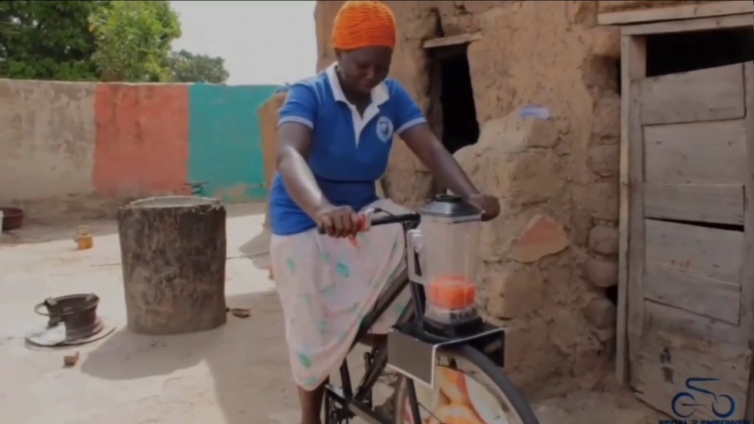
To ease their burden, a lecturer at the Takoradi Technical University developed blenders and shellers built on bicycles to support communities without electricity.
About 75% of households in Ghana’s regions of the north are farmers, but their inaccessibility to electricity makes it nearly impossible to live conveniently.

Women and children in such areas are heavily impacted by the lack of electricity.
Under the Pedal 2 Empower project, researchers at the Takoradi Technical University have designed a simple environmentally-friendly machine to aid residents in the Upper West Region.
The blenders and shellers are built on a bicycle frame which employs paddling to power the blades of the blender for cutting and shelling.
Team lead for the eco-friendly project, Kwadwo Asare Apori, explains the machine works efficiently by converting the energy from paddling into electricity.

“The machine employs the dynamo mechanism to power the blenders and sheller to function. The greater the force applied, the more efficient the machine works. This is actually sustainability designing,” he said.
Most residents in Ghana’s North are known for their adept skill in cycling as it is the major means of transport in most rural communities in the five regions.
“The bicycle blenders and shellers will be easily adopted by these communities,” Kwadwo Asare cites as one of the reasons for developing the machines.

The group built maize sheller, rice dehusker, and shea nut grinder for the communities including Mangu, Goli, Kperisi, and Manwe.
The pedal-powered machine not only provides convenience but a means to reduce carbon emissions.
“Because there’s no fossil fuel usage, the machine helps reduce greenhouse gas emissions. It helps in personal health improvement. This is a practical eco-friendly project. It can be used for educational purposes,” Kwadwo Asare added.

For users of the machine, this would ease the burden of grinding on stones and farming activities while boosting their health.
“This machine is a better alternative to the electric blenders. If have this machine at home, I will be able to prepare meals and blend spices. I sometimes have to hide or go to a friend’s place to use a blender,” one of the beneficiaries shared her experience with the machine.
The developers seek to extend the project to other regions as demand for the machine surges.
“If we have enough funding, we will be able to provide these machines freely to these communities to facilitate their domestic chores,” Kwadwo Asare appealed for support.
Latest Stories
-
NPP won’t force candidates to step down – Miracles Aboagye
4 minutes -
Black Stars: Building in the sinking sands
5 minutes -
Low inflation on paper, high cost of living: How Presidents Mahama and Trump are facing stark economic reality
13 minutes -
NPP will negotiate with popular non-politicians to secure winnable candidates – Miracles Aboagye
18 minutes -
Only 5% of Ghanaians can afford housing without support – Gov’t
18 minutes -
Nigeria launches rescue after military plane crashes with 32 aboard
24 minutes -
GES digitalisation already exists; restore discontinued platforms – Adutwum spokesperson
25 minutes -
Police launch manhunt for 7 after deadly Bunkprugu violence
27 minutes -
GTEC directs UDS to immediately cease unauthorised mode of delivering accredited LLB programme
30 minutes -
We must address the role of boys in impregnating young girls, not just blame girls – Kobby Kyei
32 minutes -
Mahama grants presidential pardon to 863 convicted persons
43 minutes -
Tema Central MP assaulted my driver – Ebi Bright alleges
59 minutes -
Gbande’s arrest directive confirms NPP’s claims of selective justice – Miracles Aboagye
1 hour -
US to announce $150 million for Alaska power lines as Vance campaigns in Senate battleground
1 hour -
Two CHPS compounds, educational facilities under construction in Keta – MP
1 hour