

Audio By Carbonatix
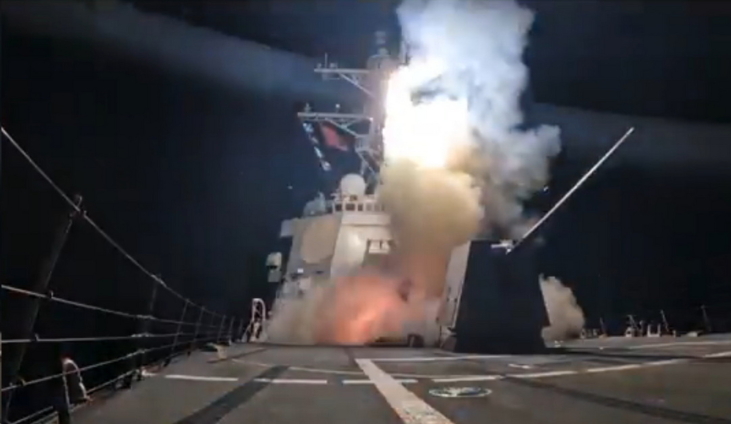
United States President Donald Trump announced Thursday that he ordered a "powerful and deadly" military strike against Islamic State militants in Northwest Nigeria. The operation, executed on Christmas Day, targeted what the president described as "ISIS Terrorist Scum" responsible for the persecution of Christians. Trump stated on Truth Social that he had previously warned these groups to "stop the slaughtering of Christians" or face "hell to pay." He characterised the mission as a series of "numerous perfect strikes" carried out by the "Department of War." In his concluding remarks, Trump wrote: "Under my leadership, our Country will not allow Radical Islamic Terrorism to prosper. May God Bless our Military, and MERRY CHRISTMAS to all, including the dead Terrorists, of which there will be many more if their slaughter of Christians continues."
U.S. Africa Command (AFRICOM) confirmed the strikes took place in Sokoto state, an area bordering Niger. "At the direction of the President of the United States and the Secretary of War, and in coordination with Nigerian authorities, U.S. Africa Command conducted strikes against ISIS terrorists in Nigeria on Dec. 25, 2025," the command stated. Initial assessments indicate that "multiple ISIS terrorists were killed in the ISIS camps." General Dagvin Anderson, commander of AFRICOM, added: “Our goal is to protect Americans and to disrupt violent extremist organisations wherever they are.” Defense Secretary Pete Hegseth echoed this sentiment on X, stating: "The President was clear last month: the killing of innocent Christians in Nigeria (and elsewhere) must end. The @DeptofWar is always ready, so ISIS found out tonight — on Christmas. More to come… Grateful for Nigerian government support & cooperation."
Nigerian Government maintains stance on religious neutrality
The Nigerian Foreign Ministry confirmed the joint operation, noting that "precision hits on terrorist targets" were achieved through intelligence sharing. Spokesperson Kimiebi Imomotimi Ebienfa clarified the partnership, stating: "The Ministry of Foreign Affairs... confirms that Nigerian authorities remain engaged in structured security cooperation with international partners, including the United States of America... This has led to precision hits on terrorist targets in Nigeria by air strikes in the North West." The ministry emphasized that "terrorist violence in any form, whether directed at Christians, Muslims, or other communities, remains an affront to Nigeria's values." This aligns with President Bola Ahmed Tinubu's November 1 post on X, where he argued that the "characterisation of Nigeria as religiously intolerant does not reflect our national reality" and that the nation "opposes religious persecution and does not encourage it."
On Christmas Eve, President Tinubu shared a "Christmas Goodwill Message" vowing to protect all citizens regardless of faith. "I stand committed to doing everything within my power to enshrine religious freedom in Nigeria and to protect Christians, Muslims, and all Nigerians from violence," Tinubu posted. His special adviser, Daniel Bwala, told CNN that "the US and Nigeria are on the same page in the fight against terrorism." However, Bwala previously warned against unilateral intervention, stating there is "no need for US to come into Nigeria to intervene in our internal affairs" while maintaining that the government would welcome help that respects territorial integrity.
Escalating intelligence and surveillance operations
Recent flight-tracking data confirms the Christmas Day strike was supported by a month-long surge in U.S. intelligence gathering. Since late November, Tenax Aerospace, a Mississippi-based contractor, has operated a modified Gulfstream V business jet on almost daily missions over Nigeria. Liam Karr, the Africa Team Lead for the Critical Threats Project at the American Enterprise Institute, noted: "In recent weeks, we've seen a resumption of intelligence and surveillance flights in Nigeria." Karr observed that these missions, typically launching from Accra, Ghana, represent an early sign that "Washington was rebuilding its intelligence and surveillance capacity in the region" following the U.S. withdrawal from air bases in Niger earlier this year.
Beyond tracking ISIS and Boko Haram, these flights serve a dual humanitarian purpose. A former U.S. official noted the missions include efforts to locate Kevin Rideout, an American missionary pilot kidnapped in neighboring Niger in October. The State Department emphasized its commitment to the safe return of U.S. citizens, stating: "It is a top priority for the Trump Administration to look after the safety of every American." This increased aerial presence underscores the "strategic security agreement" between U.S. Defense Secretary Pete Hegseth and Nigerian National Security Advisor Nuhu Ribadu, aimed at addressing what a separate administration official called the "destabilizing spread of terrorism."
Parallel Atrocities: The mosque bombing and kidnapping crisis
The U.S. airstrike occurred against a backdrop of indiscriminate violence that has ravaged both religious communities. On the night of Wednesday, December 24, a suspected suicide bomber struck a mosque in Maiduguri, Borno State, during evening prayers. Local police confirmed the blast killed at least five worshippers and injured 35 others. This attack highlights that "liberal Muslims" remain a frequent target for groups like Boko Haram and ISWAP who view moderate practitioners as apostates.
Simultaneously, the country is grappling with a "kidnapping economy" that transcends faith. On December 21, authorities secured the release of the final 130 schoolchildren and teachers abducted from St. Mary's Catholic School in Niger State, ending a month-long ordeal. This follows a broader report from the National Human Rights Commission (NHRC) which documented 570 killings and 278 kidnappings in April 2025 alone. Research by Aid to the Church in Need reveals that at least 212 Catholic priests have been kidnapped since 2015, with many targeted for their perceived value in ransom negotiations. This data underscores a national security emergency where both religious identity and economic profit drive the cycle of violence.
Regional Impacts: Ghana and the Sahelian shift
The use of Accra, Ghana, as a primary logistics hub marks a significant shift in West African security architecture. Following the expulsion of U.S. troops from Niger and that country’s subsequent pivot toward Russia, the U.S. has intensified its presence in coastal states like Ghana and Benin. This regional realignment provides the U.S. with "over-the-horizon" strike capabilities while avoiding the political volatility of the central Sahel. However, analysts warn that this increased visibility could put Ghana at higher risk of retaliatory attacks from groups like ISWAP or JNIM, which have sought to expand southward to the Gulf of Guinea.
For Africa as a whole, the Christmas Day strikes set a powerful precedent for high-intensity, targeted interventions. Regional blocs like ECOWAS and the African Union now face a new reality where U.S. military assets can be deployed rapidly based on specific humanitarian or religious criteria. While some neighboring governments welcome the decimation of ISIS cells, others remain wary of the potential for foreign military missions to override national sovereignty or unintentionally inflame local sectarian tensions.
Conflicting perspectives on persecution statistics
The strikes follow months of tension over Nigeria’s designation as a "Country of Particular Concern" (CPC). U.S. Representative Riley Moore, who introduced a resolution supporting this label, stated: "The systematic slaughter of Christians in Nigeria's Middle Belt is a genocide met with years of shameful indifference." Moore highlighted that at least 7,000 Christians have been killed in 2025 alone, referencing reports that average 35 deaths each day.
In contrast, Nigerian officials point to the 2025 Global Terrorism Index, which ranks Nigeria sixth globally. This data suggests that while Christians are heavily targeted, the majority of victims of armed groups in the north are Muslims. Analysts note that the Maiduguri mosque blast is consistent with the index’s findings that radical Islamists target anyone who rejects their specific interpretation of faith.
Legal and trade implications of the CPC designation
The CPC designation mandates that the U.S. President select from a menu of 15 "Presidential Actions" under the International Religious Freedom Act. These can include the withdrawal of development assistance or the imposition of trade sanctions. The rebranding of the Pentagon as the "Department of War" further signals a pivot toward offensive "lethality."
For Nigeria, the most immediate risk involves restricted access to U.S. military hardware. Under Section 402(c)(5) of the Act, the administration could legally justify broad economic sanctions affecting petroleum exports. While previous administrations issued waivers for Nigeria, the current "guns-a-blazing" approach suggests these waivers may be withheld, potentially impacting Africa's most populous economy.
A delicate balance of force and sovereignty
The Christmas Day strikes represent a turning point in U.S.-Nigeria relations, blending aggressive counter-terrorism with an explicit mandate to protect religious minorities. While the technical precision of the strikes demonstrates the United States' unique capabilities, the long-term success of this strategy remains tethered to the stability of the Nigerian state itself. Washington’s willingness to act decisively provides a necessary check on extremist groups, but it also challenges the diplomatic norms of West African sovereignty. Ultimately, the effectiveness of this intervention will be measured not just by neutralized targets, but by whether it fosters a sustainable peace that protects all Nigerians, regardless of their faith.
Latest Stories
-
Credit Risk Management Directive: BoG to begin implementation for banks, others from July 1, 2027
12 minutes -
Ghana Brands Awards 2026: Leading brands, business trailblazers to shine on November 20
28 minutes -
T-bills auction: Demand improves as government exceeds target by about 76%; interest rates soften
34 minutes -
Ziope undertakes initiative to build a technologically inclined community, commissions self-help ICT lab
59 minutes -
ECG announces power outage in parts of Tema, Central Region due to network fault, maintenance
1 hour -
When the Gospel Becomes a Weapon: The church, blackmail and the abuse of faith
2 hours -
JoyNews’ Jacqueline Ansomah Yeboah selected for UK Media Excellence for Emerging Technology Fellowship
2 hours -
Mental Health Alliance urges government to operationalise Mental Health Fund
2 hours -
Ghana–Holy See agreement heads to Parliament after Cabinet approval
2 hours -
Luv FM Corporate Games 2026: Kumasi Central Prisons, Amanfiman Bank win big amid fun
3 hours -
WAFU B U17: Ghana top Group A after win over Togo
3 hours -
Ho Central Mosque reopens amid unresolved leadership dispute that led to closure
4 hours -
Minority caucus questions GH¢16.4m in Ablakwa’s SA evacuation spending, demands independent audit
5 hours -
Gender Ministry meets Nana Akua Addo’s husband over domestic violence after hospital discharge
5 hours -
UG Vice-Chancellor urges swift operationalisation of National Research Fund
6 hours