

Audio By Carbonatix
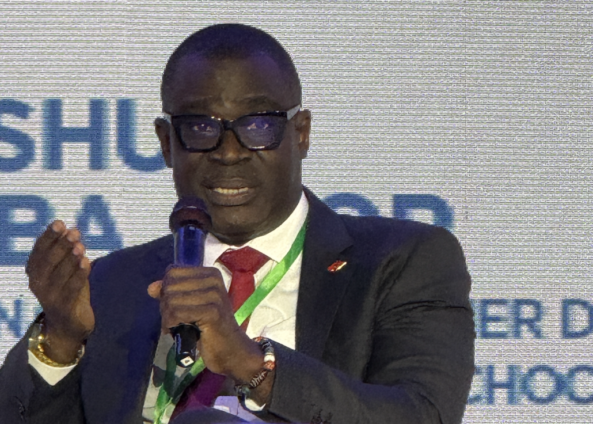
The Managing Director/CEO of UBA Ghana, Bernard Gyebi, has urged owners of small & medium enterprises (SMEs), especially exporters, to make Environmental, Social & Governance (ESG) compliance an integral part of their businesses.
He was emphatic that the adoption of ESG principles enhances their chances of attracting low-cost financing.
Mr Gyebi called for a decisive shift from policy frameworks to practical execution in advancing ESG financing in Ghana.
He was speaking as a panellist at the 10th Anniversary International Conference of Ghana Export-Import Bank, held at the Kempinski Hotel Gold Coast City Accra.
Mr Gyebi emphasised that while Ghana has made significant progress in establishing ESG frameworks, the real challenge lies in integrating these principles into actual financing decisions.
“Ghana has made strong progress on ESG frameworks, but the gap remains in execution. At UBA, ESG is not treated as a compliance layer; it is a core input into our credit decisions,” he stated.
He explained that UBA, as a pan-African financial institution, has embedded environmental and social risk assessments into its lending processes across key sectors, influencing how risk is priced and how facilities are structured.
However, he noted that broader industry alignment is needed to ensure ESG performance directly impacts access to credit and financing terms.
The Bank has partnered with Renewvia Energy Corporation to deploy solar microgrids across its Nigerian operations, delivering cleaner energy to its branches and reducing carbon emissions.

It has also collaborated with Agence Française de Développement (AFD) under the SUNREF programme to provide financing for businesses investing in solar energy and energy efficiency, helping to drive a more sustainable private sector.
At the continental level, UBA has secured a $175 million facility from the African Development Bank to support infrastructure and energy development, while its partnership with the African Guarantee Fund (AGF) is unlocking financing for green SMEs through a $100 million credit line backed by a $50 million risk guarantee.
Through these initiatives, UBA is playing a critical role in mobilising climate finance, de-risking investments, and accelerating Africa’s transition to a low-carbon, sustainable economy.
On financing instruments, the UBA Ghana CEO highlighted that while green bonds and sustainability-linked products are gaining traction globally, the Ghanaian market requires more practical and scalable solutions.
He pointed to blended finance facilities as the most practical ESG financing method that helps de-risk financing for exporters, especially SMEs.
“The issue is not lack of instruments, but lack of scalable structures that fit local realities. ESG works best when embedded into existing credit structures rather than introduced as standalone products,” he explained.
Mr Gyebi also underscored the critical role of risk management in unlocking ESG financing. He noted that while banks have sufficient liquidity to support SMEs and export sectors, risk appetite remains the primary constraint.
“The constraint is not funding, it is risk. Development finance institutions must move from direct lending to risk absorption through guarantees and first-loss structures. Even partial risk coverage can significantly unlock private sector lending,” he added.
Addressing the challenges faced by small and medium-sized enterprises (SMEs), Mr Gyebi stressed the need to simplify ESG requirements to drive adoption.
He revealed that a significant proportion of SMEs lack structured ESG practices, and overly complex frameworks could discourage participation.
“ESG will only scale when it improves access to finance, not when it increases compliance costs. For SMEs, the focus should be on simple, practical metrics linked directly to financing opportunities,” he noted.
He urged SME business owners not to view ESG compliance as complex, but to begin by implementing the simpler aspects, especially those relating to governance.
He emphasised, “once you get the governance aspects, such as appropriate board composition and data privacy right, the social and environmental aspects, such as gender inclusion and proper waste treatment, begin to fall in place”.
On global competitiveness, Mr Gyebi warned that ESG is rapidly becoming a prerequisite for participation in international trade, particularly in developed markets.
“ESG is no longer optional; it is becoming a condition for market access. Exporters who ignore ESG risk will be excluded from premium markets. The next phase of competitiveness will be driven by compliance and trust, not just pricing,” he said.
He concluded by emphasising the need for stronger alignment between policy, capital, and execution to fully unlock Ghana’s export potential.
“The focus now should be on moving from frameworks to action, and from ambition to execution. The exporters who win tomorrow will be those who integrate ESG today, and the banks that support them will shape Africa’s economic future,” he stated.
The conference brought together policymakers, financial institutions, development partners, and private-sector leaders to explore strategies to align export growth with sustainability and climate goals.
Latest Stories
-
Diaspora Nasara Caucus congratulates Mohammed Ali Suraj, new NPP executives
1 hour -
Dr Antwi-Boasiako’s cybersecurity book showcased at UN crime prevention congress
1 hour -
We will empower the grassroots and protect every vote – NPP’s 1st Vice Chair Kojo Bamba
1 hour -
I do not see myself as better than anyone – NPP’s 1st Vice Chair Kojo Bamba
2 hours -
Police blur the line between invitations and arrests – Reindorf Twumasi Ankrah
3 hours -
Turning invitations into arrests is making citizens reluctant to assist police – Twumasi Ankrah
3 hours -
The Traffitech-GH SMS spot-fine system: The good, the sad, and the funny – Bright Simons writes
3 hours -
Hawa Koomson pledges experienced and mature leadership of NPP women’s wing
4 hours -
Young woman found dead at Kasoa Peace Town
5 hours -
Playback: The Law examined lawful arrest in Ghana
5 hours -
Mahama urges African governments to treat healthcare as an investment, not budget cost
6 hours -
Bawumia congratulates John Boadu and new NPP executives, pledges support ahead of 2028
6 hours -
Aksa Energy delegation pays courtesy call on GRA Commissioner-General
6 hours -
‘No talent should be left out’ – Bawumia pledges inclusive NPP campaign for 2028
6 hours -
Prof. Mike Oquaye recounts how he blocked the Special Prosecutor’s attempt to arrest Bawku Central MP
6 hours