

Audio By Carbonatix
When 14-year-old Dorcas Cherop's family was told she needed to undergo at least a year's treatment in Uganda for bladder cancer - her future looked bleak.
The challenge lay not just in getting the medical care, which is mostly free at the Uganda Cancer Institute (UCI), but the high costs involved in making multiple journeys to the capital and finding accommodation for the frequent visits to the hospital.
"My mum and dad are farmers and so they didn't have enough money to transport me from Kapchorwa in eastern Uganda to Kampala," the teenager told the BBC.
She was diagnosed aged 11 in 2020 and while undergoing tests, and even before the treatment began, her aunt Stella Chepchirir says they had to make an arduous journey to see doctors every fortnight.
"It was bad. At one point, the family contemplated giving up and returning home," Ms Chepchirir admitted.
"We had run out of money. But the saddest part was seeing her in pain while we travelled seven hours to Kampala and back."
Their predicament was not unusual in the East African nation, where it was estimated in 2021 that one in three children with cancer abandoned their treatment because of these hidden costs.
Dr Joyce Balagadde-Kambugu, head of paediatric oncology at UCI, says that just like Dorcas, many children with cancer live in rural areas.
"Eighty to 85% of the population of the children with cancer here at the institute are peasants who live on less than $3 [£2.50] a month."
"We've had a very sorry situation, with almost 50% treatment abandonment rate because of this," she said.
The dropout figure varies from year to year, but was put at around 30% in 2021 - meaning out of the approximately 1,000 cancer patients admitted to the UCI each year, only about 300 complete their treatment.
Dr Balagadde-Kambugu says many of the patients who come from different parts of the country need to ideally stay in Kampala for six to seven months, and sometimes years.
Most cancer treatment involves regular chemotherapy - a treatment regime that involves drugs that destroy rapidly growing cancer cells in the body.
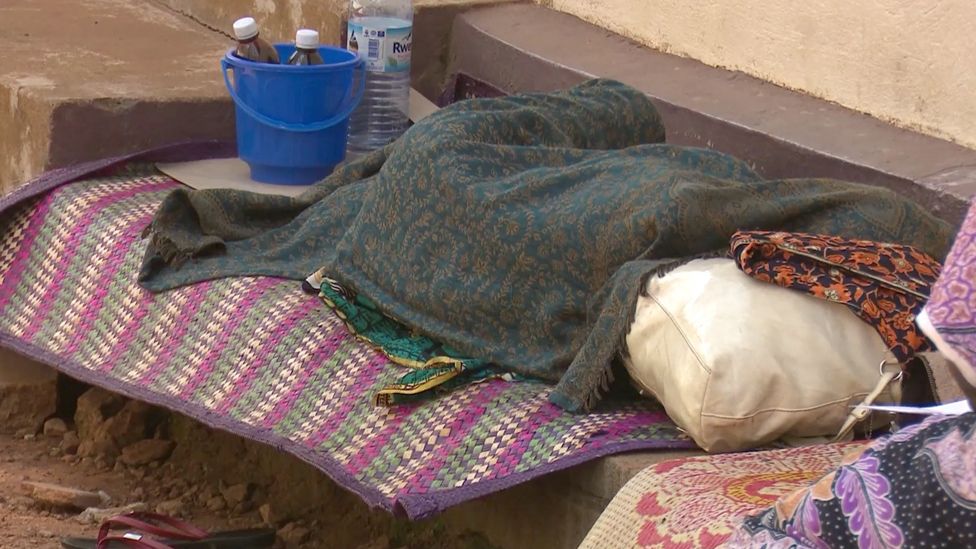
Some families come up with makeshift solutions between appointments often camping in hospital corridors, sleeping on cold floors with only a fleece blanket as protection.
These are referred to by hospital staff as "floor cases".
This also has a knock-on effect for the children's health, with some ending up catching diseases like malaria and diarrhoea, says Dr Balagadde-Kambugu.
The paediatric cancer unit has now teamed up with a charity that is stepping in to provide help.
Dorcas's family in Kapchorwa, who three years ago had given up hope of proceeding with her treatment, received an unexpected call from a man at the UCI.
He put them in contact with Bless a Child Foundation (BCF), which offers free shelter to children with cancer while they undergo treatment.
BCF opened its doors in 2010, initially offering accommodation for up to 10 children with cancer at a house in Kampala.
It has since expanded to four homes, two in Kampala, one in the western town of Mbarara and another in Gulu in the north.
Each home can accommodate about 100 children and one caregiver and now provides meals, an in-house teacher, psycho-social support and transport to and from the hospitals on treatment days.
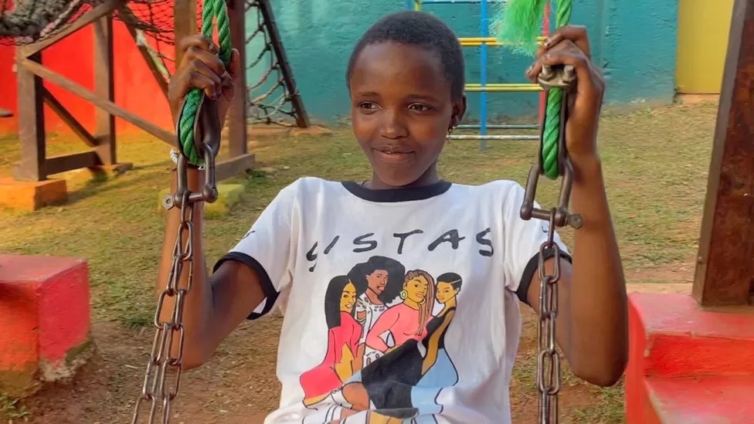
"We get everything, from accommodation, food to even clothes," Dorcas told the BBC as she sat on a swing in a BCF garden in Kampala.
Some children nearby were seen on slides, others playing a board game and another group danced to music.
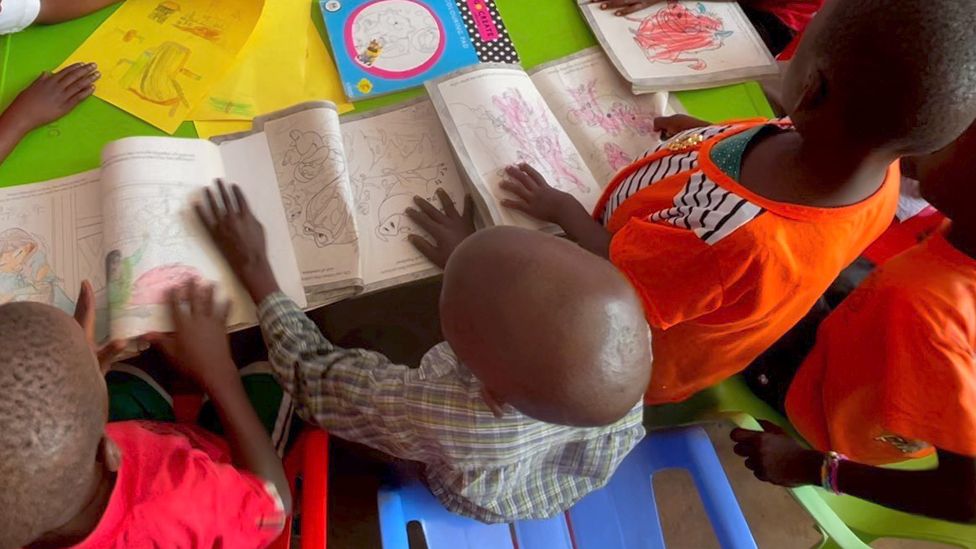
Their gleeful laughter a balm to stressed relatives.
Over the last 13 years, the BCF homes have served more than 6,000 children, says its co-founder Peter Genza.
"The homes provide accommodation, psycho-social, bereavement support, play therapy, remedial education and anything they need in order for them to access care," he told the BBC.
According to Dr Balagadde-Kambugu, the initiative appears to be having a positive impact - with the dropout rate falling dramatically over the last year to 9%.
She says it is not possible to conclusively say that this is all to do with the shelter that offers aid to children up to the age of 15, but she feels it has played a role.
For Dorcas, who is determined to beat the disease, it certainly has made a huge difference.
"I am very happy and I'm no longer in pain like in the past," she says.
"I'm grateful to the foundation for giving me a new lease of life."
The teenager is now back at home and will be going back to Kampala in December to see if she is in remission.
Latest Stories
-
I have supported highway authority financially to fix roads in my constituency – A Plus
59 minutes -
US, Iran fail to reach peace agreement after marathon talks in Pakistan
1 hour -
ECG kicks off Phase Two of transformer upgrades at Lashibi; brief outages expected
2 hours -
Port crises loom as 11,000 drivers threaten four-day strike
3 hours -
A source of excellence across generations – Vice President Opoku-Agyemang lauds Mfantsipim
4 hours -
(Photos) Mfantsipim School launches historic 150th anniversary
4 hours -
Knights and Ladies of Marshall group backs Catholic Bishops’ stance on anti-LGBTQ+
5 hours -
Bright Simons writes: All the Filla in the Ibrahim Mahama/E&P – Gold Fields Saga
5 hours -
Monetise Idiocy In Ghana
5 hours -
The Ghanaian prophet and the mysterious death of his scottish wife Charmain Speirs
6 hours -
Nearly 400 sentenced in Nigeria for links to militant Islamists
7 hours -
Ghana’s recovery supported by gold strength despite global oil price pressures – Standard Bank Research
7 hours -
Methodist Church hails Mfantsipim@150; calls for “fresh consecration” to excellence
7 hours -
‘Excellence is our inheritance’ – Nana Sam Brew-Butler hails Mfantsipim’s 150-year reign in leadership
7 hours -
Kwaku Azar writes: A-G vs OSP
7 hours