

Audio By Carbonatix
Remittance inflows from the United Kingdom to Ghana have declined to 17.5 percent of total receipts, down from about 28 percent during the same period in 2024, triggering renewed efforts by the Bank of Ghana (BoG) to channel diaspora funds into long-term, productive investments.
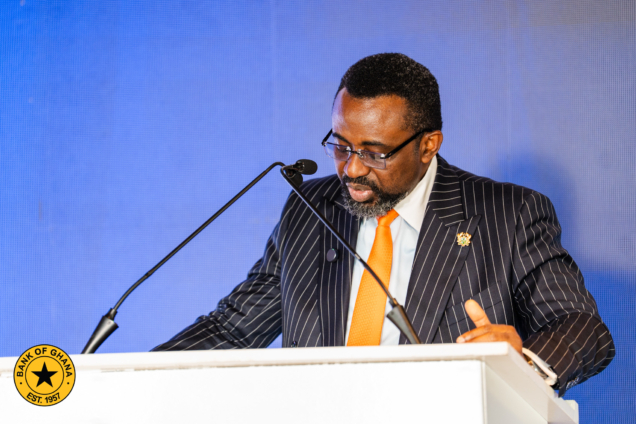
Governor of the Bank of Ghana, Dr Johnson Asiama, disclosed this at the London–Accra Economic Growth Summit, noting that while the UK remains one of Ghana’s most critical remittance corridors, the decline highlights the need for more structured and incentive-driven engagement with the diaspora.
According to Dr Asiama, remittances from the UK between January and September last year fell significantly compared with the previous year, despite their continued importance to Ghana’s foreign exchange inflows and macroeconomic stability.
He explained that diaspora remittances have traditionally supported household consumption and strengthened the balance of payments. However, he stressed that the central bank’s policy focus is shifting beyond consumption toward investments that can drive sustainable economic growth.

"Remittances constitute a structurally important and counter-cyclical source of foreign exchange for Ghana, with the Ghanaian diaspora in the United Kingdom representing a major remittance corridor. In the period between January and September last year, remittance inflows from the UK accounted for about 17.5% of total remittance receipts into the country".
"This proportion, however, marks a decline when you compare it to the same period in 2024, when the UK corridor contributed about 28%, which was equivalent to more than a quarter of all total inflows”, he said.
Dr Asiama said strategically deployed diaspora funds could support small and medium-sized enterprises, housing development, and agricultural modernisation, while also creating sustainable employment opportunities through skills and knowledge transfer.
He described remittances as a structurally important and counter-cyclical source of foreign exchange, particularly at a time of heightened global uncertainty marked by tighter financial conditions and external shocks.
As part of efforts to reverse the decline and scale up inflows from the UK, the Bank of Ghana is exploring diaspora bonds, collective investment schemes, and other capital market instruments that would allow Ghanaians abroad to invest in the economy through transparent and well-regulated platforms.
The Governor also announced that the Bank’s regulatory sandbox is open to fintech companies, encouraging them to develop innovative solutions, including tokenised investment products, that directly link diaspora savings to investment opportunities in Ghana.
He added that capital market deepening remains a key policy priority, noting that well-functioning domestic debt and equity markets reduce reliance on short-term capital flows, enhance price discovery, and improve resilience to external economic shocks.
"Our sandbox is open. If there's a way you can innovate, if there's a way you can engage in the tokenization agenda, if there's a way we can promote investment by the diaspora directly, we are welcoming you and we are ready to speak to you", he assured.
Dr. Asiama further disclosed that the Bank of Ghana is implementing foreign exchange market reforms to improve liquidity, transparency, and investor confidence, adding that increased diaspora participation through formal investment channels would strengthen these reforms and expand stable foreign exchange inflows.
He said the central bank, working with the Ministry of Finance, will roll out a National Remittance Strategy this year alongside a diaspora roadshow aimed at deepening engagement with Ghanaians abroad.
Dr Asiama described the London–Accra initiative as a strategic platform for transforming long-standing social and cultural ties into sustained economic value, positioning the diaspora as a vital bridge connecting ideas, capital, and markets.
He called on financial institutions, fintechs, development partners, and diaspora leaders to collaborate in transforming remittances from simple transfers into engines of growth, stressing that strong institutions and transparent frameworks are essential to building a more resilient, investment-driven economy.
Latest Stories
-
GTA sensitises taxi drivers in ‘Know Ghana’ tourism campaign
11 minutes -
Archbishop Agyinasare calls for responsible speech amid growing social media abuse
16 minutes -
‘It will be inexcusable for gov’t not to honour payment of teachers’ arrears by 30th October’ – Haruna Iddrisu
24 minutes -
Forbes’ World’s Best Employers 2026: No Ghanaian firm ranked among 900 companies
27 minutes -
Electronic processing of teachers’ data: ‘The decision is the Controller’s’ – GES boss
31 minutes -
Teachers’ Strike: Haruna Iddrisu questions paper-based processing of promoted teachers’ data
43 minutes -
Teachers’ strike: GES targets Monday deadline to submit promotion data to Controller
51 minutes -
Inflation to average 11.3% in 2027 – Fitch Solutions
1 hour -
I didn’t campaign for NDC to come and do this nonsense – Kpebu on EOCO
1 hour -
Fitch Solutions maintains policy rate forecast of 14% by December 2026
1 hour -
Diaspora Nasara Caucus congratulates Mohammed Ali Suraj, new NPP executives
3 hours -
Dr Antwi-Boasiako’s cybersecurity book showcased at UN crime prevention congress
3 hours -
We will empower the grassroots and protect every vote – NPP’s 1st Vice Chair Kojo Bamba
3 hours -
I do not see myself as better than anyone – NPP’s 1st Vice Chair Kojo Bamba
4 hours -
Police blur the line between invitations and arrests – Reindorf Twumasi Ankrah
4 hours