

Audio By Carbonatix
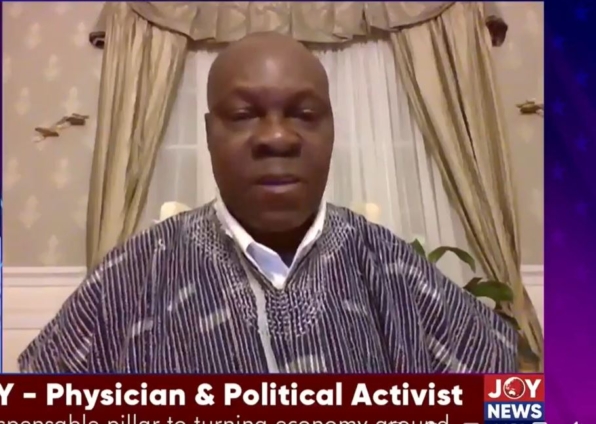
Political activist and physician, Dr Arthur Kobina Kennedy, has insisted that former Microfinance and Small Loans Centre (MASLOC) Chief Executive, Sedina Tamakloe-Attionu, should serve her prison sentence.
His comments follow the extradition and conviction of Tamakloe-Attionu, who was recently returned to Ghana from the United States after being convicted on more than 70 corruption-related charges.
Speaking in an interview on JoyNews ' Newsfile on Saturday, June 13, Dr Kennedy argued that the conviction against her is clear and must be enforced without delay.
According to him, public debate over whether time spent outside prison or abroad should count toward a sentence is misplaced, stressing that actual incarceration is the only meaningful measure of punishment.
“Sedina Tamakloe-Attionu should be in jail. The conviction is clear.
“I think only lawyers would argue about whether when you spend a couple of years relaxing abroad, you have served some of your sentence. It is common sense that if you haven’t been in prison, you haven’t served any of your sentence,” he stated.
He further noted that while concerns have been raised about Tamakloe-Attionu’s health and possible extradition from the United States, such concerns are unlikely to prevent action if proper procedures are followed.
“I think the Americans will not extradite somebody whose health will be jeopardised by the extradition process,” he said.
Dr. Kennedy suggested that authorities would only proceed with extradition if they were satisfied that she was medically fit to travel, adding that Ghana’s prison system is capable of providing adequate healthcare for inmates when required.
He stated that while health considerations must be respected, they should not be used to avoid serving a lawful sentence.
At the same time, he insisted that Tamakloe-Attionu must be allowed to exhaust her legal rights, including the appellate process.
“She should be allowed to go through the appellate process and all her rights should be respected,” he said.
Beyond the specifics of the case, Dr. Kennedy raised broader concerns about public confidence in Ghana’s justice system, warning of what he described as an increasing perception of unequal treatment under the law.
“There is an increasing perception that we have tiers of justice and that when your government is in power, the law is far more lenient to you than when your government is out of power,” he observed.
He added that such perceptions persist particularly in cases involving politically connected individuals, contributing to public dissatisfaction with the justice system.
“Even if your government is out of power, if you are a powerful connected person, the law seems to treat you differently,” he said.
Dr. Kennedy argued that whether based on perception or fact, the justice system must be seen to be fair in order to maintain public trust.
He also referenced prosecutorial decisions, including the use of nolle prosequi in some cases, saying such developments fuel doubts about accountability.
“When there are no consequences, people start to believe that the powerful can get away with everything,” he said.
Latest Stories
-
Ghana seeks long-term mining investments that benefit local communities – Armah-Kofi Buah
13 minutes -
Ghana’s Ambassador to China, Kojo Bonsu, presents credentials to Nepalese President
26 minutes -
Fairtrade Africa’s Cocoa Hubs Project strengthens rural service centres in cocoa-growing communities
31 minutes -
SEC cautions investors against fraudulent investment schemes
33 minutes -
Land Ministry urges rCOMSDEP operators to reserve earnings for land reclamation
36 minutes -
Commercial drivers give authorities one week to clear traders from lorry terminals, bus stops
40 minutes -
Nana B denies claims that Kojo Bamba was his driver and bodyguard
1 hour -
Engage Now Africa to construct a 10-unit classroom block for struggling Navrongo Vocational Training Centre
1 hour -
One digital financial breach could expose linked accounts to fraud – Financial Crimes Manager
1 hour -
Ghana Russia Centre signs ICT cooperation agreement with Moscow University
1 hour -
The powerhouses of the village: Honouring Ghana’s rural women on International Rural Women’s Day
1 hour -
Vincent Assafuah petitions CHRAJ to investigate alleged irregularities in 2026 World Cup visa arrangements
1 hour -
12-year-old boy found dead in muddy pit at Opeikuma
1 hour -
GHS begins Yellow Fever vaccination campaign in three Upper West districts
1 hour -
Organised Labour pushes for higher 2027 base pay despite slowing inflation
1 hour