

Audio By Carbonatix
The US's Food and Drug Administration (FDA) has authorised emergency use of the Ebola drug remdesivir for treating the coronavirus.
The authorisation means the anti-viral drug can now be used on people who are hospitalised with severe Covid-19.
A recent clinical trial showed the drug helped shorten the recovery time for people who were seriously ill.
However, it did not significantly improve survival rates.
Experts have warned the drug - which was originally developed to treat Ebola, and is produced by Gilead pharmaceutical company in California - should not be seen as a "magic bullet" for coronavirus.
The drug interferes with the virus's genome, disrupting its ability to replicate.
During a meeting with US President Donald Trump in the Oval Office, Gilead Chief Executive Daniel O'Day said the FDA authorisation was an important first step.
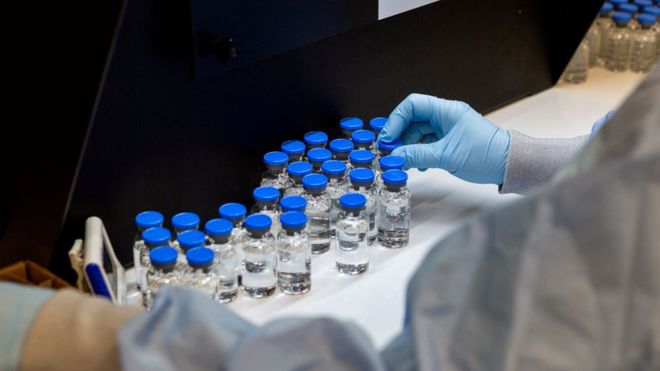
The company would donate 1.5 million vials of the drug, he said.
FDA Commissioner Stephen Hahn also said at the meeting: "It's the first authorised therapy for Covid-19, so we're really proud to be part of it."
Emergency FDA authorisation is not the same as formal approval, which requires a higher level of review.
What do we know about remdesivir?
The drug did not cure Ebola, and Gilead says on its website: "Remdesivir is an experimental medicine that does not have established safety or efficacy for the treatment of any condition." Gilead also warns of possible serious side-effects.
However, President Trump has been a vocal supporter of remdesivir as a potential treatment for the coronavirus.
In its clinical trial, the US National Institute of Allergy and Infectious Diseases (NIAID) found that remdesivir cut the duration of symptoms from 15 days down to 11.
The trials involved 1,063 people at hospitals around the world - including the US, France, Italy, the UK, China and South Korea. Some patients were given the drug and others were given a placebo (dummy) treatment.
Dr Anthony Fauci who runs NIAID, said that remdesivir had "a clear-cut, significant, positive effect in diminishing the time to recovery".
However, although remdesivir may aid recovery - and possibly stop people having to be treated in intensive care - the trials did not give any clear indication whether it can prevent deaths from coronavirus.
As much remains uncertain about the treatment regime, Gilead suggests a 10-day dosing duration for patients on ventilators and five days for patients who are not.
Could other countries use remdesivir?
Gilead says it is currently using up existing stocks of the drug, and the supply is limited. The US government will co-ordinate distribution of remdesivir to hospitals in US cities most heavily impacted by Covid-19.
So it is not clear how much of the drug could be distributed worldwide, nor at what price.
Gilead says it is donating 1.5 million individual doses of remdesivir, which "equates to more than 140,000 treatment courses that will be provided at no cost". The emergency distribution in the US is included in that.
But worldwide there are more than three million confirmed cases, in 185 countries.
Gilead says it is striving to expand production rapidly, with global partners.
The company aims to produce at least 500,000 treatment courses by October, 1 million treatment courses by December 2020 and millions more in 2021, if required.
The Institute for Clinical and Economic Review, a US body which studies drug prices, estimated the cost of a 10-day course of remdesivir at $10 (£8), but suggested a cost-effective price could be as much as $4,500, based on the clinical trials.
New York nursing home deaths
News of the potential treatment comes as a nursing home in New York reports 98 coronavirus-related deaths.
The Isabella Geriatric Center in Manhattan said 46 of its residents died after testing positive, while the other 52 were suspected to have had the virus.
And Dr Fauci has been barred from testifying next week to a congressional committee examining the Trump administration's response to the pandemic.
"While the Trump administration continues its whole-of-government response to Covid-19, including safely opening up America again and expediting vaccine development, it is counter-productive to have the very individuals involved in those efforts appearing at congressional hearings," White House spokesman Judd Deere said in a statement.
Latest Stories
-
GPL 2025/26: Dreams FC stage stunning comeback to hammer Eleven Wonders
1 hour -
Livestream: The Probe examines Kumasi’s looming water crisis
1 hour -
MTN Ghana gears up to lead Africa’s AI revolution
1 hour -
Philanthropist Alhaji FuZak donates Da’wah bus to Ambariya Sunni community
1 hour -
GUTA calls for suspension of Publican AI system over trade disruptions
2 hours -
TTAG raises alarm over proposed recruitment of 7,000 teachers, demands national posting roadmap
2 hours -
Civilians feared killed after reports of air strike on Nigerian market
2 hours -
Bishop Simon Kofi Appiah installed as new Jasikan Diocese Bishop
2 hours -
Trump’s Strait of Hormuz blockade threat raises risks and leaves predicaments unchanged
2 hours -
US Court backs extradition of former MASLOC CEO Sedina Tamakloe-Attionu to Ghana
3 hours -
Seven arrested as NAIMOS dismantles illegal mining camp, seizes firearms at Boin River
3 hours -
Fire erupts at Madina Ritz Junction, destroys multiple wooden structures and containers
3 hours -
Daniel-Kofi Kyereh returns from long-term injury, registers assist for Freiburg U23
3 hours -
Knifeman calling himself ‘Lucifer’ slashes three at NYC’s Grand Central
3 hours -
Brands are built from within to without
3 hours