

Audio By Carbonatix
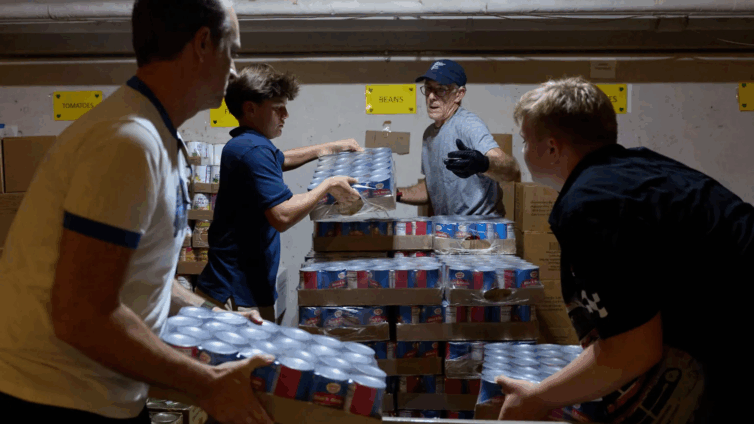
Food assistance used by more than 40 million Americans will not be distributed from November due to the ongoing US government shutdown, according to the US Department of Agriculture.
"Bottom line, the well has run dry," the Department said in a notice on its website, which also blamed Democrats in the Senate for the impasse.
The Supplemental Nutrition Assistance Program (SNAP) is used by one in every eight Americans, and plays a vital role in many grocery budgets.
Earlier this month, the Trump administration declined to draw on a contingency fund that would have continued benefits, saying the money was needed for potential emergencies such as natural disasters.
Democrats have condemned President Donald Trump for refusing to use the contingency fund.
"This is perhaps the most cruel and unlawful offence the Trump administration has perpetrated yet," Congresswomen Rosa DeLauro and Angie Craig said in a joint statement on Friday.
They also criticised Trump for providing assistance to Argentina and building a new White House ballroom during the shutdown.
According to the Centre on Budget and Policy Priorities (CBPP), a think-tank focused on policies that help low-income families, the contingency fund would only cover about 60% of one month of benefits, however.
In a letter sent to the agriculture department on Friday, Democratic House members said there was still "significant funding available in SNAP's contingency reserve – which Congress provides precisely for this reason – that can be used to fund the bulk of November benefits".
They asked Agriculture Secretary Brooke Rollins to release the reserves and then transfer other available money in her department to fully fund the programme for the month.
In a memo obtained by US outlets, Rollins said the reserve can only be used for "true emergencies", mostly natural disasters.
Earlier, in its published plan for the shutdown, her department had said it would keep a small number of employees from being furloughed to operate the programme, noting Congress had created "multi-year contingency funds" to ensure states could continue to distribute benefits.
Snap works by giving people reloadable debit cards that they can use to buy essential grocery items.
A family of four on average receives $715 (£540) per month, according to CBPP, which breaks down to a little less than $6 (£4.50) per day per person.
The states administer the programmes, with much of the funding coming from the federal government.
Several states have pledged to use their own funds to cover any shortfall; however, the federal government has warned that they will not be reimbursed.
Some, including Massachusetts, where one million people are expected to lose benefits, have said they do not have enough money to make up for the lack of funds.
Many states are working with people in Snap to try to locate charity food pantries and find alternative sources for meals, and California is deploying its National Guard to help distribute food.
The US government shutdown entered its 26th day on Sunday, making it the second-longest shutdown in history.
Latest Stories
-
Association of Small-Scale Industries empowers trade executives in Bono East with a mentorship programme
4 minutes -
AMA evacuates refuse along Graphic Road, warns against indiscriminate dumping
9 minutes -
STC interdicts driver over Pokuase overtaking incident
13 minutes -
Ekumfi: How $6m EXIM participation built a $53m industrial asset — now poised for a 24-Hour Economy breakthrough
14 minutes -
4 arrested, 142 parcels of suspected Indian hemp seized as officers reject GH¢50k bribe
15 minutes -
No MMDCE can say they don’t see galamsey – Local Government Ministry
16 minutes -
Ghana, Germany explore stronger partnership in technical and vocational education
22 minutes -
AMA urges motorists and road users to comply with traffic regulations
23 minutes -
Sam George urges One Million Coders participants to complete all three levels
24 minutes -
Communications Minister announces 2,800-site telecom expansion during Volta visit
25 minutes -
Impunity fuelling sexual abuse in Ghana – Angela Dwamena-Aboagye
26 minutes -
NUGS condemns alleged sexual abuse by Obuasi SHTS headmaster, calls for prosecution
30 minutes -
President Mahama urges investors to employ trained local residents as 1,238-acre industrial park takes off
34 minutes -
Media doing its job, but politicians fuelling insults on social media – NMAG president
35 minutes -
Child protection must be the state’s responsibility, not NGOs’ burden – ARK Foundation Boss
41 minutes