

Audio By Carbonatix
U.S. customs agents began collecting President Donald Trump's unilateral 10% tariff on all imports from many countries on Saturday, with higher levies on goods from 57 larger trading partners due to start next week.
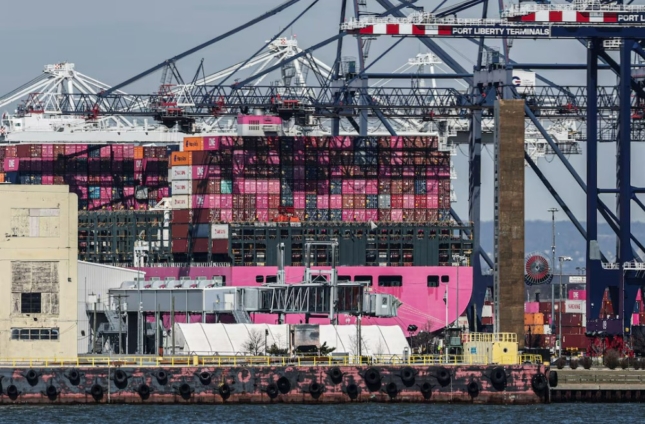
The initial 10% "baseline" tariff took effect at U.S. seaports, airports and customs warehouses at 12:01 a.m. ET (0401 GMT), ushering in Trump's full rejection of the post-World War Two system of mutually agreed tariff rates.
"This is the single biggest trade action of our lifetime," said Kelly Ann Shaw, a trade lawyer at Hogan Lovells and former White House trade adviser during Trump's first term.
Shaw told a Brookings Institution event on Thursday that she expected the tariffs to evolve over time as countries seek to negotiate lower rates. "But this is huge. This is a pretty seismic and significant shift in the way that we trade with every country on earth," she added.
Trump's Wednesday tariff announcement shook global stock markets to their core, wiping out $5 trillion in stock market value for S&P 500 companies by Friday's close, a record two-day decline. Prices for oil and commodities plunged, while investors fled to the safety of government bonds.
Among the countries first hit with the 10% tariff are Australia, Britain, Colombia, Argentina, Egypt and Saudi Arabia. A U.S. Customs and Border Protection bulletin to shippers indicates no grace period for cargoes on the water at midnight on Saturday.
But a U.S. Customs and Border Protection bulletin did provide a 51-day grace period, opens new tab for cargoes loaded onto vessels or planes and in transit to the U.S. before 12:01 a.m. ET Saturday. These cargoes need arrive to by 12:01 a.m. ET on May 27 to avoid the 10% duty.
At the same hour on Wednesday, Trump's higher "reciprocal" tariff rates of 11% to 50% are due to take effect. European Union imports will be hit with a 20% tariff, while Chinese goods will be hit with a 34% tariff, bringing Trump's total new levies on China to 54%.
Vietnam, which benefited from the shift of U.S. supply chains away from China after Trump's first-term trade war with Beijing, will be hit with a 46% tariff and agreed on Friday to discuss a deal with Trump.
Canada and Mexico were exempt from both Trump's latest duties because they are still subject to a 25% tariff related to the U.S. fentanyl crisis for goods that do not comply with the U.S.-Mexico-Canada rules of origin.
Trump is excluding goods subject to separate, 25% national security tariffs, including steel and aluminum, cars, trucks and auto parts.
His administration also released a list, opens new tab of more than 1,000 product categories exempted from the tariffs. Valued at $645 billion in 2024 imports, these include crude oil, petroleum products and other energy imports, pharmaceuticals, uranium, titanium, lumber and semiconductors and copper. Except for energy, the Trump administration is investigating several of these sectors for further national security tariffs.
Culled from The Reuters
Latest Stories
-
President Mahama is not sincere with Ghanaians on LGBTQ bill matter – Hassan Tampuli
5 minutes -
Gov’t to establish Prison Industrial Hub to equip inmates with income-generating skills – Prison Service boss
24 minutes -
Alhassan Tampuli donates cement, roofing sheets to support storm victims in Gushegu
24 minutes -
Alhassan Tampuli appeals for urgent support for storm victims in Gushegu
27 minutes -
The hypocrisy must stop; pass Anti-LGBTQ+ Bill now – Alhassan Tampuli to Mahama
31 minutes -
Imprisonment should be rehabilitative, not punitive – Ghana Prisons boss at UNGA
53 minutes -
Ga Adangbe traditional priests petition Mahama over McDan aviation licence revocation
1 hour -
Anti-LGBTQ Bill: NDC’s arrogance is worrying – Hassan Tampuli
1 hour -
Let’s give OSP time to mature, not to scrap it – Hassan Tampuli
1 hour -
Nigeria convicts 386 Islamist militants in mass trials
1 hour -
Djibouti president wins election with 97.8% of vote, state media says
1 hour -
We don’t have mandate to deduct tax from rent allowance of security services personnel – Interior Ministry clarifies
2 hours -
Ablakwa receives Presidential Special Envoy on Reparations to advance global agenda
2 hours -
Christina Koch becomes first woman to travel around the moon on Artemis II
2 hours -
Epstein survivors’ calls to meet King Charles and Queen harder to ignore as US visit approaches
2 hours