


Audio By Carbonatix
Every year, when WASSCE results are released, Ghana erupts into the same familiar debates: Did the national pass rate go up or down? Is Free SHS working or failing? Almost always, the conversation revolves around one number: THE NATIONAL AVERAGE. But our obsession with this single figure hides more than it reveals.
The truth is simple: national averages tell us nothing about what is really driving performance in our schools.
Beneath the headlines sit hundreds of Senior High Schools performing at dramatically different levels. Some continue to excel, recording four-credit pass rates of 60 to 90 per cent.
Others have been stuck below 20 per cent for years. If we continue fixating on national averages, we will never understand the real forces shaping our educational outcomes.
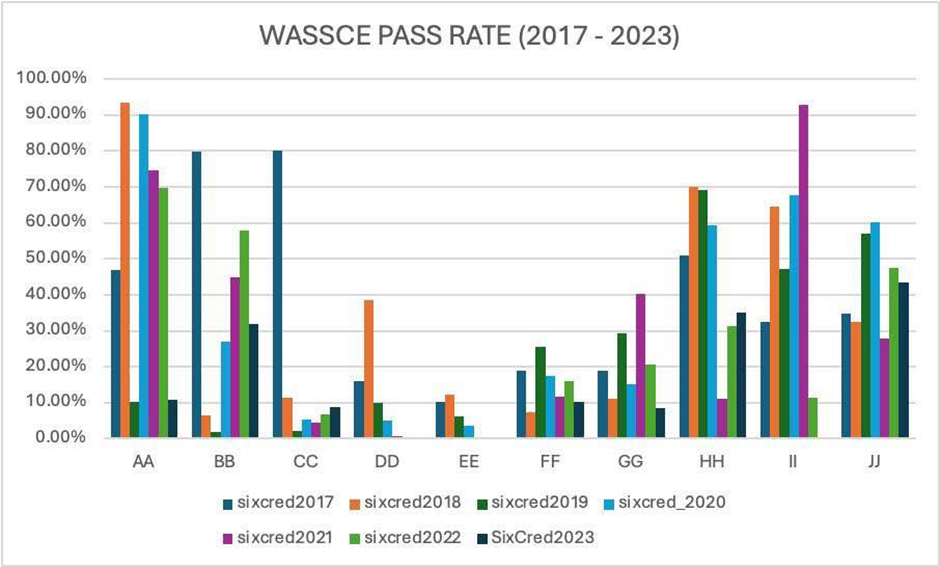
A recent look at school-level WASSCE performance between 2017 and 2023 (shown in a cluster of anonymised schools labelled AA to JJ) makes this painfully clear. While schools such as AA, BB, HH, II and JJ consistently push national averages upward, others like CC, DD, EE and FF rarely cross the 20 per cent mark. Their chronic underperformance drags the national average down year after year.
Yet when the national results are announced, we never ask the most important question:
Which schools improved, which declined, and why?
It is the same mistake economists would make if they tried to analyse inflation without looking at the specific items driving prices up or down. To understand inflation, you do not examine the overall rate alone; you break it down. Is it food? Transport? Rent? Only then can you craft targeted solutions.
Education is no different.
If we want to raise national WASSCE performance, we must abandon the lazy comfort of national averages and embrace the hard work of MICRO-LEVEL ANALYSIS. Policymakers must be able to point clearly to which schools are improving, which are deteriorating, and what factors, teachers, facilities, leadership, and student preparation, explain the differences.
This is how real interventions are designed.
A school that has recorded 8 per cent pass rates for five straight years does not need the same support as a school steadily performing at 70 per cent. Yet our policies often treat them as though they face the same challenges.
They do not. Until the Ministry of Education and the Ghana Education Service shift from broad national conversations to detailed school-level diagnostics, many struggling schools will continue to be invisible in the data and in the policy response.
Ghana does not have a national performance crisis; it has a distribution crisis. A relatively small group of persistently low-performing schools determines whether the national average rises or falls.
If even a fraction of these schools were supported to move from 10 per cent pass rates to 35 or 40 per cent, the national picture would change dramatically. WASSCE analysis must therefore evolve.
It must stop being an annual ritual of political point-scoring and become a serious exercise in identifying the real drivers of educational performance. A nation that measures properly can intervene properly. A nation that analyses deeply can improve meaningfully.
Until then, Ghana will continue to be fixated on national averages, while ignoring the granular realities that truly shape the future of its children.
Latest Stories
-
Trump says he is considering firing US ambassador to Greece
2 hours -
Man City bananas ‘brought fun back’, says Varadi
2 hours -
Meta releases Muse Wonder AI models to challenge Anthropic and OpenAI
2 hours -
Daily Insight for CEOs: The CEO as Chief Decision Maker
2 hours -
Burnham had formal meeting with Man City chair while mayor
2 hours -
Is Ghana producing too many lawyers? What is the best lawyer-to-citizen ratio?
2 hours -
NDC sinking Ghana’s democracy with Emelia Agbenyo’s appointment – Miracles Aboagye
2 hours -
Seedorf back in football as Corinthians head coach
2 hours -
Hincapié and Zubimendi injured in post-match training session
2 hours -
Fridges in French supermarkets hit by cyberattack
3 hours -
Qantas flight grounded after bedbug outbreak
3 hours -
Reality Zone with Vicky Wireko: International Day of the Girl, shaping today’s girl for tomorrow’s future – ZONTA Clubs lead the way
3 hours -
Global health must be led by countries, not designed for them – Mintah Akandoh
4 hours -
Mahama honoured at 2026 World Health Summit in Berlin for global health leadership
4 hours -
Breast cancer is not a death sentence – Besease Kontire Obaapanin, Magmina Foundation lead awareness campaign
4 hours