

Audio By Carbonatix
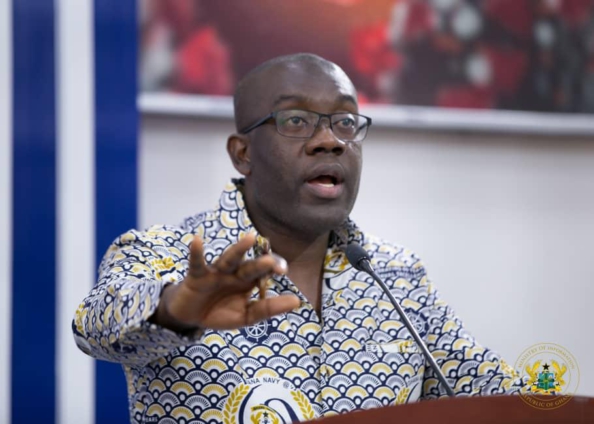
Information Minister, Kojo Oppong Nkrumah says the New Patriotic Party-led government will work hard to break the eight-year tenure jinx that has characterised Ghana’s political electoral system since 1992.
“It's a well-known fact that since 1992, the Ghanaian electorate changes the political party that has governed the nation for eight years, no matter the performance of that particular party,” he said.
Mr Oppong Nkrumah, responding to a question regarding the Economist Intelligence Unit's (EIU) risk analysis of the country's political and economic environment that alluded to a possible change of the NPP-led government in the 2024 general election, said the party was keen on changing the narrative.
The EIU is a research and analysis division of The Economist Group based in the United Kingdom that researches countries' economic performances and forecasts possible outcomes.
In its latest report, the EIU provided guiding notes and risk assessment of Ghana's economic and political climate and consequences for the future.
Mr Oppong Nkrumah noted that the ruling government was well aware of the country's electoral trends since it returned to multiparty democracy in 1992.
According to him, the policies and programmes earmarked for implementation in the next four years would help rejuvenate the economy, create jobs and turn the electoral fortunes in favour of the NPP in the 2024 polls.
The Minister expressed belief that the government's GH¢100 billion Coronavirus Alleviation and Revitalisation of Enterprises Support (CARES) and Post-Covid-19 Recovery programmes would put the economy on a sound footing.
Early on, Mr Oppong Nkrumah lauded Parliament for approving the Government's 2021 Budget and Economic Policy Statement and expressed the hope that the Legislature would subsequently approve the Appropriation Bill by March 30, to give authorisation to the Government to spend.
He debunked assertions in sections of the media that the new taxes proposed by the Government was intended to pay for the free water and electricity provided last year.
He said the intended revenues from the new taxes were explained in detail on page 58 of the Budget, and that all over the world, governments had been imposing new taxes to help raise funds to resuscitate their economies, ravaged by the Covid-19 pandemic.
Latest Stories
-
St Augustine’s College retain National Investment Quiz title after nail biting grand finale
8 minutes -
Education infrastructure investment will drive Banda’s development – Ahmed Ibrahim
15 minutes -
Teacher unions strike: Gov’t presents fresh proposals as talks end inconclusively
57 minutes -
51,000 teachers’ promotion arrears to be validated for October payment – Education Minister
1 hour -
Kwabena Boamah appointed Board Chair for Impact Investing Ghana
2 hours -
Striking teacher unions to meet Fair Wages and Salaries Commission on October 6
2 hours -
EOCO working with AG to arraign Nana Baffour Awuah before weekend court
2 hours -
Duraplast reassures customers after fire, announces October 5 reopening
2 hours -
Call off strike, gov’t will not renege on promotion arrears pledge – Haruna Iddrisu appeals to teacher unions
2 hours -
Committee set up to validate teachers eligible for 20% deprived-area allowance – Education Minister
2 hours -
Five-member committee to search for new Black Stars coach after Sports Ministry-GFA meeting
3 hours -
Pinktober: Breast cancer survival exceeds 90% when detected early – Breast Society of Ghana
3 hours -
TCDA to adopt Upper West’s MATCO mango farm as northern prototype, issues warning against felling shea trees
3 hours -
‘Fear delegates’ tag: Afoko touts genuineness among delegates ahead of NPP delegates conference
3 hours -
John Boadu: The leader our party needs at this time – Amb. Edward Akwasi Boateng
3 hours