

Audio By Carbonatix
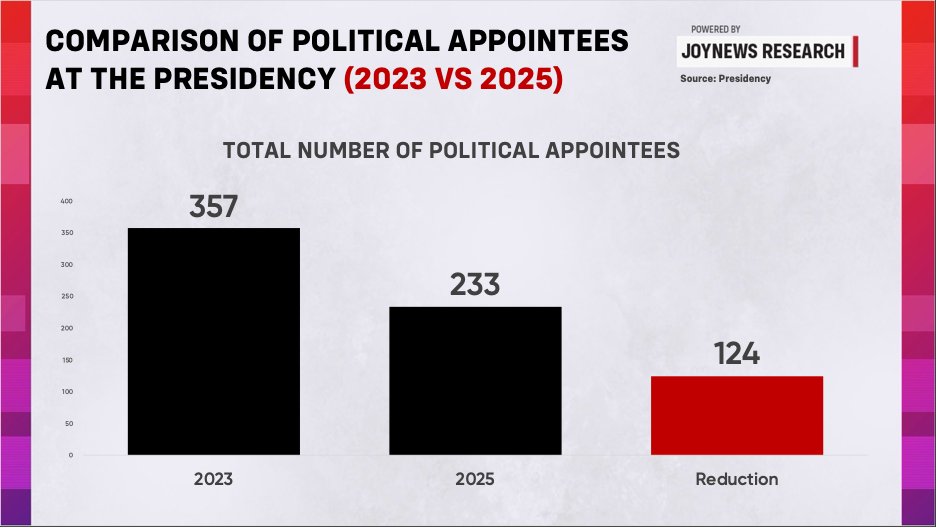
President Mahama had 124 fewer political appointees at the Jubilee House in 2025 than the last publicly available figures from the Akufo-Addo administration in 2023.
Yet the Office of the President's compensation bill is projected to more than double, rising from ¢100 million in 2025 to ¢248 million in 2026 and raising questions about whether a smaller Presidency has necessarily become a cheaper one to run.
Under Section 11 of the Presidential Office Act, 1993 (Act 463), the Office of the President is required to submit an annual report to Parliament detailing its staffing position.
In March 2026, the Presidency complied by submitting its 2025 staffing report.
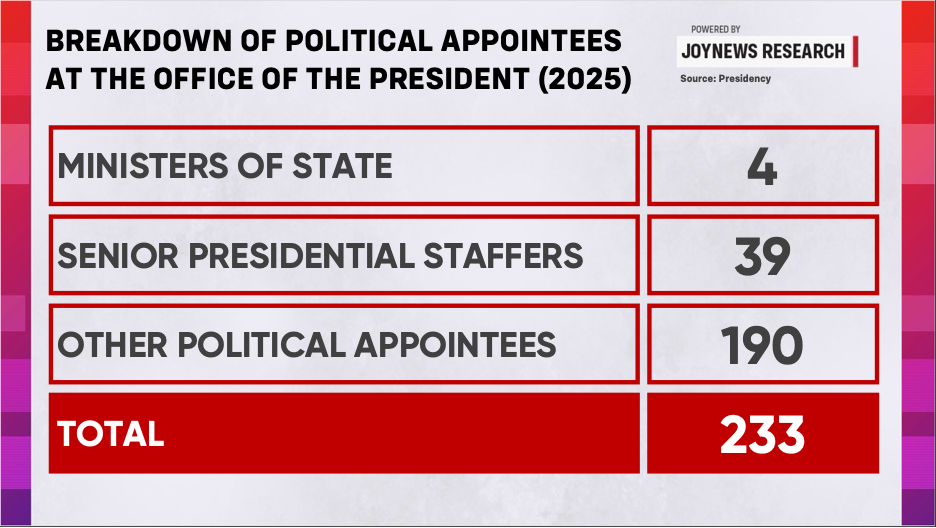
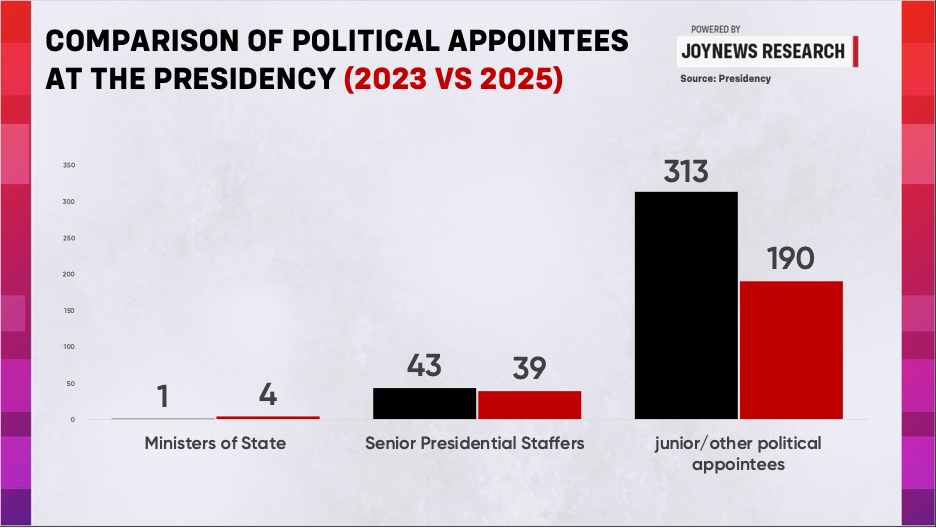
The report shows that the Presidency had 4 Ministers of State, 39 Senior Presidential Staffers and 190 other political appointees, commonly referred to as junior political appointees.
In total, President Mahama's Presidency had 233 political appointees in 2025.
For comparison, the latest publicly available data from the previous administration is for 2023.
The 2024 staffing report, which should have been submitted by March 2025 following the change in administration, has not been made public.
It remains unclear whether the report was submitted by President Mahama in 2025 and, if so, how many staffers served at the Presidency during former President Akufo-Addo's final year in office.
The absence of the 2024 report also means there is no publicly available benchmark for assessing how staffing levels changed during the transition between the two administrations.
The 2023 report showed one Minister of State, 43 Senior Presidential Staffers and 313 junior political appointees.
That summed up to 357 political appointees.
Compared with the current figure of 233, the Presidency has reduced the number of political appointees by 124.
That is a significant reduction.
However, a closer look at President Mahama's appointments suggests the classification may understate the number of senior-level appointees.
There appear to be at least 11 other political appointees whose responsibilities broadly resemble those of positions the Akufo-Addo administration classified as Senior Presidential Staffers.
Among them are:
- Nathan Kofi Boakye – Director of Operations at the Presidency
- Goosie Tanoh – Presidential Advisor, 24-Hour Economy & Accelerated Export Development
- Priscilla Santuo-Ocrah – Presidential Staffer at the Sustainable Development Goals (SDGs) Secretariat
- Khalid Sharif Mahmud – Policy Advisor, Economy at the Vice President’s Secretariat
- Dr Samuel Ofosu Ampofo – Policy Advisor at the Vice President’s Secretariat
- Dr Peter Boamah Otokunor – Director of Presidential Initiative in Agriculture and Agribusiness
- Mansa Amoa-Awuah – Policy Advisor, Finance at the Vice President’s Secretariat
Several of these positions appear broadly comparable to roles that the previous administration classified as senior appointments, including Director of Operations, Presidential Advisor on the Economy and Presidential Advisor on the Sustainable Development Goals.
The difference may simply be one of administrative structure.
President Mahama appears to have decentralised some advisory functions into specialised secretariats and the Office of the Vice President, whereas the Akufo-Addo administration concentrated many of those functions within the Presidency itself and classified them as senior appointments.
If these positions were classified using the same approach as the previous administration, the number of Senior Presidential Staffers would rise from 39 to about 50, exceeding the 43 recorded in 2023.
Whether intentional or not, the classification has the effect of keeping the official number of Senior Presidential Staffers below the level recorded under the previous administration.
The headline numbers, therefore, tell only part of the story.
The Presidency has clearly reduced the number of political appointees, but the classification of some positions complicates comparisons with the previous administration.
Another interesting observation concerns the cost of running the Presidency.
The NDC, while in opposition, frequently criticised the size of the Presidency, arguing that the large number of appointees imposed high costs on the state through salaries, allowances and travel expenditure.
The latest budget figures present an interesting picture.
The total number of staff at the Presidency, including political appointees, civil servants and public servants on attachment, stood at 808 in 2025.
In 2023, the total staff stood at 921.
This represents a reduction of 113 employees.
Yet compensation costs tell a different story.
Compensation at the Office of the President amounted to ¢125 million in 2023 and rose to ¢153 million in 2024. It then fell to ¢100 million in 2025, possibly reflecting the reduction in staff numbers.
However, the 2026 budget projects compensation of GH¢248 million.
That is an increase of about 148% in a single year.
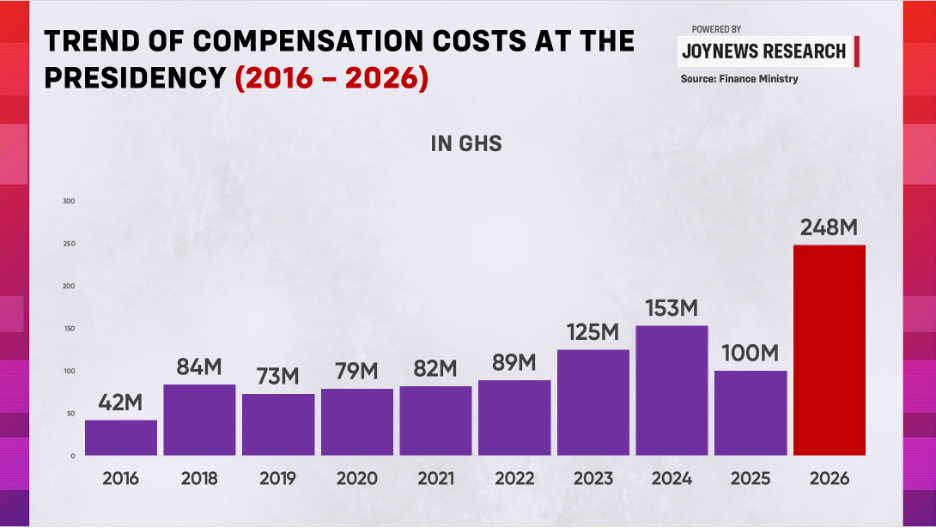
Which raises an obvious question: if staff numbers are falling, why is compensation projected to rise so sharply?
One possible explanation is that the 2025 compensation figures did not fully reflect the revised Article 71 salaries that were subsequently approved.
The new salary structure reportedly places MPs on about ¢60,000 per month, with ministers earning around similar levels.
Senior Presidential Staffers are generally remunerated in line with ministers, while many junior political appointees are aligned with deputy minister salary levels.
Another possibility is that staffing levels may have increased since the end of 2025 and that this increase is being reflected in the higher compensation allocation for 2026.
A further possibility is that part of the higher allocation could be intended to settle outstanding salary obligations or other compensation-related arrears owed to former presidential staff.
At this stage, there is insufficient information to determine which explanation is more accurate.
The 2025 staffing report, therefore, presents two seemingly contradictory developments.
The Presidency has significantly reduced the number of political appointees and overall staff numbers.
Yet compensation costs are projected to surge.
The reduction in staff numbers is notable.
However, the reclassification of some positions and the sharp rise in compensation costs suggest that the true cost of running the Presidency may be more complicated than the headline reduction in staff numbers implies.
Update:
The Presidency says the projected increase in compensation is being driven by a combination of arrears and ex gratia owed to former office holders, implementation of salary determinations approved under the previous administration and the fact that the Presidency was not operating at its full staffing complement for much of 2025.
- Read here: Presidency explains 148% compensation jump, cites arrears, ex gratia and staffing changes
Latest Stories
-
Man City suffer as PSG masterclass sets up Champions League win
50 minutes -
Customer Service Africa CEO urges business leaders to observe staff and customer interactions
59 minutes -
On night of mayhem for Liverpool, Barcola arrives in style
1 hour -
Muzic Mensah finds healing and renewed love in new single ‘WayƐ Late’
1 hour -
FIFA to offer extra £2.6bn for football development
1 hour -
Government backing is no EPA permit – Authority warns GoldBod, ministries
1 hour -
Real Madrid produce stunning late fightback to down Roma
2 hours -
EPA orders immediate halt to unpermitted reclamation and dredging nationwide
2 hours -
Afenyo-Markin’s lawsuit against Sammy Gyamfi takes focus away from development – Kpebu
2 hours -
FWSC urges media to guard against misinformation in proposed IPEC transition
2 hours -
MoMo Fest 2026: Shatta Wale to Rock Accra Stadium on October 17
2 hours -
GTEC’s letter directing public universities to reopen by October 16 is unprofessional – GAUA
2 hours -
Suspect in viral video assaulting wife jailed for 3 months
2 hours -
GAUA insists strike will end only after Fair Wages addresses market premium issue
2 hours -
Kpemka seeks compensation as he sues BOST over alleged unlawful termination
2 hours