

Audio By Carbonatix
In the blistering heat of our constitutional crossfire, the critique by Akaneweo Kabiru Abdul, though draped in the fine silk of intellectualism, is a hollow monument to legalistic overreach.
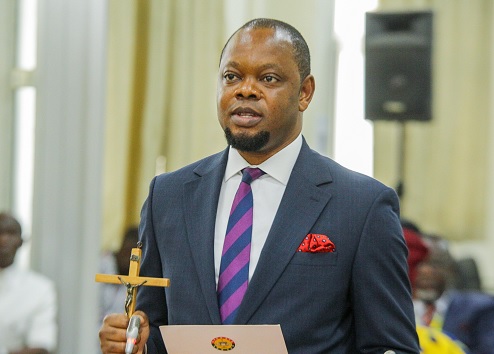
He demands that the Executive perform like a Court, conveniently forgetting that the President, guided by the wisdom of the Deputy Attorney-General, Justice Srem-Sai, is the Sentinel of State Stability, not a robed clerk tethered to a preliminary desk.
To trigger the heavy machinery of Article 146 is to balance the very soul of the Republic on a razor’s edge. If the Deputy Attorney-General’s position appears as a retreat into the "Black Box" of policy, it is because he understands a truth the critic ignores: the total judicialisation of the threshold is a recipe for a paralysed Presidency and a compromised Judiciary.
Kabiru Abdul argues that a prima facie determination must be a "Reasoned Legal Opinion." This is a seductive but lethal proposition. To demand that the President issue a detailed, public justification at the threshold is to ask the Executive to prejudge the Chief Justice before the battle has even begun. Justice Srem-Sai’s refusal to indulge this demand is not an act of opacity; it is an act of constitutional chivalry.
If the President brands the head of the Judiciary with a "Reasoned Opinion" of guilt before the Article 146(4) Committee even sits, he does not uphold justice; he poisons the well. The Deputy Attorney-General rightly recognises that the Executive provides a "Shield of Silence" that protects the dignitary interest of the Chief Justice until a proper, private inquiry can be conducted. To speak too soon is to judge too early; to judge too early is to execute the office before the trial.
The critique treats the removal of a Chief Justice like the mundane dismissal of a civil servant under Article 23. This is a profound category error. We are not haggling over an administrative grievance; we are navigating a sui generis constitutional crisis that affects the balance of powers. Justice Srem-Sai’s logic correctly identifies that we cannot treat the Sovereign’s delegate as if he were a junior manager in a government department.
Where the framers intended for reasons to be published, they spoke with the clarity of a bell. In Article 146, they chose the wisdom of the "Political Buffer", the Council of State. To insist on a legal dissertation at the start is to treat the President like a District Chief Executive rather than the Sovereign Delegate. The Deputy Attorney-General understands that the threshold is a policy filter, intended to sift the frivolous from the factual without turning the Presidency into a "super-court" that renders the subsequent Committee redundant.
The position defended by Justice Srem-Sai finds its most resilient form in what we must call functional transparency. We do not need a legal thesis from the President; we need a "Summary of Satisfaction." This is the bridge between executive prerogative and public accountability that the Deputy Attorney-General has so masterfully navigated.
The President provides a Certificate of Regularity, confirming that the mind was applied to material allegations, without revealing the granular evidence that belongs exclusively to the Committee. It is transparency without exposure; accountability without prejudice. It ensures the Executive is not acting on a whim, but also not acting as a hangman.
Transparency is the antidote to suspicion, but restraint is the guardian of the Bench. The Law does not require the Sun to explain why it rises, but it does require the State to prove it is not acting in the dark. Justice Srem-Sai is the architect of this light, ensuring that the process remains intelligible without becoming inflammatory.
Akaneweo Kabiru Abdul fears a "Perilous Precedent" of opacity. Yet, the greater peril is a Presidency rendered impotent, unable to initiate accountability without first writing a judgment that usurps the Committee’s role. The Constitution is a blueprint for a working State, not a manual for perpetual litigation.
The Deputy Attorney-General’s view is the anchor that holds the ship of state steady in a storm. By adopting this middle path, where the Executive provides enough reason to be rational, but enough restraint to be fair, we do not weaken the Judiciary; we protect the process from becoming its own obstacle.
Independence is not merely the absence of interference; it is the presence of a functional system.
Justice Srem-Sai understands what the critic forgets: that in the high stakes of constitutional governance, restrained discretion is the ultimate form of accountability. It is time to stop asking the President to be a Judge and start allowing him to be the President. The Republic, and the Deputy Attorney-General’s clear-eyed defence of it, demands no less.
Latest Stories
-
Imagination Africa, Mentors Chess Academy to host second African Genius Chess Championship at Ghud Park
1 hour -
Nana B passport claims a diversionary tactic — Abu Jinapor
2 hours -
Pope Leo diagnosed with cancer as doctors remove lobe of lung, Vatican says
2 hours -
Legal Aid Commission takes free legal services to Techiman main lorry terminal
2 hours -
Nana B denies seeking passport favour, accuses Ablakwa of failing to account for GH¢16.4m
2 hours -
Young girls demand climate action, stronger protection against child marriage
3 hours -
Ex-gang boss sentenced to 40 years for orchestrating Tupac Shakur’s murder
3 hours -
From near-deferral to three awards: UMaT graduate’s academic journey
3 hours -
Atta Akyea denies seeking presidential pardon for Wontumi in galamsey case
3 hours -
Photos: Mahama commissions 85-bed Police Hospital ward, donates two ambulances
3 hours -
GTEC directs Ghana’s public universities to reopen by October 16 and begin lectures on October 19
3 hours -
Star Oil donates GH¢1million towards construction of new CID facility
3 hours -
Court hands Adjetey Sowah, two others lifetime bans after Amputee Football legal dispute
4 hours -
NDC appoints Julius Kwame Anthony as a Deputy Communications Director
4 hours -
Ghana repatriates 120 Nigerians rescued from suspected cybercrime centres
4 hours