

Audio By Carbonatix
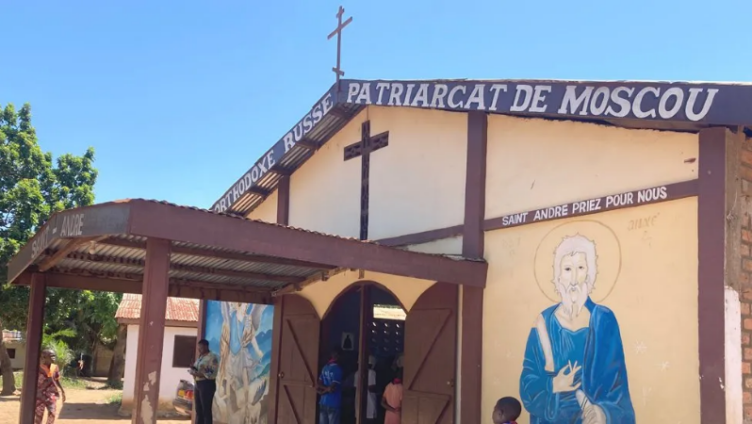
A welcoming atmosphere greets congregants shuffling into the Russian Orthodox Church, tucked away on an unassuming but badly pot-holed side street in the capital of the Central African Republic (CAR).
At first glance there is nothing out of the ordinary about this Sunday morning scene in the mainly Christian country.
But Saint-André-Apôtre, about a 20-minute drive from the centre of Bangui, has come to symbolise for some the friendly ties between Russia and the CAR.
Father Serguei Voyemawa, who runs the country's only Russian Orthodox Church, is dressed in a floor-length white robe covered by an ornate gold cloak. He walks around reciting prayers and swinging an incense burner as the congregation watches his every move.
The walls of the modest building, which has a concrete floor and aluminium roof supported by wooden beams, are adorned with hand-painted images of saints while half a dozen candles burn on the wooden altar.
Fr Voyemawa was initially hesitant about our visit. It came a few months after the death of Wagner chief Yevgeny Prigozhin in August, which has led to increased scrutiny and concern over the growing influence of Russia in CAR and especially the presence of the mercenary group.
Nearly 200 Russian military instructors arrived in the CAR after President Faustin-Archange Touadéra asked for help to tackle rebel groups in 2018.
But according to a report by investigative group The Sentry, in that time Wagner has taken advantage of weak institutions and a weak army to perfect "a blueprint for state capture".
"We've seen them focus on four pillars: political, economic, information, disinformation and propaganda - and the military," Nathalia Dukhan, a senior investigator at The Sentry who has spent many years reporting on the country, tells the BBC.
"They have been infiltrating and compromising these sectors to advance their financial and economic interests. In the mining sector, Wagner has been using the national army to advance and neutralise some of the armed groups that were controlling areas of interest."
Ms Dukhan says the mercenaries are waging a "campaign of terror" and are responsible for widespread human rights abuses including extrajudicial killings, torture and rape.
Earlier this year, the UK proscribed the network as a terrorist group, while the US designated it a "significant transnational criminal organisation".
However, for many Central Africans, after a decade of civil war, the situation is more complex.
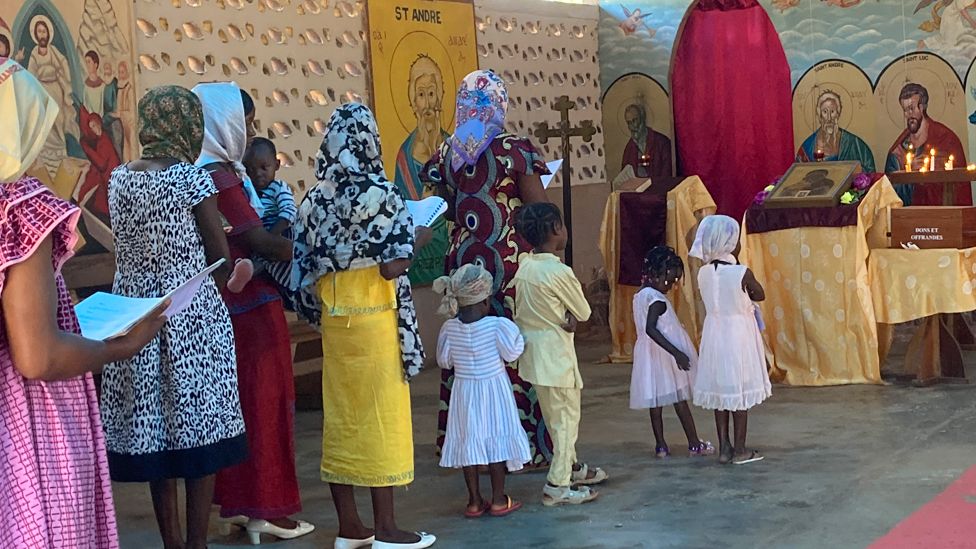
Fr Voyemawa is keen to point out that his relationship with Russia predates the arrival of Wagner forces. He started fundraising for the church in 2010 and building commenced in 2015.
His reluctance to discuss politics is clear: "Our relationship with Moscow is a religious one."
Even so, he tells me how much things have changed since the troops arrived: "We Central Africans are very happy because the Russians are here today and on the security front, well there is peace.
"There is peace in the Central African Republic. It's been five years now that we live in peace, without war."
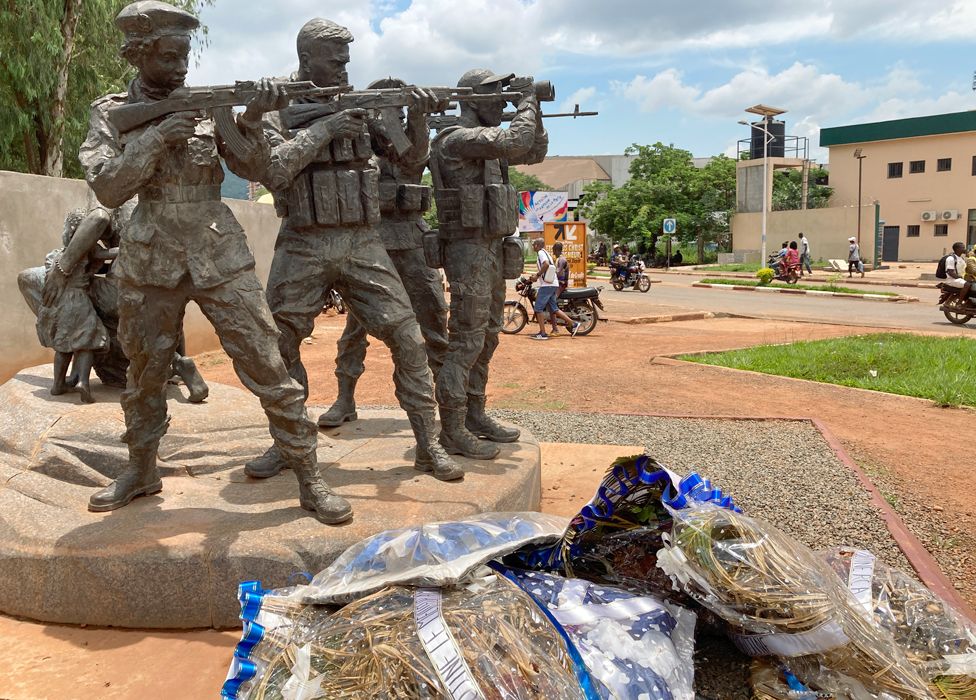
This sentiment has now been immortalised in the centre of Bangui, where a statue of Russian troops shielding a woman and her children stands.
At their feet fading bouquets from August remain with messages for "our best friend Yevgeny Prigozhin".
Pro-Russia sentiment has recently swept across West and Central Africa, where there have been eight military coups since 2020.
Countries including Mali, Niger and Burkina Faso are rejecting former colonial power France, which they say has failed to adequately assist with security challenges.
Many Central Africans echo these feelings.
"We need a win-win partnership. That's why the Russians are here... so that this country can also benefit from future development," says Emery Brice Ganzaléis, a Central African businessman who recently relocated to Bangui after two decades living in France.
"If Russia adopts the same policy as France in Africa, that won't work."
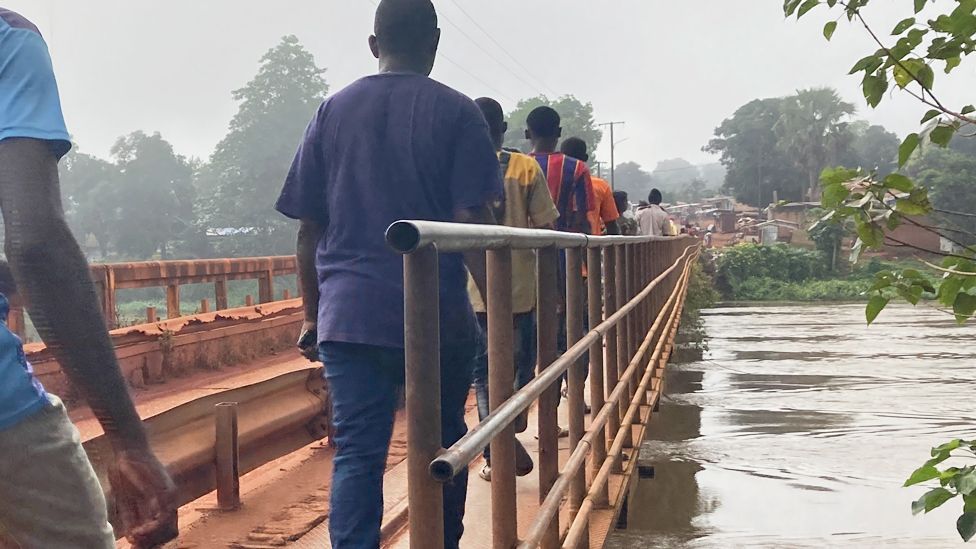
Bambari, the capital of Ouaka region roughly 400km (250 miles) north-east of Bangui, witnessed some of the worst violence during the conflict and illustrates how security has slowly improved.
The only viable way to get to the town is on a UN-operated flight that runs three days a week. Driving is inadvisable and would take days because the roads are either badly dilapidated or non-existent.
It is a stark reminder of the challenges facing the country. So too is the massive presence of the UN mission, known by its acronym Minusca, with trademark blue helmets and white vehicles visible all over town.
Since 2014, Minusca has played an important role in protecting civilians and working with the authorities, but they are not authorised to take sides or fight offensively.
Bambari was still under rebel control two years ago, but is now vibrant and bustling - though the charred remains of burnt-out buildings still dot the town.
The relative peace has allowed 15-year-old Jovanie Renemeya - and the thousands of children who were recruited into armed groups - to hope for a better future.
She was captured as a young girl with her grandmother and taken to work in a rebel camp.
"I was traumatised for a long time," Jovanie says softly, explaining how she endured horrific physical abuse and narrowly escaped being forced to marry one of the rebels.
After a year she and her grandmother managed to escape when going to fetch water. Back with her parents, Jovanie has now started pig farming to save money and she dreams of becoming a doctor.
For Victor Bissekoin, the governor of Ouaka, this return to normality would not have been possible without the intervention of Wagner troops.
"When we have asked for weapons and support from the international community, they put sanctions on us," he tells the BBC.
"In 2021 Russia arrived [here] and within two years helped us to control almost the whole country, apart from some tiny pockets along some borders.
"When your house burns and you shout: 'Fire! Fire!' you don't care if the water you are given is sweet or salty. All you care about is that it extinguishes the flames."

President Touadéra echoes this and defends Wagner's presence in the country.
"It was said that 80% of the territory was occupied by armed groups. Today, thanks to this co-operation, these figures are completely reversed," he tells the BBC during an interview, granted after several days of negotiations, at the presidential palace in Bangui.
The 66-year-old, who controversially won a referendum earlier in the year to remove presidential term limits, often surrounds himself with Wagner forces, and it is the first time we see the mercenaries up close.
Dressed in military fatigues with faces covered by balaclavas, the handful of troops dart in and out of the palace.
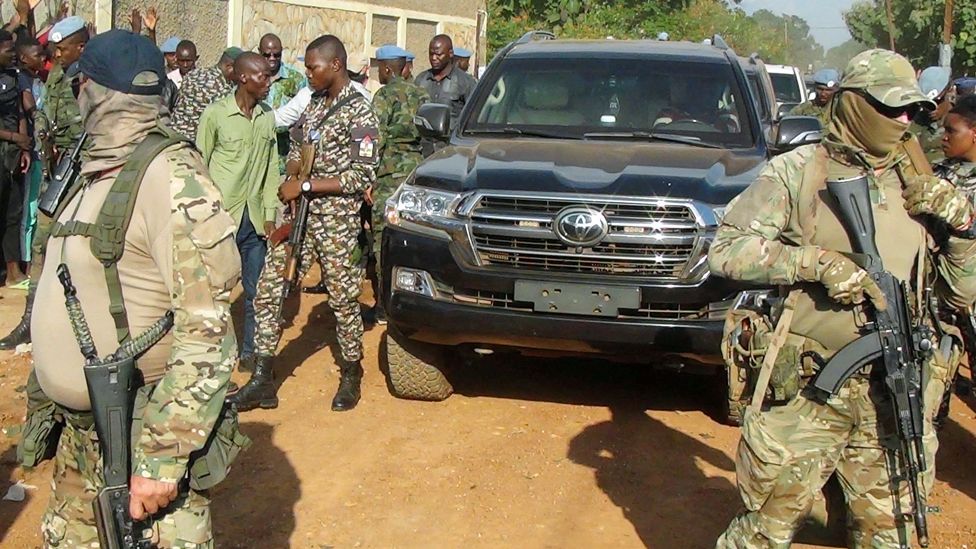
During the interview, the president admits there are still challenges ahead: "We are training our defence forces so that they become professional forces, ready to be deployed to provide security for the population."
When confronted with the allegations that Wagner mercenaries have committed serious human rights abuses, including torture, rape and extrajudicial killings, he says an investigative committee has been set up to verify the claims.
Critics are unconvinced.
"It's very dangerous because [the Wagner Group] are in the economic field, they are in the security field, they are in the political field, and now they are leading the country," former Prime Minister Martin Ziguele tells the BBC.
He initially supported the request for Russian help, but was disappointed when they sent mercenaries from Wagner, a "criminal group".
"They are totally free to do what they want, to go where they want, and to decide what they want," he says.
President Touadéra refuses to give a date for the eventual withdrawal of Wagner, emphasising the need for peace first.
Ms Dukhan maintains this is part of Wagner's strategy of infiltration, making the country dependent.
It had been thought that Wagner's power in Africa would wane after Prigozhin's failed mutiny against Russia's President Vladimir Putin and then his death. But the group has not been disbanded and its fighters are yet to be fully absorbed into the Russian army.
"They've been reorganising, redeploying their men and their equipment," says Ms Dukhan. "At first, some interpreted that as departure, but it wasn't. It was simply a reorganisation."
And it certainly appears to be business as usual in the CAR. One clear sign of this is a sighting at the presidential palace of two unmasked Russian men, who are hurriedly whisked in to see the president as we wait for our interview.
One of them is top Wagner official Dmitry Syty, who was spotted beside Prigozhin in the last video he posted before his death and is rumoured to be the group's new frontman.
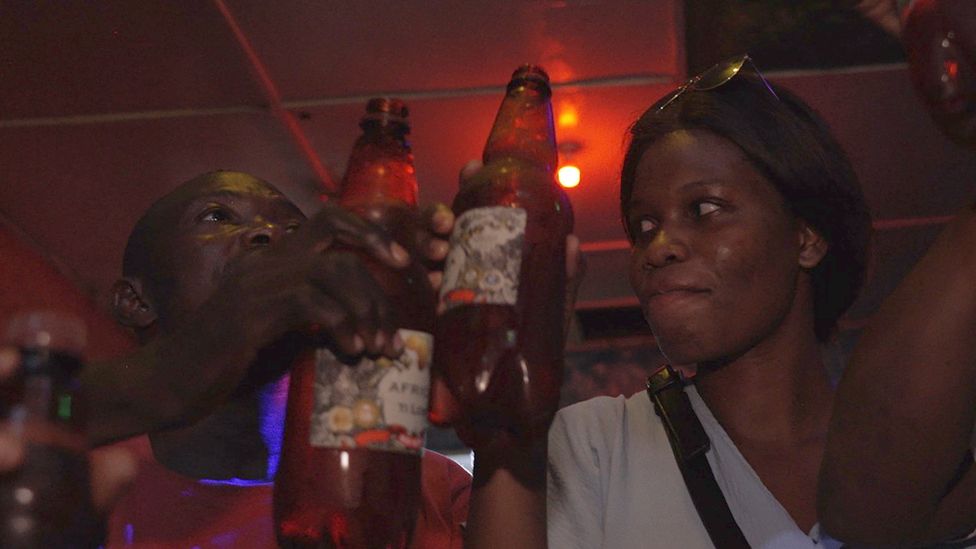
Another indication are the signs all over Bangui advertising Africa Ti L'Or, a new Russian beer.
At the city's Cave bar, it is apparent the aggressive marketing campaign has already won over some customers.
"I wish there were more of [it] in the Central African Republic," says Max Franklin as he nurses his Africa Ti L'Or, which is regarded as more potent than local beer and better value as it is sold in bigger bottles.
Latest Stories
-
Glut! Farmers count losses as prices crash, customers happy
17 minutes -
GSA postpones auction of unserviceable vehicles
19 minutes -
Man charged with attempted murder after stabbing
23 minutes -
World Cup visa scandal: Senyo Hosi says issue goes beyond calls for Sports Minister’s resignation
24 minutes -
Yaw Ampofo Ankrah hasn’t taken or received any money to facilitate visas – Lawyer insists
42 minutes -
World Cup visa scandal: Senyo Hosi urges focus on constitutional accountability
42 minutes -
La Beach demolition: Senyo Hosi condemns lack of consultation
54 minutes -
Russian glide bomb attack on Zaporizhzhia kills at least 15 people
1 hour -
Jinapor warns underperforming energy sector CEOs of consequences, says no protection for failure
1 hour -
Fire destroys head of tipper truck on Lower Volta Bridge
1 hour -
Palmer signs new Chelsea contract until 2034
1 hour -
World Cup visa scandal: Mahama will act on corruption allegations – Abass Nurudeen
1 hour -
Abass Nurudeen accuses Minority of ‘scandal scavenging’ over World Cup visa controversy
1 hour -
US Embassy recognised NSA, GFA and GTA as separate entities for visa applications – Sports Minister’s aide
1 hour -
Only 30% of Ghanaian teachers satisfied with their jobs – CAPCOE data reveals
2 hours