

Audio By Carbonatix
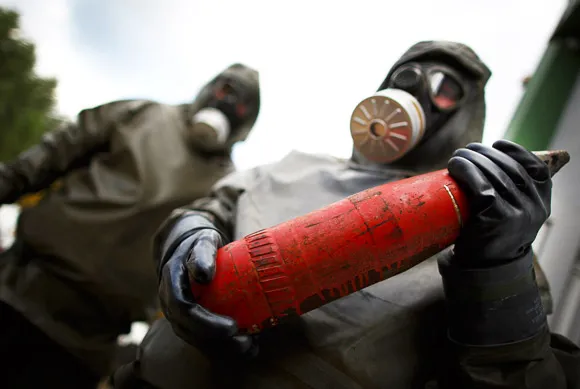
Chemical contamination resulting from the use of chemical weapons in Sudan has caused human casualties, material destruction, agricultural damage, and deaths linked to respiratory failure.
This has driven Sudanese rights organizations to pursue international accountability for Port Sudan’s military authorities over chemical strikes.
The Sudanese rights group SAR filed a case before the International Criminal Court (ICC) demanding an investigation into the army’s use of chemical weapons, following U.S. confirmation that such attacks did take place in 2024, leading to sanctions on Port Sudan authorities.
Lawsuit and Investigation
On September 25, the Sudanese Alliance for Rights submitted a formal complaint to the ICC, requesting an investigation and prosecution of those responsible for deploying chemical weapons during Sudan’s civil war.
The group directly accused Abdel Fattah al-Burhan, Chairman of the Sovereignty Council and army commander; Yasir al-Atta, deputy army commander; Shams al-Din al-Kabbashi, Sovereignty Council member and army deputy commander-in-chief; and Major General al-Tahir Mohamed, former commander of Sudan’s special forces.
The alliance also filed a complaint with the African Commission on Human and Peoples’ Rights regarding the use of chemical weapons against civilians, and sent a letter to the head of the Organization for the Prohibition of Chemical Weapons urging investigations and suspension of Port Sudan’s membership.
The group said it awaits the ICC’s move to investigate Sudan’s use of chemical weapons, in order to impose sanctions that would prevent their recurrence amid the ongoing conflict and the military authorities’ refusal to engage in peace talks with rival factions, foremost the Ta’sis Alliance.
U.S. Sanctions
The United States disclosed evidence confirming that Sudan’s army used chemical weapons at least twice last year. State Department spokesperson Tammy Bruce said: “Under the 1991 Chemical and Biological Weapons Control and Elimination Act, the United States has determined that the Government of Sudan used chemical weapons in 2024.”
She added that, under the Chemical Weapons Convention, Sudan was in violation of its obligations as a signatory, and that Washington would impose sanctions including restrictions on U.S. exports to Sudan and limits on access to U.S. government credit. She called on Sudan “to cease the use of chemical weapons and comply with its commitments under the Chemical Weapons Convention.”
In January, The New York Times reported, citing four senior U.S. officials, that Sudan’s army had deployed chemical weapons at least twice during the conflict, using them in remote areas of the country.
Worsening Humanitarian Crisis
The chemical strikes of 2024 poisoned agricultural soils, reduced arable land, and led to crop failures, according to testimonies collected by the Sudanese rights group Emergency Lawyers.
One witness, who asked not to be named, said his sorghum fields no longer produced crops, declaring all his agricultural projects ruined due to “soil poisoning.” Another witness, his neighbor, reported massive livestock deaths between May and July 2024 in the Al-Rifaiyeen plains stretching from Jabal Moya to Daly and Al-Mazmoum. He said thousands of sheep perished without clear cause, alongside the collapse of his farming projects.
The breakdown of agricultural production has intensified Sudan’s humanitarian crisis, pushing regional and international actors to mobilize aid. In April 2023, the French capital Paris hosted the “Paris Conference” on Sudan, which concluded with pledges of more than 2 billion euros in humanitarian support for civilians amid the conflict that erupted in mid-April 2023.
Latest Stories
-
GHIMA sounds alarm over unlicensed practitioners handling health data, warns of threat to patient safety
8 minutes -
Old Edubiase pupils turn to trading, farming as teachers’ strike disrupts schooling
10 minutes -
Energy Minister commends NPA CEO for maintaining petroleum market stability amid global shocks
16 minutes -
Armah-Kofi Buah, Sam George, other MPs among newly qualified lawyers
24 minutes -
Ghana exporting eggs to Burkina Faso amid local surplus – Agric Minister
24 minutes -
Governance failure in Ghanaian football and a presidential reform agenda
30 minutes -
IJM Ghana welcomes country’s upgrade to Tier 1 in 2026 Trafficking in Persons report
32 minutes -
REAC urges stakeholders to comply with Real Estate Act or face sanctions
32 minutes -
‘Nkoko Nketenkete’ boosts local poultry production from 4.6% to 22% in one year – Agric Minister
56 minutes -
ARK Foundation boss warns against stigmatisation of abuse victims
1 hour -
Health investment beginning to improve access to care – Akandoh
1 hour -
“It is meaningless” – Parent laments as teachers’ strike leaves boarding school students idle
1 hour -
Austin Gamey predicts possible end to teachers’ strike, urges better negotiation
1 hour -
Mahama and Trade Minister champion local manufacturing during Ghato Foods visit
1 hour -
Labour Minister, ILO Country Director strengthen partnership on decent work and jobs
1 hour