

Audio By Carbonatix
The day after Carlos Queiroz left the Black Stars as head coach, the Sports Minister sat the GFA down and handed over seven directives. The technical team and the national team management committees would be dissolved. Separate men’s and women’s committees would replace them. A five-member panel would help find the next coach, and the GFA would not be allowed to appoint one alone. It looked decisive, and some of it is sensible. But nothing in those directives asks who sits at the table where Ghana’s football decisions are made, whose interests they serve, or who is allowed to check them. We have been here before, and the paper trail proves it.
The “cocoa season” problem
The slide of Ghana football is a mirror of how we treat wrongdoing generally. We pay lip service, we move on, and we quietly frown on anyone who keeps asking for accountability, because too many people are busy getting theirs. Government has helped by treating sport as a field that runs itself. Money appears when the Black Stars qualify and tournaments need funding, and the league, women’s football and grassroots are left to cope in between. The national team becomes a cash cow, and everyone near it knows when the harvest is.
The Dzamefe Commission, set up after the 2014 World Cup in Brazil, put numbers on it. US$4 million in cash was flown to the tournament, and US$122,500 of it was never accounted for. Supporters’ catering left GH¢189,000 unexplained, and unused match tickets cost US$75,150. Some US$900,000 separated the World Cup prize money Ghana expected from what arrived. Management appearance fees of US$577,500 were collected for seven committee members when only five were in Brazil, a matter the government’s own White Paper called “unfinished business” before handing it to the BNI.
The White Paper also accepted a reform architecture: a Public Interest Committee with a government-appointed chair sitting between the ministry and the GFA, a separate and publicly accounted bank account for national team sponsorship money, performance contracts for management committees, no more cash lifted to tournaments, and enforcement of the FIFA Standard Cooperation Agreement. The 2025 GFA Statutes contain none of it. The cooperation agreement is back as directive number seven, eleven years later.
What the GFA Statutes protect
Read the 2025 Statutes next to the Dzamefe findings and the design becomes plain.
The Executive Council has twelve seats: the President, 5 Premier League representatives, 3 Division One representatives, 1 person from the Women’s Premier League, and 2 regional FA chairpersons. Every one belongs to the game’s existing constituencies. There is no independent director and no supporter. In my opinion, this is deliberate and not accidental. Annex A requires every Executive Council candidate to have held an active role in football within the GFA or a member body in two of the last five years, which rules out an outsider by definition.
Congress, the body that could change this, is built to protect it. Clubs hold 92 of its 124 delegates, equivalent to 74 per cent. Amending the Statutes needs three-quarters (75%) of delegates present, so if everyone shows up, the clubs alone are one vote short of passing an amendment and more than strong enough to block one. Only members and the Executive Council can table proposals, so government and supporters have no standing to put anything on the agenda.
There are smaller leaks. The Executive Council proposes the members of the independent committees that are supposed to judge it. The chair of the Referees Committee must be an Executive Council member. Integrity checks apply only to the President, and pending investigations are merely disclosed. A President’s earlier terms as a council member do not count against his three-term limit, which opens the door to twenty-four years in office. And Article 73 declares the GFA and its members original owners of all competition rights, which sits awkwardly with the White Paper’s principle that national team revenue belongs to the people of Ghana.
What the England FA changed
England reached its own reckoning after the failed European Super League. The government commissioned a Fan-Led Review of football governance that took evidence from supporters’ representatives of more than 130 clubs, along with administrators, players and independent experts. An online survey drew over 20,000 responses. The principle was simple: fans are not just customers, and their experience should help shape the rules of the game.
The FA then rebuilt its board in July 2023. It now has ten directors: an independent non-executive chair, a chief executive, 4 independent non-executive directors (one of them the senior independent director), 2 National Game directors and 2 Professional Game directors. Both the National and Professional Game sides gave up a seat, going from 3 directors to 2, to make room for independent scrutiny. Half the board now answers to no club. Ghana’s has none.
Parliament backed it with law. The Football Governance Act 2025 created an Independent Football Regulator with licensing powers, financial oversight, a tougher test for owners and directors, and duties around fan engagement.
The real question about independent directors is whether they can judge without being beholden to the people they scrutinise. In Ghana, it will matter that an “independent” director is not simply the GFA president’s ally or the minister’s nominee under a new title.
Spain and Portugal
Two other models are worth a glance because they show how a state can push without being banned.
Spain’s Law 39/2022 gives the state a supervisory role over federations in matters of general interest, and the national sports council ratifies their regulations. After the Rubiales scandal and a criminal probe into his interim successor, the council created a supervisory commission in 2024, made up of up to five independent figures and chaired by Vicente del Bosque. FIFA and UEFA said they would check whether it threatened the federation’s independence. Spain stayed in both.
Portugal pulled a different lever. The state suspended the federation’s public-utility status in 2010 while FIFA and UEFA pressed for statutes aligned with national law. The 2011 statutes, passed against resistance from regional associations that held half the votes, gave players, coaches and referees seats in the assembly. A later amendment stopped federation office-holders from serving as active club or league officials. Portugal’s problem of persuading entrenched voters to give up power is Ghana’s problem too.
A plan that fits Ghana
Copying is no shame; repeating the same crisis is. Five moves would start the work:
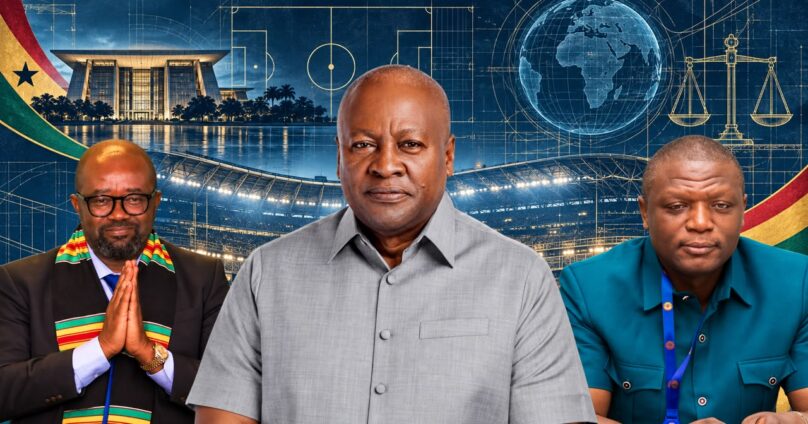
- A presidential mandate: The President of Ghana, his excellency John Dramani Mahama, must as a matter of urgency and to demonstrate political will, based on his RESET agenda, take decisive action by creating a time-bound Football Governance Task Force with regional hearings and written submissions from fans, players, coaches, women’s football and grassroots clubs, and publish what it finds.
- A restructured Executive Council: 12 seats could be split like this: the President, 2 Premier League, 1 Division One, 1 women’s league and 1 regional FA representative, plus 1 player, 1 supporters’ representative and 4 independent directors with defined portfolios in finance, governance, commercial development and safeguarding. Half the table would sit outside the club bloc. Independence would need real rules: declarations of interest, enforceable recusal, cooling-off periods and open appointments.
- A supporters’ council with consultation rights, a route into Congress, and a duty on the GFA to respond in writing.
- A restored Public Interest Committee and a ring-fenced, published national team account, with a multi-year budget for all national teams, no cash to tournaments and accounts published within 60 days of each one.
- Legislation: The National Sports Authority Act, 2016 (Act 934) should be amended to add a fit-and-proper test for federation officers, audit access to public money and conditions on state funding, with the Sports Fund used to end the boom-and-bust financing of the national team.
Because no federation holds well without clear lines, the three bodies must each have a job. The Ministry sets policy, funds the game and negotiates with FIFA and CAF, and it should not pick coaches. The National Sports Authority becomes the independent auditor, with powers to demand books, certify compliance and withhold public money. The GFA runs competitions, the local league, clubs, referees and national teams with real autonomy, in return for open books and greater accountability as per recommendations above. A quarterly Football Governance Council would bring them together, publish its decisions within a week, and report jointly to Parliament once a year. A sanctions ladder, from public warning to withheld funding to referral for prosecution, would apply without exceptions.
The aim is attractive football: full, safe stadiums, a league clubs can genuinely live off, visible pathways from school pitch and colts league to national team, and a women’s game that plays regularly.
If government and the GFA are serious, the clock is short. Within 30 days, name the Task Force and sign the cooperation agreement. By 90 days, publish the findings. By 180 days, hold an Extraordinary Congress to vote on the new Statutes. By a year, seat the first independent directors and publish the first national team audit.
None of this should cost Ghana its FIFA membership if it is done through Congress and with FIFA and CAF in the room from day one. In 2018, after “Number 12”, the government went to court to dissolve the GFA, FIFA threatened a ban over interference, and a normalisation committee ended up running the game instead. That is what confrontation costs.
What remains unclear is whether those who benefit from the present arrangement will surrender some control. In 2015 the state accepted a blueprint for reform. Ten years later, the GFA’s Statutes still don’t contain it. The test of this crisis is whether it ends with another committee or with a new constitution.
Latest Stories
-
Ernest Kwasi Okoh
40 seconds -
The Trotro has become a House of Worship!
8 minutes -
Fire guts Zeko Genius spare parts depot in Techiman; firefighter hospitalised after smoke inhalation
9 minutes -
Common insecticides linked to lower sperm concentration in men, study finds
10 minutes -
CXP urges businesses to localize AI to improve customer experience
15 minutes -
TUC calls on government to urgently address striking teachers’ grievances
20 minutes -
GHIMA sounds alarm over unlicensed practitioners handling health data, warns of threat to patient safety
40 minutes -
Old Edubiase pupils turn to trading, farming as teachers’ strike disrupts schooling
43 minutes -
Energy Minister commends NPA CEO for maintaining petroleum market stability amid global shocks
48 minutes -
Armah-Kofi Buah, Sam George, other MPs among newly qualified lawyers
56 minutes -
Ghana exporting eggs to Burkina Faso amid local surplus – Agric Minister
57 minutes -
Governance failure in Ghanaian football and a presidential reform agenda
1 hour -
IJM Ghana welcomes country’s upgrade to Tier 1 in 2026 Trafficking in Persons report
1 hour -
REAC urges stakeholders to comply with Real Estate Act or face sanctions
1 hour -
‘Nkoko Nketenkete’ boosts local poultry production from 4.6% to 22% in one year – Agric Minister
1 hour