

Audio By Carbonatix
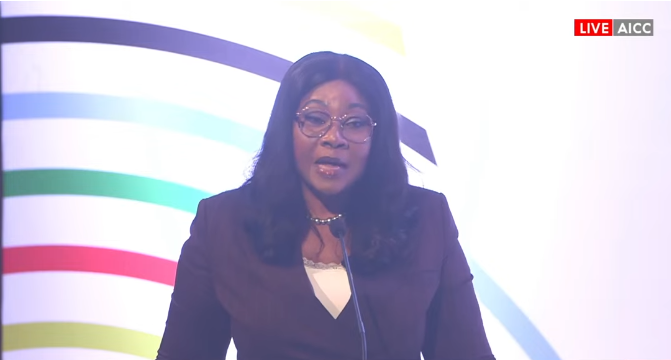
The second Deputy Governor of the Bank of Ghana (BoG), Matilda Asante Asiedu, has warned that Africa’s ambition of building a truly integrated continental market will remain unattainable without efficient, affordable and reliable cross-border payment systems.
Speaking at the 2026 Africa Prosperity Dialogue at the Accra International Conference Centre (AICC) on Wednesday, February 4, Mrs Asiedu said trade agreements alone are not enough to drive economic integration under the African Continental Free Trade Area (AfCFTA), stressing that payment systems are the backbone of trade.
According to her, the absence of secure and dependable mechanisms for transferring value continues to undermine Africa’s trade potential, despite the continent’s vast economic opportunities.
“Without secure, affordable, and reliable means of transferring value, the promise of a truly integrated African market cannot be achieved,” she stated, describing payment systems as strategic trade infrastructure critical to monetary stability, financial integration, and long-term economic transformation.
She noted that cross-border payments within Africa remain among the most expensive and inefficient globally, with transaction costs ranging between 7 and 10 per cent, compared to a global average of about 3 per cent.
She added that settlement times can take anywhere from several days to weeks, further constraining intra-African trade.
Mrs Asiedu, however, pointed to the AfCFTA as a major opportunity to reverse the trend, highlighting that the agreement brings together a market of more than 1.5 billion people with a combined GDP of approximately $2.8 trillion.
She said fully implementing the AfCFTA could potentially double intra-African trade in the medium term, but cautioned that such growth would only materialise if Africa’s payment systems are aligned with its trade ambitions.
Despite existing challenges, the second Deputy BoG Governor expressed optimism, noting that Africa has already demonstrated global leadership in digital finance and innovation.
She cited the continent’s dominance in mobile wallet usage, accounting for more than half of the world’s total, as evidence of its capacity to leverage technology for financial inclusion and economic transformation.
Ghana, she said, stands as a notable example of how digital finance can expand access to financial services and improve livelihoods.
"With more than half of the world's mobile wallets being on the continent, we've shown that with technology we can expand financial inclusion, transform livelihoods, and Ghana stands as a notable example.
"But for digital finance to be fully empowered, and for Africa's single market to explode, inclusion must not just be within borders. It must extend beyond individual country borders," she added.
Latest Stories
-
MTN Ghana trains civil society organisations on artificial intelligence
11 minutes -
GoldBod FX framework aims to make dollar supply predictable – Acheampong
46 minutes -
How does a Ghanaian team make it to the BAL?
53 minutes -
Ghana’s investment climate presents opportunities for industrial growth and job creation.
54 minutes -
‘I paid thousands to a company for jobs that never came’
1 hour -
SSNIT intensifies informal sector enrolment drive with Techiman float
2 hours -
Ghana seeks long-term mining investments that benefit local communities – Armah-Kofi Buah
2 hours -
GHATOF demands compensation for 85 businesses affected by La Pleasure Beach demolition
2 hours -
Bono Regional Minister calls for investor education to drive economic growth
2 hours -
Ghana’s Ambassador to China, Kojo Bonsu, presents credentials to Nepalese President
2 hours -
Fairtrade Africa’s Cocoa Hubs Project strengthens rural service centres in cocoa-growing communities
2 hours -
MPs are not development officers – Edem Kpotosu
2 hours -
SEC cautions investors against fraudulent investment schemes
2 hours -
Land Ministry urges rCOMSDEP operators to reserve earnings for land reclamation
2 hours -
Commercial drivers give authorities one week to clear traders from lorry terminals, bus stops
2 hours