

Audio By Carbonatix
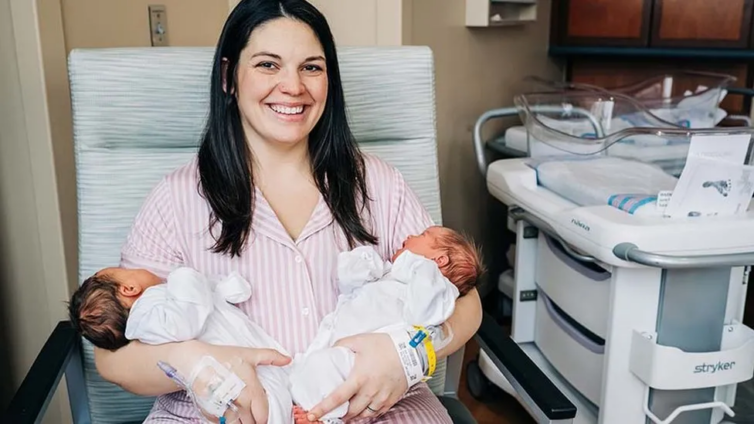
A US woman with a rare double uterus has given birth twice in two days - after a "one in a million" pregnancy and a total of 20 hours in labour.
Kelsey Hatcher, 32, delivered one daughter on Tuesday, and a second on Wednesday, at the University of Alabama at Birmingham (UAB) Hospital.
Announcing the arrival of her "miracle babies" on social media, Ms Hatcher hailed the medics as "incredible".
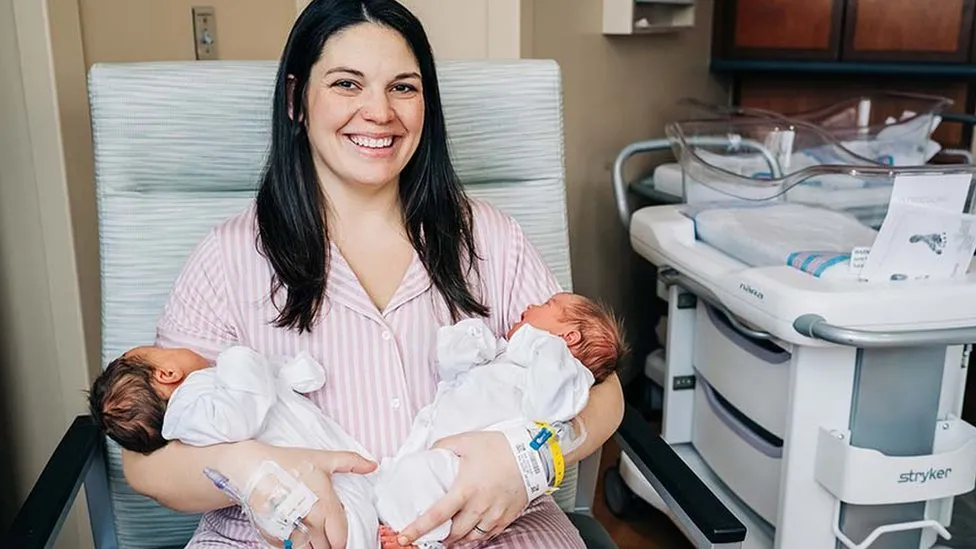
The girls are described as fraternal twins - with rare separate birthdays.
Hatcher said the family was now back at home and could "enjoy the holidays". She had previously expected a Christmas due date.
The mother was told at age 17 she had a double uterus (uterus didelphys) - which the UAB described as a rare congenital anomaly affecting 0.3% of women.
And the odds of becoming pregnant in both uteri - a dicavitary pregnancy - were even slimmer, at "one in a million", according to the UAB.
Reported cases worldwide are extremely rare. In 2019, a doctor in Bangladesh told the BBC a woman had given birth to twins almost a month after delivering a premature baby in her other uterus.
Ms Hatcher had three previous, healthy pregnancies. This time, she believed herself to be pregnant in only one uterus - until a routine ultrasound revealed there was also a baby in her second.
"I gasped... We just could not believe it," she recalled.
She went on to document her unusual journey on Instagram. One update at 38 weeks asked: "What the heck?! HOW have we made it this far?!"
UNIVERSITY OF ALABAMA AT BIRMINGHAM
The UAB described her pregnancy as routine. Prof Richard Davis, who co-managed the delivery, pointed out that each baby had enjoyed "extra space to grow and develop".
This was because each baby had a womb to itself, he said - unlike in a typical twin pregnancy.
Ms Hatcher's labour was induced at 39 weeks and required double the monitoring and charting at the hospital - as well as double the staffing.
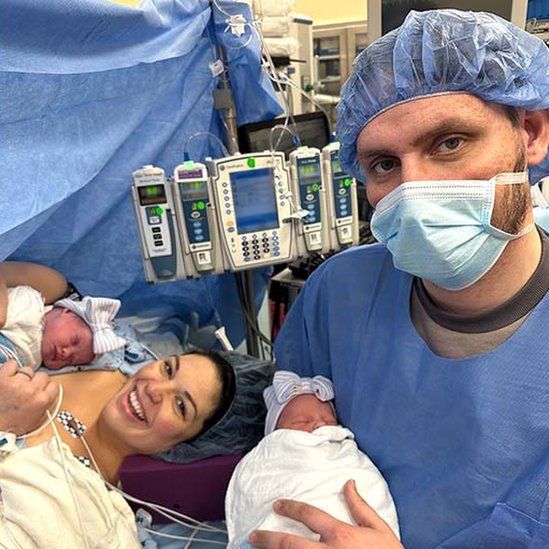
Her obstetrician described "a cheer from everyone in the room" when the first baby was delivered vaginally at about 19:45 local time on 19 December.
The second came by C-section more than 10 hours later, at about 06:10 the following morning.
Prof Davis said the girls could be called fraternal twins - a term used when each baby develops from a separate egg, each fertilised by a separate sperm.
"At the end of the day, it was two babies in one belly at the same time," he said. "They just had different apartments."
Latest Stories
-
Power restoration fault suspected in Kumasi Central Market fire
1 hour -
The 7-foot giant of Ngleshie Amanfro: Seven-foot Ghanaian Ephraim Saawa dreams of joining the national basketball team
2 hours -
Government promises support for Kumasi Central Market fire victims
2 hours -
Vibes The Movie: Big Ghun’s Ghanaian film earns five nominations at 2026 REFFA
3 hours -
MamaCare CEO warns unresolved conflicts among health workers could undermine maternal and neonatal care
3 hours -
Health professionals urged to translate medical knowledge into practice to save mothers
3 hours -
Conflicts among care providers linked to maternal, neonatal deaths – Expert
5 hours -
GIS marks 10th TIME conference, champions improved teaching practices
5 hours -
BRICS Or Balance? What Ghana’s bid really means
5 hours -
GPRTU wants full TRAFFITECH-GH implementation to start in 2027
6 hours -
Mahama announces plans to import electric wheelchairs for PWDs
6 hours -
KGL U17 Colts 2026: Western beat Prempeh Elite Academy to set up final final with Greater Accra Region
6 hours -
Late Solanke strike salvages 10-man Spurs draw at Man United
6 hours -
Gender Ministry to monitor welfare of Nana Akua Addo’s children amid domestic violence case
6 hours -
Benedict Okyere Yeboah: Ghana’s football problem goes beyond sacking a coach
6 hours