

Audio By Carbonatix
Ghana’s inflation of 40.1% is the 4th highest in Sub-Saharan Africa in 2023, the World Bank October 2023 Africa Pulse Report has revealed.
Zimbabwe is 1st with more than 80% inflation and is followed by Sudan (60%) and Sierra Leone (42%).
According to the report, food and energy prices are still contributing to driving headline inflation in most countries in the region.
By July 2023, it said, nearly half of the countries in the region with monthly available information on food prices (20 of 41 countries) had double-digit year-on-year rates of food inflation, with the fastest increases experienced in Burundi, Ghana, Malawi, Sierra Leone, Sudan, and Zimbabwe.
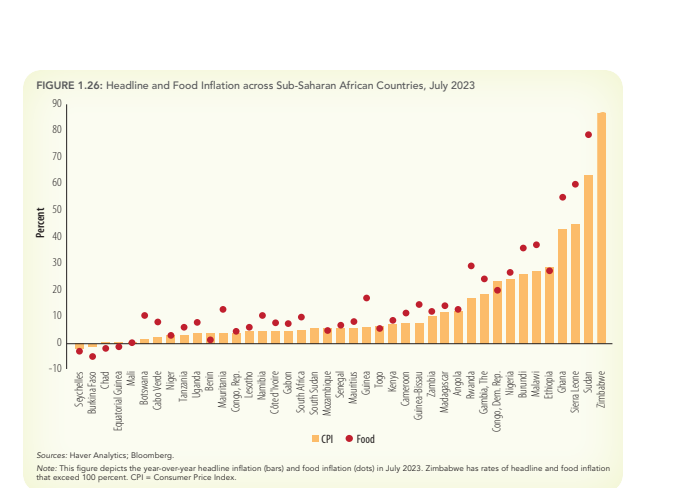
The report furthered that there has been progress in the fight against inflation in several countries in the region with some of them having already reduced inflation to near or within the central bank target band for example, Kenya, South Africa, and Uganda.
“In other countries, inflation still remains above target and has been for a prolonged period of time and/or shows no sign of having peaked Ghana, Nigeria, and Sierra Leone”, it added.
Despite the disinflation trend exhibited by some countries in the region, the report stressed that the rates of consumer price growth are still high, above target, and above pre-pandemic levels for others.
In contrast, the rate of inflation in four countries in the region is expected to accelerate by more than 10 percentage points in 2023 from last year, namely, the Democratic Republic of Congo, Ghana, Sudan, and Zimbabwe.
Inflation for August 2023 falls to 40.1%
The year-on-year inflation for the month of August 2023 fell to 40.1% from the 43.1% recorded in July 2023, the lowest in 12 months.
According to data from the Ghana Statistical Service, Food inflation witnessed a decrease to 51.9% in August 2023, from 55.0% the previous month.
Non-food inflation also dropped by 2.9% to 30.9% in August 2023.
For the first time in the year, inflation for imported products recorded a rate lower than locally produced items. Whilst inflation for locally produced items was 42.4%, inflation for imported items was 36.2%.
Latest Stories
-
US, Iran fail to reach peace agreement after marathon talks in Pakistan
3 minutes -
ECG kicks off Phase Two of transformer upgrades at Lashibi; brief outages expected
37 minutes -
Port crises loom as 11,000 drivers threaten four-day strike
1 hour -
A source of excellence across generations – Vice President Opoku-Agyemang lauds Mfantsipim
2 hours -
(Photos) Mfantsipim School launches historic 150th anniversary
3 hours -
Knights and Ladies of Marshall group backs Catholic Bishops’ stance on anti-LGBTQ+
4 hours -
Bright Simons writes: All the Filla in the Ibrahim Mahama/E&P – Gold Fields Saga
4 hours -
Monetise Idiocy In Ghana
4 hours -
The Ghanaian prophet and the mysterious death of his scottish wife Charmain Speirs
5 hours -
Nearly 400 sentenced in Nigeria for links to militant Islamists
5 hours -
Ghana’s recovery supported by gold strength despite global oil price pressures – Standard Bank Research
5 hours -
Methodist Church hails Mfantsipim@150; calls for “fresh consecration” to excellence
6 hours -
‘Excellence is our inheritance’ – Nana Sam Brew-Butler hails Mfantsipim’s 150-year reign in leadership
6 hours -
Kwaku Azar writes: A-G vs OSP
6 hours -
Mfantsipim–Adisadel rivalry built excellence, not division – Sam Jonah
6 hours