

Audio By Carbonatix
Ghana’s efforts to reduce plastic pollution are gaining momentum, driven by collaborative action and growing commitment from the private sector.
At the heart of this momentum is the Voluntary Pact to Reduce Single-Use Plastics, a business-led initiative co-designed by Plastic Punch, a local environmental NGO, in partnership with Ghanaian businesses and supported by the German Development Cooperation, under the global program, Go Circular.
The initiative is backed by the Ministry of Environment, Science, and Technology (MEST) and the Environmental Protection Authority (EPA).
The Voluntary Pact brings together supermarkets, retail businesses, banks, and markets across Ghana, committed to cutting single-use plastics (SUP) by 50% by 2030.
Inspired by best practices from Germany, Kenya or Rwanda, the Pact adopts home-grown solutions to reduce single-use plastic consumption, with a focus on consumer behaviour change.
A flagship campaign under the Voluntary Pact is the “Bag the Habit of Single-Use Plastic,” encouraging Ghanaians to refuse, reduce, and reuse single-use plastic bags.
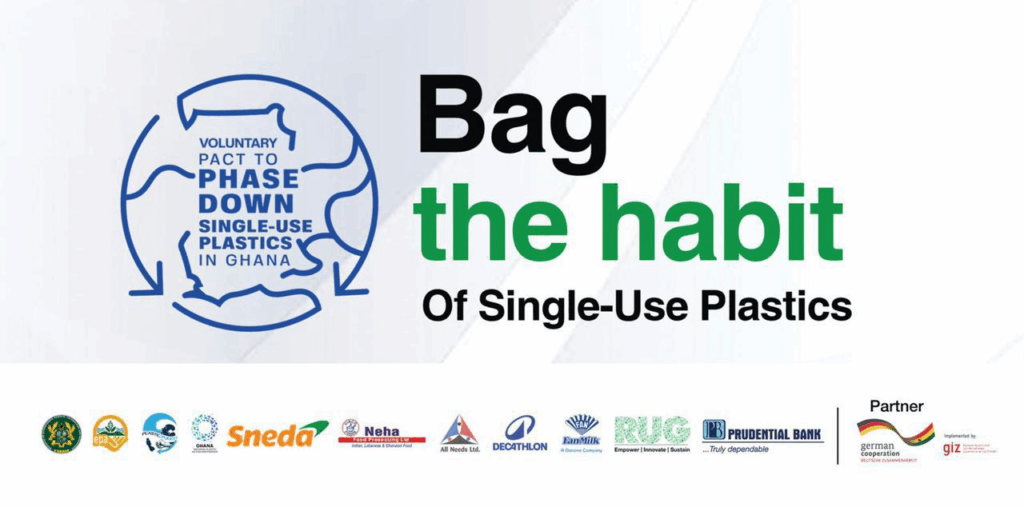
It supports existing advocacy and regulatory efforts, reinforcing the idea that the shift starts with everyday choices.
To mark the 2025 World Environment Day, key stakeholders from the EPA, Plastic Punch, the Food and Beverage Association of Ghana (FABAG), and SNEDA Supermarket have emphasised the urgent need for policy reforms, business leadership, and public engagement on single-use plastics.
According to Hobson Agyapong, Principal Programme Officer, Intersectoral Network Development at EPA, “single-use plastics pose a real threat to our environment.
The collaborative spirit behind the Voluntary Pact helps us build bridges between regulators, civil society, and the private sector to create practical solutions.”
One key measure being piloted is a 50-pesewa fee on plastic bags, encouraging consumers to switch to reusable alternatives.
Richmond Quarcoo, Executive Director of Plastic Punch, shares that “charging for plastic bags may seem small, but it is a powerful behavioural nudge, and it prompts consumers to bring reusable bags and think differently about waste.”
Supermarkets part of the Voluntary Pact, including SNEDA, All Needs Supermarket (Legon), and Neha Supermarket, are already rolling out the Bag the Habit campaign.
While supermarkets are a visible source of plastic bag consumption, other sectors, particularly Ghana’s vibrant food and catering industry, are also major contributors to plastic waste and play a crucial part in the solution.
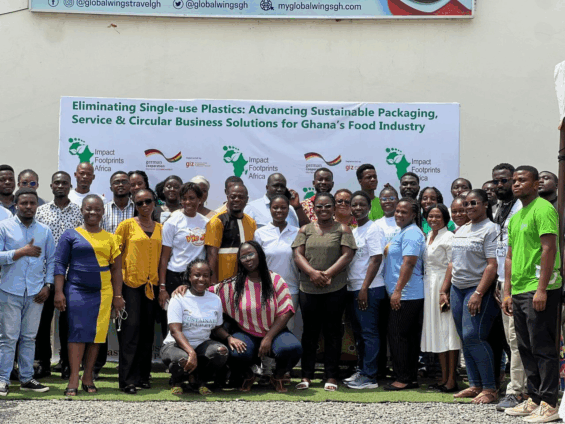
To address this sector, the Go Circular Project recently completed its Business Development Programme for Circular SMEs, in partnership with Impact Footprints Africa.
The initiative supports small and medium-sized enterprises in the food and catering sector, demonstrating that in this space, it is possible to reduce reliance on single-use plastic.
Participating SMEs are reintroducing sustainable, locally rooted practices, like wrapping waakye in leaves or switching to paper bags, reusable jars, and crates.
From Accra’s supermarkets to local food vendors, a national shift is underway. As Ghana rewrites its plastic story, the Voluntary Pact stands as a growing movement and a shared responsibility for a cleaner, more circular future.
Latest Stories
-
NCA announces major voice and data disruption across Northern Ghana due to fibre cuts
27 minutes -
Photos: Housing solutions take centre stage at Day 2 of the 3rd Republic Bank-JoyNews Habitat Fair
59 minutes -
Video: Immunity should be exercised without creating classism – Inusah Fuseini on cocaine bust
2 hours -
Ghana Air Force passes out 293 recruits after six months of intensive training
2 hours -
EOCO vrs Baffour Awuah: EOCO should have secured warrant before arrest attempt at court – Inusah Fuseini
2 hours -
Triple fibre cuts disrupt telecom services across Northern, Oti regions – Sam George
2 hours -
Politicisation could undermine parliamentary probe into cocaine seizures – Dr Osae-Kwapong
2 hours -
EOCO chases MP: Can Section 41 cure lacuna in EOCO Act? – Inusah Fuseini asks
2 hours -
GNFS, GWL inspect fire hydrants in Ministries enclave; 23 found faulty
2 hours -
Gov’t directs release of 50,000 bags of grain to ECOWAS
2 hours -
Ghana, Germany deepen cooperation on railways, labour mobility
2 hours -
Huge crowds greet Pope in Paris for open-air Mass
2 hours -
Ghana’s Charles Amofah Elected Vice President of African Bowling Federation
3 hours -
‘I never said I’ll declare a state of emergency’ – President Mahama on galamsey
3 hours -
Bobby Banson condemns EOCO’s attempted arrest of Nana Agyei Baffour Awuah
3 hours