


Audio By Carbonatix
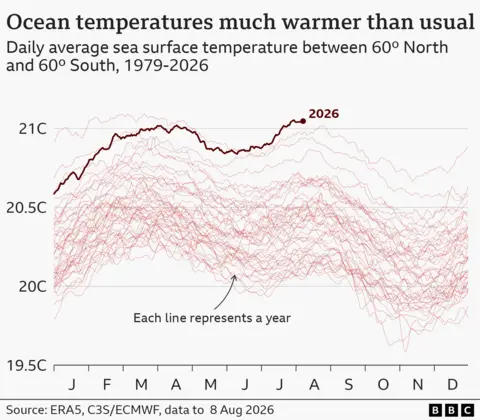
The world's oceans hit their hottest-ever recorded temperatures in July, partly fuelled by developing El Niño conditions in the Pacific, according to the EU's climate monitoring service.
The average sea surface temperature (SST) outside the world's polar regions - between 60 degrees north and 60 degrees south - was 20.96C last month, beating the previous high of 20.89C, set in 2023.
Last month was the joint second-warmest July globally on record, with temperatures 1.47C above the estimated pre-industrial average, according to the Copernicus Climate Change Service.
Meanwhile, Western Europe experienced its hottest ever June and July, with prolonged hot and dry conditions fuelling extreme wildfires across the region.
Elsewhere, the UK is braced for its fifth heatwave of the year this week, as persistent dry weather puts further pressure on water supplies and could see more areas officially declared in drought.
Around Europe, sea surface temperatures in July reached record highs along the Atlantic coast and in the western Mediterranean, contributing to widespread strong and severe marine heatwaves.
Sea temperatures remained exceptionally high across much of the tropical Pacific, where El Niño conditions are developing and forecast to strengthen in the coming months.
El Niño is a natural weather pattern in the Pacific that combined with human-driven global warming can cause temperature spikes and more extreme weather.
Oceans are a vital regulator of the climate, absorbing most of the excess heat generated by greenhouse gas emissions and producing half of Earth's oxygen.
The greatest effect of ocean warming is on sea level rise. As seawater warms it expands, and this thermal expansion accounts for roughly a third of sea level rise recorded by scientists to date. That water encroaches on low-lying coasts and island nations.
Hotter seas are also driving longer and fiercer marine heatwaves, which have bleached coral reefs on a mass scale and decimated kelp forests and fisheries.
Warmer ocean surfaces also evaporate more heat and moisture into the air, intensifying tropical storms and loading them with heavier rainfall.
'Climate change is intensifying heat extremes'
Western Europe is experiencing an exceptional run of extreme heat - with record-breaking temperatures in June and July, and some areas facing their third or fourth heat wave since May.
The average temperature across western Europe for June and July was 21.62C - 2.79C above average and the highest for the two-month period.
"July 2026 was the third consecutive month of exceptional heat in western Europe," said Samantha Burgess, strategic lead for climate at the European Center for Medium-Range Weather Forecasts.
Persistent high-pressure systems trapped heat over the region, she said, while dry soils reduced the ability to provide natural cooling.
"This is a clear example of how climate change is intensifying heat extremes, with heat and drought increasingly reinforcing one another," she added.
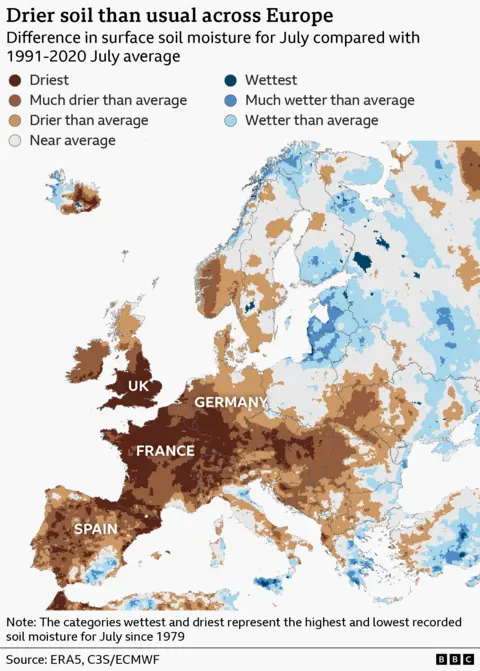
France, Spain, parts of Germany and the UK recorded exceptionally low rainfall and/or soil moisture, while soil moisture levels across much of western Europe were significantly lower than in 2022, when the region experienced severe drought.
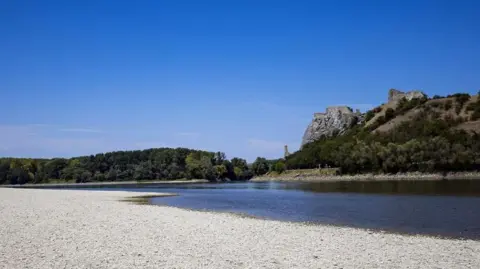
River levels have been much lower than average - in some places exceptionally low -with the Seine, Rhine and Danube among those particularly affected.
Low flows exacerbate pressure on water supplies and irrigation, aquatic ecosystems, river transport and energy production.
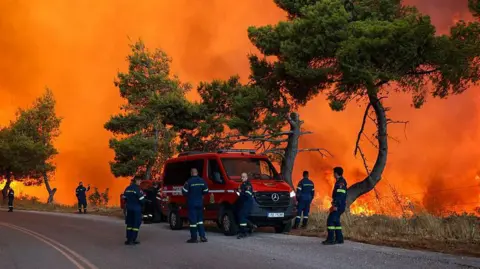
The prolonged hot and dry conditions have created favourable conditions for wildfires, with massive wildfires raging across western Europe last month and "exceptional activity" in terms of the area burned and smoke and emissions generated.
"Climate change is increasingly bringing the kinds of hot and dry conditions that favour large, high-intensity wildfires in southern Europe while extended the fire season northwards," said Laurence Rouil, director of the Copernicus Atmosphere Monitoring Service.
Larger fires produce more smoke and inject it higher into the atmosphere, allowing it to travel much further, he said.
That means countries that experience relatively few wildfires could be increasingly affected by smoke traveling long distances.
Extreme weather 'new normal'
In the UK, meanwhile, the prolonged dry spell is increasing pressure on already-stretched water supplies.
England and Wales recorded their driest July since records began 190 years ago, according to the Met Office, while large parts of England and all of Wales have already been officially declared in drought.
The Environment Agency has warned that more areas of England could be declared in drought if dry conditions persist.
Weather that was once considered extreme is becoming the "new normal", according to the latest Met Office report on the UK's climate.
Its latest assessment found that the hottest day of the year in southern England is now 4.5C warmer than it was between 1961 and 1990.
"We are right now living in a time of historic and unprecedented change," said Mike Kendon, Met Office climate information scientist, adding that "evidence shows the climate of the 20th century has now gone".
Scientists say El Niño may temporarily push global temperatures even higher. Its effects are being felt against a backdrop of man-made warming, particularly the burning of fossil fuels.
The world is now about 1.4C warmer on average than it was in the late 19th Century.
Latest Stories
-
Diaspora Nasara Caucus congratulates Mohammed Ali Suraj, new NPP executives
1 hour -
Dr Antwi-Boasiako’s cybersecurity book showcased at UN crime prevention congress
1 hour -
We will empower the grassroots and protect every vote – NPP’s 1st Vice Chair Kojo Bamba
1 hour -
I do not see myself as better than anyone – NPP’s 1st Vice Chair Kojo Bamba
2 hours -
Police blur the line between invitations and arrests – Reindorf Twumasi Ankrah
3 hours -
Turning invitations into arrests is making citizens reluctant to assist police – Twumasi Ankrah
3 hours -
The Traffitech-GH SMS spot-fine system: The good, the sad, and the funny – Bright Simons writes
3 hours -
Hawa Koomson pledges experienced and mature leadership of NPP women’s wing
4 hours -
Young woman found dead at Kasoa Peace Town
5 hours -
Playback: The Law examined lawful arrest in Ghana
5 hours -
Mahama urges African governments to treat healthcare as an investment, not budget cost
6 hours -
Bawumia congratulates John Boadu and new NPP executives, pledges support ahead of 2028
6 hours -
Aksa Energy delegation pays courtesy call on GRA Commissioner-General
6 hours -
‘No talent should be left out’ – Bawumia pledges inclusive NPP campaign for 2028
6 hours -
Prof. Mike Oquaye recounts how he blocked the Special Prosecutor’s attempt to arrest Bawku Central MP
6 hours