

Audio By Carbonatix
The Minister for Lands and Natural Resources, Emmanuel Armah Kofi Buah, has revealed that 907 out of 1,278 small-scale mining licences are currently under review for possible revocation due to irregularities uncovered by the Small-Scale Mining Review Committee.
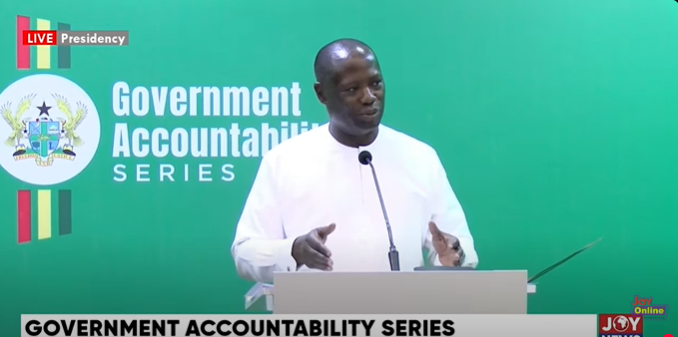
Speaking at the Government Accountability Series, Mr Buah said: “907 out of 1,278 licences are now under review for possible revocation due to irregularities identified by the Small-Scale Mining Review Committee.”
He added that a similar exercise is underway in the large-scale mining sector.
“A similar exercise is currently ongoing to review large-scale mining licences to ensure compliance.” According to the Minister, these actions form part of the government’s broader strategy to sanitise the mining sector.
“These measures are aimed at sanitising the mining sector to ensure transparency and sustainable operations,” he emphasised.
As part of the clampdown on illegal mining, also known as galamsey, Mr Buah disclosed that 55 small-scale mining licences issued during the transitional period were revoked earlier this year.
He also highlighted the collaborative efforts with state security agencies:
“In collaboration with other agencies, including the Ghana Police Service, the Ghana Armed Forces, and the National Security Secretariat, 425 excavators and other machinery have been seized. We have also made 1,345 arrests nationwide, and prosecutions are steadily progressing. I believe the Attorney-General will speak to this in his updates.”
Providing further details on enforcement actions within forest reserves, the Minister stated: “For instance, in forest reserves alone, 177 excavators, 4 bulldozers, 12 vehicles, 43 motorcycles, 155 pumping machines, 184 changfangs, 15 detector machines, and 10 heavy-duty generators have been seized across the country. A total of 286 persons have been arrested.”
To strengthen coordination of the anti-illegal mining campaign, the Ministry has established the National Anti-Illegal Mining Operations Secretariat (NAIMOS), which Mr Buah described as:
“The operational nerve centre for Ghana’s fight against illegal small-scale mining and its associated environmental degradation, particularly in water bodies and forest reserves.”
He concluded: “It embodies Ghana’s coordinated response to the scourge of illegal mining, integrating security, environmental, and legal responses into a unified operational strategy.”
Latest Stories
-
Power restoration fault suspected in Kumasi Central Market fire
41 minutes -
The 7-foot giant of Ngleshie Amanfro: Seven-foot Ghanaian Ephraim Saawa dreams of joining the national basketball team
1 hour -
Government promises support for Kumasi Central Market fire victims
1 hour -
Vibes The Movie: Big Ghun’s Ghanaian film earns five nominations at 2026 REFFA
2 hours -
MamaCare CEO warns unresolved conflicts among health workers could undermine maternal and neonatal care
2 hours -
Health professionals urged to translate medical knowledge into practice to save mothers
2 hours -
Conflicts among care providers linked to maternal, neonatal deaths – Expert
4 hours -
GIS marks 10th TIME conference, champions improved teaching practices
4 hours -
BRICS Or Balance? What Ghana’s bid really means
5 hours -
GPRTU wants full TRAFFITECH-GH implementation to start in 2027
5 hours -
Mahama announces plans to import electric wheelchairs for PWDs
5 hours -
KGL U17 Colts 2026: Western beat Prempeh Elite Academy to set up final final with Greater Accra Region
5 hours -
Late Solanke strike salvages 10-man Spurs draw at Man United
5 hours -
Gender Ministry to monitor welfare of Nana Akua Addo’s children amid domestic violence case
6 hours -
Benedict Okyere Yeboah: Ghana’s football problem goes beyond sacking a coach
6 hours