


Audio By Carbonatix
Low-skilled workers from EU countries will no longer have the automatic right to work in the UK after Brexit, under proposed new immigration rules.
Home Secretary Sajid Javid said the plans did not include a "specific target" for reducing numbers coming into the UK.
But they would bring net migration down to "sustainable levels", he told BBC Radio 4's Today programme.
There was "no reason to think" the plans would harm the economy, he added.
Asked repeatedly if the government was sticking to its manifesto commitment to bring annual net migration down to the tens of thousands, Mr Javid would only say "the objective is to bring net migration down to more sustainable levels".
But during Prime Minister's Questions, Theresa May confirmed the government was sticking to the "tens of thousands" target for net migration.
The home secretary said most people would agree the current level, 273,000, was "very high" and it should be cut to a level that "meets first our economic need but at the same time is not too high a burden on our communities or infrastructure".
He said the new immigration system would be based around skills rather than where people came from and would be the "biggest shake-up in 40 years".
The much-delayed White Paper - a document setting out proposed new laws before they are formalised in a government bill - includes:
- Scrapping the current cap on the number of skilled workers such as doctors or engineers from the EU and elsewhere
- A consultation on a minimum salary requirement of £30,000 for skilled migrants seeking five-year visas
- Low-skilled workers may be able to apply for short-term visas of up to a year
- Visitors from the EU will not need visas
- Plans to phase in the new system from 2021
The ending of free movement is a key part of Mrs May's Brexit deal, although any replacement system is set to be part of post-Brexit trade talks.
Mr Javid has previously suggested his plans do not depend on the UK leaving the EU on 29 March in an orderly manner, saying freedom of movement will end "deal or no deal".
Mr Javid described the White Paper as "delivering on the clear instruction to get control over our borders and will bring in a new system that works in the interest of the British people.
"It will be a single, skills-based immigration system built around the talent and expertise people can bring, rather than where they come from - maximising the benefits of immigration and demonstrating the UK is open for business."
No cap on high-skilled workers
The White Paper introduces a new visa route for skilled migrants, from Europe and beyond.
It accepts a recommendation from the independent Migration Advisory Committee to scrap the current limit of 20,700 on workers classed as high-skilled coming to the UK using "Tier 2" visas.
Tier 2 is the name for general work visas for people from outside the European Economic Area and Switzerland who have been offered a skilled job in the UK. Eligible professions include nurses and doctors.
There will be a consultation about the salary threshold of £30,000 amid opposition to such a cap from business and some cabinet members.
The £30,000 minimum earnings rule already applies to non-EU workers in most Tier 2 visa cases but could also apply to migrants from the EU.
Extending it to skilled migrants could affect the NHS's ability to recruit the staff it needs, the body representing NHS trusts has warned.
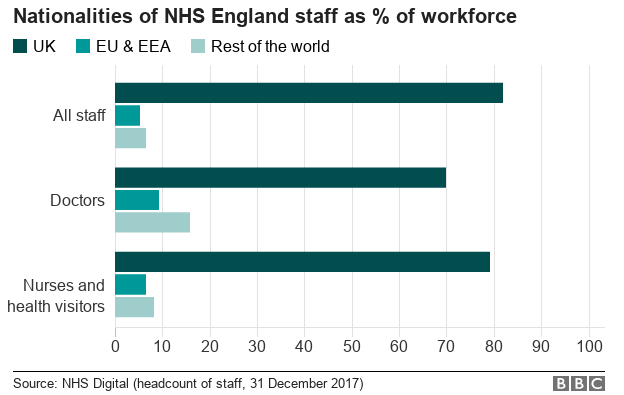
NHS Providers deputy chief executive Saffron Cordery told Today: "We are deeply concerned about what is going to happen. High skills does not equal high pay.
"You have got starting salaries for nurses at £23,000 - also for paramedics, midwives. Junior doctors starting salaries at £27,000, healthcare assistants at £17,000, all coming in way below that £30,000 cap.
"It is not just health workers, it is social care as well. We have to remember where the skills lay. They lay in those staff under £30,000."
Mr Javid said: "We are not setting the exact threshold today. There will be a threshold." He added: "We will consult further on whether it is £30,000 or thereabouts."
Analysis: Routes into Britain
The BBC's home affairs correspondent Danny Shaw
The White Paper was trailed as creating an immigration system based on "skills". The delay in publication was partly down to a dispute between ministers over a possible £30,000 salary threshold for skilled workers.
But it's the plan to create a route into Britain for unskilled or low-skilled workers which is likely to prove particularly controversial.
The document says the reason for the route is that some sectors have built up a "reliance" on such staff from the EU and require a "period of time" to adjust to the end of freedom of movement.
But the new scheme will be in place until at least 2025; it'll be open to those in other "low-risk" countries, not just the EU; and there is currently no numerical cap.
It raises the prospect that the immigration system the government is designing is as much about ensuring there's a flow of unskilled labour, as it is about skilled workers.

Labour, SNP and business reaction
Labour's shadow home secretary Diane Abbott said the government had "disgracefully labelled workers on less than £30,000 as low-skilled" when "our economy and public services are kept ticking by this majority of workers".
"The government is not, as it wrongly claims, using a skills-based criteria to meet the needs of our economy and our society.
"It is using an income-based system which allows derivatives traders free movement but which excludes nurses, social care workers and other professions in which we have severe skills or labour shortages."
Speaking in the Commons, Ms Abbott said the government's "rhetoric about a global Britain was not enough" and ministers must take steps to "dismantle the hostile environment" it had encouraged to deter migrants.
Scotland's First Minister Nicola Sturgeon said the government's plans would be "devastating for the Scottish economy" because "our demographics make it essential that we attract people to live and work here".
"Apart from the serious economic damage, these proposals send a terrible message that the UK is becoming less open and welcoming and more insular.
"Why any PM would want to claim this as a personal legacy is beyond me," added the SNP leader in a tweet.
Business groups said the salary threshold would need to be lower than £30,000 and warned the proposals could "tie the hands" of employers
Adam Marshall, director general of the British Chambers of Commerce, said: "Employers are hugely concerned that the complexity and cost associated with new immigration rules will impact their ability to invest and grow at a time when many areas are facing near-full employment."
But former Tory leader Iain Duncan Smith said businesses had failed to adequately train British workers in recent years and the proposals were a step in the right direction.
Who counts as a high-skilled worker?
Currently, someone is eligible to apply for a "Tier 2" general work visa - which can last for up to five years - if they are from outside the European Economic Area and Switzerland.
They must also have been offered a high-skilled job in the UK - which is any profession ranked at level six and above on a list called the Regulated Qualifications Framework (RQF) - and which has not been filled by a UK worker.
The high-skilled category includes a range of professions such as doctors, nurses, musicians, aircraft pilots, brokers, paramedics, librarians, journalists, food inspectors, probation officers, social workers, surveyors, architects, lawyers, and some teachers.
In most cases, the migrant will need to be earning at least £30,000 per year (or £20,800 for new entrants), or the "appropriate rate" for their job if that figure is higher. Some professions, like nurses, are exempt.
People who do jobs which the UK needs - on the shortage occupation list - are also eligible to apply for the Tier 2 visa, even if the job is less highly-skilled and ranked at RQF level four.
Latest Stories
-
Bono Regional Minister calls on community to support fight against illegal mining
12 minutes -
MELPWU demands immediate reinstatement of Korle Bu lab head amid ongoing dispute
12 minutes -
2026 World Cup: Adingra and Pepe return to the Côte d’Ivoire squad for tournament
23 minutes -
The case for Prince-Osei Owusu: Why the CF Montréal captain deserves a place in Ghana’s World Cup squad
24 minutes -
New Ebola deaths in eastern DR Congo spark fears of regional spread amid ongoing conflict
27 minutes -
Manhyia Palace Museum honours Ghanaian, international creative arts personalities
42 minutes -
Ghana’s favourite sausages might be costing your kids more than you think
44 minutes -
Mohammed Fuseini scores winner as USG beat Anderlecht win Belgian Cup
46 minutes -
New Delta One Missoni amenity kits feature five seasonal colors, exclusive Grown Alchemist skincare routine
54 minutes -
2026 U20 WWC: Black Princesses drawn in Group, face France, South Korea and Ecuador
57 minutes -
Korle Bu Polyclinic receives anti-bed sore mattresses to improve patient care
58 minutes -
Quartey-Papafio Medical Foundation and Reroy Group donate GH₵200,000 to GMTF
1 hour -
Fire guts Monte Carlo at Tema Community 10
1 hour -
Gender Ministry marks International Day of Families with call to tackle inequalities affecting children
1 hour -
Lighthouse Chapel marks Bishop Dag Heward-Mills’ birthday with outreach to Winneba prison inmates
2 hours