

Audio By Carbonatix
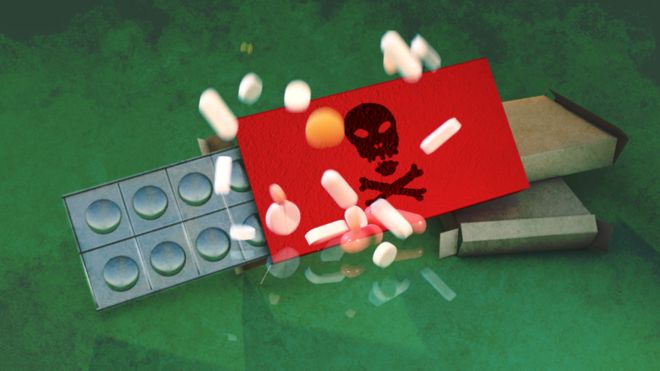
Growing numbers of fake medicines linked to coronavirus are on sale in developing countries, the World Health Organization (WHO) has warned.
A BBC News investigation found fake drugs for sale in Africa, with counterfeiters exploiting growing gaps in the market.
The WHO said taking these drugs could have "serious side effects".
One expert warned of "a parallel pandemic, of substandard and falsified products".
Around the world, people are stockpiling basic medicines. However, with the world's two largest producers of medical supplies - China and India - in lockdown, demand now outstrips the supply and the circulation of dangerous counterfeit drugs is soaring.
In the same week the World Health Organization (WHO) declared coronavirus a pandemic last month, Operation Pangea, Interpol's global pharmaceutical crime fighting unit, made 121 arrests across 90 countries in just seven days, resulting in the seizure of dangerous pharmaceuticals worth over $14m (£11m).
From Malaysia to Mozambique, police officers confiscated tens of thousands of counterfeit face masks and fake medicines, many of which claimed to be able to cure coronavirus.
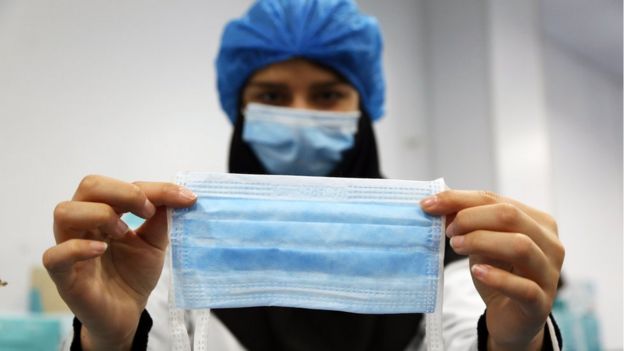
"The illicit trade in such counterfeit medical items during a public health crisis, shows a total disregard for people's lives," said Interpol's Secretary General Jurgen Stock.
According to the WHO, the broader falsified medicines trade, which includes medicines which may be contaminated, contain the wrong or no active ingredient, or may be out-of-date, is worth more than $30bn in low and middle-income countries.
"Best case scenario they [fake medicines] probably won't treat the disease for which they were intended", said Pernette Bourdillion Esteve, from the WHO team dealing with falsified medical products.
"But worst-case scenario they'll actively cause harm, because they might be contaminated with something toxic."
The supply chain
The global pharmaceutical industry is worth more than $1 trillion. Vast supply chains stretch all the way from key manufacturers in places such as China and India, to packaging warehouses in Europe, South America or Asia, to distributors sending medicines to every country in the world.
There is "probably nothing more globalised than medicine" said Esteve. However, as the world goes into lockdown, the supply chain has already begun to uncouple.
Several pharmaceutical companies in India told the BBC they are now operating at 50-60% of their normal capacity. As Indian companies supply 20% of all basic medicines to Africa, nations there are being disproportionately affected.
Ephraim Phiri, a pharmacist in Zambia's capital Lusaka, said he was already feeling the strain.
"Medicines are already running out and we are not replenishing them. There is nothing we can do. It's been really hard to get supplies... especially essential medicines like antibiotics and antimalarials."
Producers and suppliers are also struggling as the raw ingredients to manufacture tablets are now so expensive, some companies can simply not afford to keep going.
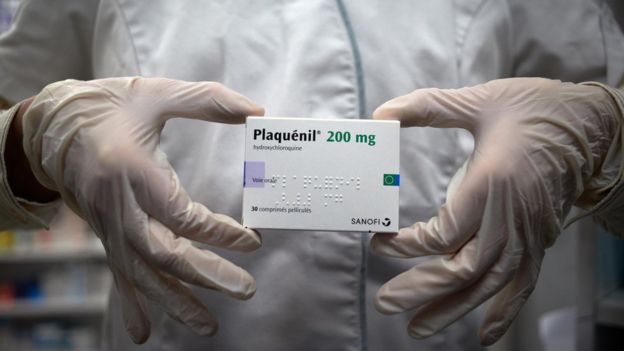
One producer in Pakistan said he used to buy the raw ingredients for an antimalarial drug called hydrochloroquine for about $100 a kilo. But today, the cost has increased to $1,150 a kilo.
With an increasing number of countries going into lockdown, it's not only the reduction in production that's problematic, it's also the increase in demand, as people around the world anxiously stockpile basic medicines.
It's this unstable combination of reduced supply and increased demand that has led the WHO to warn of a dangerous spike in the production and sales of fake drugs.
"When the supply does not meet the demand," said Esteve, from the WHO, "it creates an environment where poorer quality or fake medicines will try to meet that demand."
Fake medicine
Speaking to pharmacists and drug companies around the world, the global supply of antimalarials is now under threat.
Ever since US President Donald Trump began referring to the potential of chloroquine and a related derivative, hydroxychloroquine, in White House briefings, there has been a global surge in the demand for these drugs, which are normally used to tackle malaria.
The WHO has repeatedly said there is no definitive evidence that chloroquine or hydroxychloroquine can be used against the virus that causes Covid-19. However, at a recent news conference, whilst referring to these antimalarials, President Trump said: "What do you have to lose? Take it."
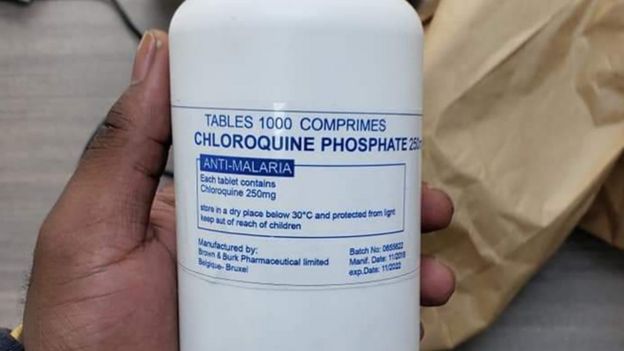
As the demand has soared, the BBC has discovered large quantities of fake chloroquine in circulation in the Democratic Republic of Congo and Cameroon. The WHO has also found the fake medicines for sale in Niger.
The antimalarial chloroquine is normally sold for about $40 for a pot of 1,000 tablets. But pharmacists in the DRC were found to be selling them for up to $250.
The medicine being sold was allegedly manufactured in Belgium, by "Brown and Burk Pharmaceutical limited". However, Brown and Burk, a pharmaceutical company registered in the UK, said they had "nothing to do with this medicine. We don't manufacture this drug, it's fake."
As the coronavirus pandemic continues, Professor Paul Newton, an expert in fake medicines at the University of Oxford, warned the circulation of fake and dangerous medicines would only increase unless governments around the world present a united front.
"We risk a parallel pandemic, of substandard and falsified products unless we all ensure that there is a global co-ordinated plan for co-ordinated production, equitable distribution and the surveillance of the quality of the tests, medicines and vaccines. Otherwise the benefits of modern medicine... will be lost."
Latest Stories
-
Health Ministry warns nursing training college heads over admission quotas, timeline breaches
2 hours -
Laws won’t stop abuse if homes keep raising boys to dominate women — Zuwera Ibrahimah
2 hours -
Special police team to investigate killing of an anti-migrant leader in South Africa
2 hours -
New monkey species with orange lips found ‘hiding’ in DRC forest
2 hours -
One dead and three missing after boat sinks near Alcatraz
2 hours -
Trump sanctions on ICC violate free speech, says lawsuit
3 hours -
More people around the world now favour China over the US, Pew study suggests
3 hours -
US military to start testosterone testing, Hegseth says
3 hours -
Parliaments must prioritise gender-responsive budgets to fight violence against women and girls – Kenyan advocate
3 hours -
Don’t blame only EOCO officers; hold their political bosses accountable – Osae-Kwapong
3 hours -
Ghana must end the cycle where every high-profile investigation becomes political – CDD Fellow
3 hours -
Argentina face fine for Falklands banner in semi-final win
4 hours -
Ghana-Russia trade hits $800m as Moscow seeks deeper economic partnership
4 hours -
Man jailed for spending ex-girlfriend’s GH¢114,000 loan on betting
4 hours -
West African women parliamentarians push for stronger action against gender-based violence
4 hours