

Audio By Carbonatix
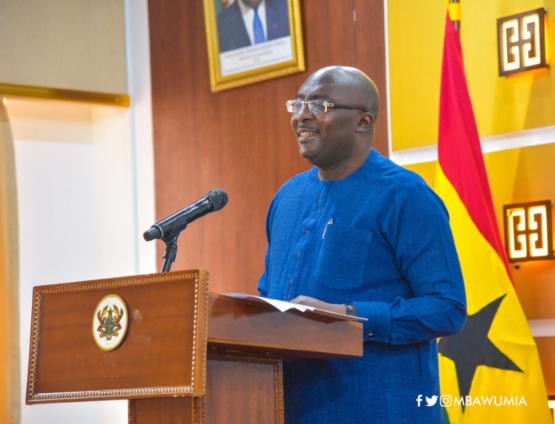
Vice President Mahamudu Bawumia says Ghana is prepared for the digitalised economy which would be the new global norm after the Covid-19 pandemic.
Speaking at the launch of the Microfinance and Small Loans Centre (MASLOC’s) Integrated ICT System, Dr Bawumia indicated that the current global health crisis has awakened many nations to the importance of digitalisation.
However, he said Ghana will not be left out since President Akufo-Addo has aggressively pursued digitalisation of government operations and every aspect of the economy when he assumed office in January 2017.

“Covid-19 has been destructive in many ways of our lives but destructive events can catalyze change for the better, we are witnessing an awakening of a new world order which will be an increase reliance and confidence in technology.
“Thankfully Ghana is already on course as far as digitalization is concerned,” he said.

MASLOC's integrated ICT system is a new innovation which will automate all the operations of microfinance companies to improve efficiency in the institution.
The platform which is a collaboration between the centre, the ARP Apex bank and designed by the Eban Capital, the software providers automates end to end process of credit management, loan application, credit assessment, disbursement of loan, loan repayment and monitoring and reporting all to make loan assessable.
Addressing officials of the MASLOC, Dr Bawumia said the initiative is a technological solution that would address payment and settlement challenges of MASLOC and make it business friendly to its customers.
He further commended the leadership of MASLOC for the initiative since it is in line with President Nana Akufo-Addo’s vision of a digitalised economy and formalize the informal sector as well.
“With this Integrated ICT system, MASLOC is poised to effectively deliver on its objective of providing funds to SMEs especially the unbanked customers who form a greater percentage of the informal sector of the economy.
“And the organisation will also position itself for the next world order of service delivery.”

Finance minister Ken Ofori Atta speaking about the effect of the pandemic on the economy, revealed that the lockdown was not extended because a chunk of the Ghanaian population operate within the informal sector; the hardest hit sector during the restriction.
It therefore became "increasingly impossible to continue" with the lockdown directive he added.
Latest Stories
-
GAF sets Sept. 28–30 for Documentation, Body Selection Exercise
25 minutes -
I resigned five months ago – BoG Governor Asiama explains GoldBod Board exit
41 minutes -
Trump says men arrested at UK air base used by US were looking to do ‘big damage’
57 minutes -
Trump confirms meeting with Anthropic’s Amodei, repeats dismissal of AI fears
1 hour -
China pushes back against US on Iran and Cuba in UN speech
1 hour -
OpenAI, Anthropic CEOs called to appear at Australian AI probe
2 hours -
WHO says Congo Ebola outbreak spreads to two new health zones
4 hours -
Nigeria come from benhind to win in AFCON 2027 qualifier
4 hours -
South African white genocide does not exist, new ambassador to US tells BBC
4 hours -
T-bills auction: Government exceeds target marginally; yield on 91-day bill remains unchanged
5 hours -
Pope says ‘scourge’ of abuse must be rooted out as he visits Lourdes
5 hours -
GPL 2026/27: 10-man Aduana hand Kotoko defeat in Kumasi
5 hours -
News media must stay relevant or ‘society will struggle’, says World News Day boss
5 hours -
Kenyan High Commissioner hosts Heads of Mission from 25 countries
5 hours -
Embattled Serbian president resigns, paving way for early elections
5 hours