


Audio By Carbonatix
What could be the highest temperature ever reliably recorded on Earth - 130F (54.4C) - has been reached in Death Valley National Park in California.
The recording is being verified by the US National Weather Service.
It comes amid a heatwave on the US's west coast, where temperatures are forecast to rise further this week.
The scorching conditions have led to two days of blackouts in California, after a power plant malfunctioned on Saturday.
Sunday's reading was recorded in Furnace Creek in Death Valley.
Before this, the hottest temperature reliably recorded on Earth was 129.2F (54C) - also in Death Valley in 2013.
A higher reading of 134F, or 56.6C a century earlier, also in Death Valley, is disputed.
It is believed by some modern weather experts to have been erroneous, along with several other searing temperatures recorded that summer.
According to a 2016 analysis from weather historian Christopher Burt, other temperatures in the region recorded in 1913 do not corroborate the Death Valley reading.
Another record temperature for the planet - 131F, or 55C - was recorded in Tunisia in 1931, but Mr Burt said this reading, as well as others recorded in Africa during the colonial era, had "serious credibility issues".
The current heatwave stretches from Arizona in the south-west, up the coast to Washington state in the north-west.
It is expected to hit its peak on Monday and Tuesday, before temperatures start to drop later in the week. However, the sweltering heat will continue for at least another 10 days.
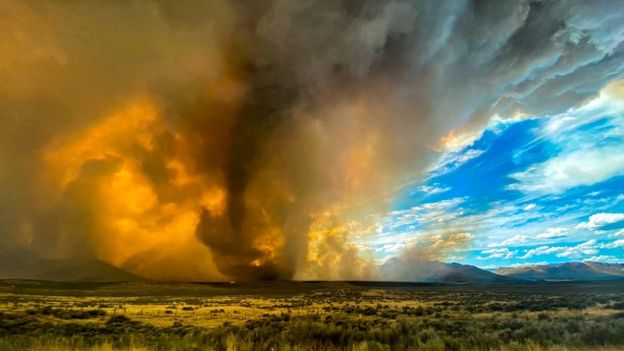
As temperatures soared in California, a large "firenado" was observed on Saturday in Lassen County.
California's Independent System Operator (CISO), which manages the state's power, has declared a Stage 3 Emergency, meaning "when demand [for electricity] begins to outpace supply".
Because so much of the region's power relies on solar and wind energy, and because people use their electricity for air conditioning, during heatwaves the power grid becomes strained and is at risk of completely malfunctioning.
In order to manage the state's demand for power and prevent a complete shutdown, officials are using scheduled rolling blackouts to control and conserve energy.
Latest Stories
-
VC inaugurates three committees ahead of UG’s 80th anniversary celebration
5 minutes -
Today’s Front pages: Monday, September 14, 2026
13 minutes -
The Or Foundation to launch recycled textiles platform Foose Materials during London Design Week
19 minutes -
110 children at Cardiothoracic Centre get second chance at life as Ghana Medical Trust Fund marks first year
23 minutes -
‘I’m suffering’ – Motherless 12-year-old who lost both legs, father in Ofankor-Pokuase crash seeks support
27 minutes -
Education Ministry extends 2026 SHS placement exercise by one week
2 hours -
Better roads will create sustainable jobs for Ghana’s youth – Joyce Bawah Mogtari
2 hours -
Kumasi Expressway to cut travel time, boost economic activity – Joyce Bawah Mogtari
2 hours -
GOIL could hold fuel prices despite $100 crude oil shock – Edward Bawa
2 hours -
Fitch lifts Ghana’s 2026 current account surplus forecast to 7.8%
2 hours -
Do not identify yourself as Ziavi Paramount Chief or Queen – Volta Region House of Chiefs warns
2 hours -
Sosu demands probe into $260m cocaine shipment seized in France
2 hours -
Mahama to receive cleared Accra-Kumasi Expressway right-of-way today
2 hours -
Mahama to cut sod for US$1.3bn Sentuo Airport Garden City on Tuesday
3 hours -
Ghana, China agree to tighten crackdown on illegal mining
3 hours