

Audio By Carbonatix
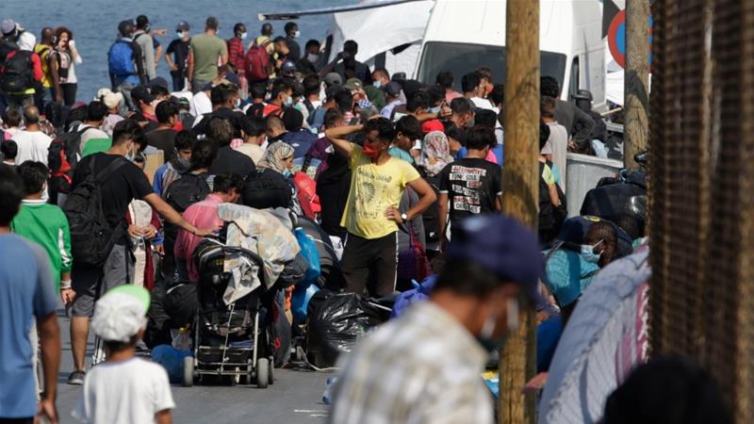
Refugees and migrants on the Greek island of Lesbos, having escaped the fire that engulfed Moria, have told Al Jazeera that living conditions inside a new camp are squalid and uninhabitable, just one day after their arrival.
"There is no water, no toilet, no food," 24-year-old Zaynab, an Afghan woman, told Al Jazeera by phone. "The smell is very bad because people go to the toilet on the floor in front of my tent."
On Thursday, police launched an operation to rehouse thousands of asylum seekers who had been sleeping rough in supermarket car parks and roadsides, a week after a massive fire tore through their shelters in Moria, a sprawling unsanitary site originally designed with a capacity of 3,000, where 13,000 had lived.
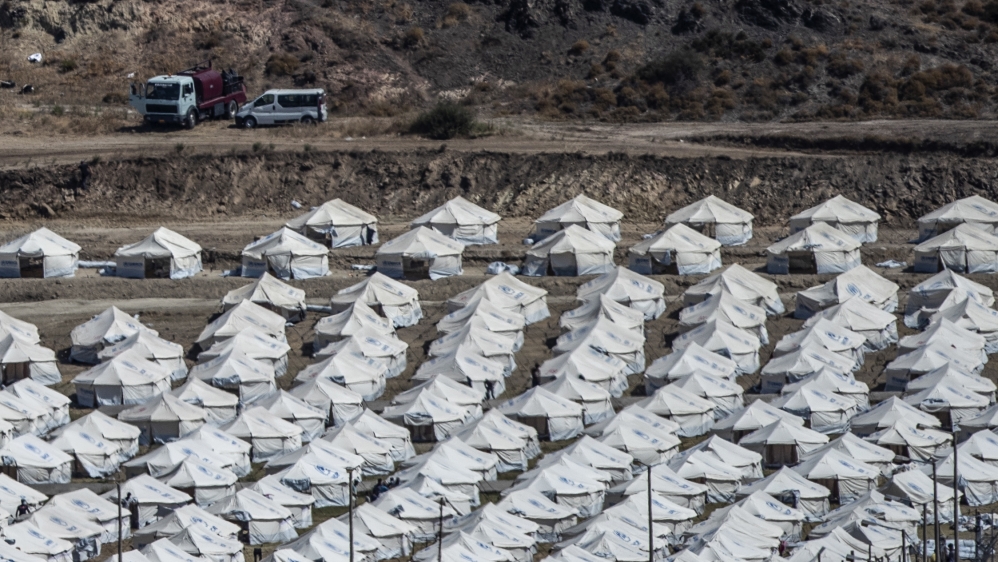
The new Kara Tepe camp, near the island's main town Mytilene, was made on a former military firing range and is close to the remains of the Moria site.
As of Friday, capacity at Kara Tepe had been expanded to 12,000 according to the Greek government, with 6,180 new residents. But many remain wary of the new accommodation.
Since her arrival, Zaynab has been staying inside her tent, too afraid to step outside amid heightened tensions.
Many refugees are angry and view the new shelter as a continuation of the notoriously neglected Moria camp.
Like in Moria, access to food and water is limited.
"They gave me one piece of meat and one bottle of water," said Zaynab on Friday, who has not eaten since Thursday afternoon.
The flimsy privacy of a tent could not offer the young woman respite from a week of sleeping rough.
"The tents are very near to each other and at night, people were fighting until 1am."
Zaynab suffers from migraines and insomnia but has been unable to take her medication.
"I asked an [aid] organisation to bring my medication but they said the police are not allowing them."
Tensions have been compounded by a two-week quarantine enforced by the Greek government, with some refugees fearing their freedom of movement will be further stifled.
Like Zaynab, Mariam, a teenager, has not had access to running water since moving to Kara Tepe.
"We cannot live in here, we can just sleep," she told Al Jazeera.
She is worried about the coming winter because her family tent has no wooden pallets to protect them from cold and rain.
Aid workers say the camp's proximity to the sea could put refugees at further risk as icy winter winds set in.
Moussa 30, has taken to bathing in the sea, but says even that has become impossible because many people use the beach and the water as a toilet.
"If we continue this way, we will have another disease without corona[virus] ... I am not going anywhere, I am inside my tent because I am afraid of corona."
Astrid Castelein of the UN High Commissioner for Refugees told Al Jazeera: "For the moment it is an emergency site … but improved on a daily basis as much as possible."
But conditions in the new camp fall short of minimum standards of dignified living under Greek and international law, according to Refugee Support Aegean (RSA), a local nonprofit.
"They are only given two bottles of water both for drinking and washing and many of them say they are washing themselves in the sea," said Asterios Kanavos, a lawyer at RSA.
"They have no mattresses and their tents are very hot due to the weather because they are not protected from the sun."
Authorities have temporarily blocked lawyers from accessing their clients inside the camp, citing health concerns.
Meanwhile, the UNHCR says it is working to provide Kara Tepe residents with chemical toilets, showers and hand-washing facilities, while NGOs and the Greek government are setting up water supply systems and drainage.
"The priority is that everyone enters by today, at the latest tomorrow, also because of tensions with the local population," said UNHCR's Castelein.
A stone's throw away, in the town of Moria, locals welcomed the move.
"We want them to be collected somewhere for their safety and ours," said Moria resident Nevrakis Konstantinos.
By Sunday, Kara Tepe is expected to hold all 12,000 displaced refugees and migrants. Greek authorities this week said all asylum seekers should be able to leave the island by Easter next year.
Latest Stories
-
Journalists look back on a decade of breast cancer reporting in Ghana
19 minutes -
President Mahama ends Resetting Ghana tour of Ahafo Region
2 hours -
African negotiators seek delivery of climate commitments at COP31
2 hours -
BoG develops AI rules for financial sector
2 hours -
‘Big Push’: Government assures contractors of prompt payments
2 hours -
Court fines miner for breaking into gold buying shop
2 hours -
Tarkwa court jails labourer for three years over GH¢123,000 theft
3 hours -
GAEC must retain nuclear scientists for Ghana’s nuclear ambitions – Minister
4 hours -
Man reportedly mistaken for game and shot by hunter dead in forest
4 hours -
19-year-old mason jailed 15 years for defiling seven-year-old pupil
4 hours -
Ghana’s banking sector assets rise 20.47% to GH¢500.2bn – BoG Governor
4 hours -
22 injured as Sprinter bus overturns at Sege after tyre burst
4 hours -
UN housing expert urges Ghana to strengthen Rent Control Department amid housing affordability concerns
4 hours -
Delta-BCI partnership reaches 166,000 people with breast cancer education
4 hours -
Power restoration fault suspected in Kumasi Central Market fire
10 hours